{"title":"Exploring the Discharge Phenomenon at the Interface of Immiscible Liquids: Current Understanding and Potential Applications in Nanomaterial Synthesis","authors":"Ahmad Hamdan","doi":"10.1007/s11090-023-10413-z","DOIUrl":null,"url":null,"abstract":"<div><p>The research field of plasma–liquid interactions is quickly expanding due to its great potential in many applications, including nanomaterial synthesis. In this paper, we present a novel kind of in-liquid discharge that is generated at or near the interface of two immiscible liquids, water and liquid hydrocarbon. The optical emission characteristics of this discharge are studied using ICCD imaging, and their dependence on the position of the interface with respect to the electrode are analyzed. The results show that when the electrode is at the interface, discharge efficiency is optimal due to increased discharge probability and plasma volume. Moreover, when the electrical conductivity of the solution is increased beyond ~ 500 µS/cm, the discharge mode transits from streamer to spark. Analysis of the nanomaterial produced by interfacial discharges reveals that when the discharge is ignited at the interface of distilled water-heptane, amorphous carbonaceous sheet-like materials are formed; however, when Ni-nitrate is added to raise the electrical conductivity of water, Ni nanoparticles embedded in C-matrix are synthesized. Furthermore, the particle surface density in the C-sheet increases at higher electrical conductivity. As the discharge transits from streamer (low conductivity) to spark (high conductivity), the amorphous C-sheet becomes graphitized. When two or three salts (Ni-, and/or Co-, and/or Fe- nitrate) are added at the high conductivity condition (5000 µS/cm), nanoalloys (NiCo, NiFe, CoFe, and NiCoFe) embedded in C-matrix are formed. Overall, the data reported herein demonstrates interfacial discharges in liquid offer great opportunities for efficiently and ecologically synthesizing novel nanomaterials with unique properties.</p></div>","PeriodicalId":734,"journal":{"name":"Plasma Chemistry and Plasma Processing","volume":"44 :","pages":"1327 - 1342"},"PeriodicalIF":2.5000,"publicationDate":"2023-10-14","publicationTypes":"Journal Article","fieldsOfStudy":null,"isOpenAccess":false,"openAccessPdf":"","citationCount":"0","resultStr":null,"platform":"Semanticscholar","paperid":null,"PeriodicalName":"Plasma Chemistry and Plasma Processing","FirstCategoryId":"5","ListUrlMain":"https://link.springer.com/article/10.1007/s11090-023-10413-z","RegionNum":3,"RegionCategory":"物理与天体物理","ArticlePicture":[],"TitleCN":null,"AbstractTextCN":null,"PMCID":null,"EPubDate":"","PubModel":"","JCR":"Q3","JCRName":"ENGINEERING, CHEMICAL","Score":null,"Total":0}
引用次数: 0
Abstract
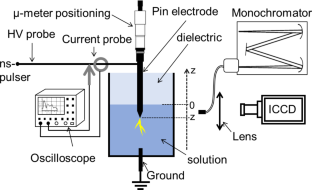
The research field of plasma–liquid interactions is quickly expanding due to its great potential in many applications, including nanomaterial synthesis. In this paper, we present a novel kind of in-liquid discharge that is generated at or near the interface of two immiscible liquids, water and liquid hydrocarbon. The optical emission characteristics of this discharge are studied using ICCD imaging, and their dependence on the position of the interface with respect to the electrode are analyzed. The results show that when the electrode is at the interface, discharge efficiency is optimal due to increased discharge probability and plasma volume. Moreover, when the electrical conductivity of the solution is increased beyond ~ 500 µS/cm, the discharge mode transits from streamer to spark. Analysis of the nanomaterial produced by interfacial discharges reveals that when the discharge is ignited at the interface of distilled water-heptane, amorphous carbonaceous sheet-like materials are formed; however, when Ni-nitrate is added to raise the electrical conductivity of water, Ni nanoparticles embedded in C-matrix are synthesized. Furthermore, the particle surface density in the C-sheet increases at higher electrical conductivity. As the discharge transits from streamer (low conductivity) to spark (high conductivity), the amorphous C-sheet becomes graphitized. When two or three salts (Ni-, and/or Co-, and/or Fe- nitrate) are added at the high conductivity condition (5000 µS/cm), nanoalloys (NiCo, NiFe, CoFe, and NiCoFe) embedded in C-matrix are formed. Overall, the data reported herein demonstrates interfacial discharges in liquid offer great opportunities for efficiently and ecologically synthesizing novel nanomaterials with unique properties.
期刊介绍:
Publishing original papers on fundamental and applied research in plasma chemistry and plasma processing, the scope of this journal includes processing plasmas ranging from non-thermal plasmas to thermal plasmas, and fundamental plasma studies as well as studies of specific plasma applications. Such applications include but are not limited to plasma catalysis, environmental processing including treatment of liquids and gases, biological applications of plasmas including plasma medicine and agriculture, surface modification and deposition, powder and nanostructure synthesis, energy applications including plasma combustion and reforming, resource recovery, coupling of plasmas and electrochemistry, and plasma etching. Studies of chemical kinetics in plasmas, and the interactions of plasmas with surfaces are also solicited. It is essential that submissions include substantial consideration of the role of the plasma, for example, the relevant plasma chemistry, plasma physics or plasma–surface interactions; manuscripts that consider solely the properties of materials or substances processed using a plasma are not within the journal’s scope.



 京公网安备 11010802042870号
京ICP备2023020795号-1
京公网安备 11010802042870号
京ICP备2023020795号-1

 分享
分享
 求助内容:
求助内容: 应助结果提醒方式:
 扫码关注我们
