{"title":"Optimization on Cruciform Specimen Geometries of AA5052 Under Equi-Biaxial Loading: Acquisition of Ultimate Fracture Strain","authors":"S. S. Chen, D. Cai, J. J. Cui, G. Y. Li, H. Jiang","doi":"10.1007/s11340-023-01003-3","DOIUrl":null,"url":null,"abstract":"<div><h3>Background</h3><p>The evaluation of the formability for aluminum alloy under complex loading conditions is particularly significant. Based on the characteristics of conveniently achieving multiple strain path states, the cruciform specimen has been widely used in the experiment of evaluating formability. But there is no general specimen design scheme to realize proportional strain path history in initial fracture point.</p><h3>Objective</h3><p>This paper was aiming at obtaining the equi-proportional strain path history and exploring the ultimate fracture strain of AA5052 aluminum alloy sheets under the equi-biaxial tension.</p><h3>Methods</h3><p>Firstly, two cruciform specimen schemes suitable for 1.2 mm sheet materials were proposed. The strain localization characteristics were estimated and thinning critical value in the central region was determined by simulations. Subsequently, through the 3D digital image correlation (DIC) test system, the strain path history of the initial fracture point was obtained. Finally, the fracture morphology characteristics were observed through SEM.</p><h3>Results</h3><p>The results showed that the initial fracture point could be located in the center of the specimen in both designs (Design-straight and Design-flaring). The specimens with slits showed a smaller strain gradient existed in the central region. Meanwhile, the initial point of fracture was closer to the equi-biaxial tensile strain path, and the strain limit was larger.</p><h3>Conclusions</h3><p>The two design methods could optimize forming limit value and realize the equi-proportional strain path history in central fracture point. The Design-straight and Design-flaring was more suitable for the AA5052-O and AA5052-H material respectively. It was related to the local stress concentration effect of the material.</p></div>","PeriodicalId":552,"journal":{"name":"Experimental Mechanics","volume":"64 1","pages":"33 - 51"},"PeriodicalIF":2.4000,"publicationDate":"2023-10-13","publicationTypes":"Journal Article","fieldsOfStudy":null,"isOpenAccess":false,"openAccessPdf":"","citationCount":"0","resultStr":null,"platform":"Semanticscholar","paperid":null,"PeriodicalName":"Experimental Mechanics","FirstCategoryId":"5","ListUrlMain":"https://link.springer.com/article/10.1007/s11340-023-01003-3","RegionNum":3,"RegionCategory":"工程技术","ArticlePicture":[],"TitleCN":null,"AbstractTextCN":null,"PMCID":null,"EPubDate":"","PubModel":"","JCR":"Q2","JCRName":"MATERIALS SCIENCE, CHARACTERIZATION & TESTING","Score":null,"Total":0}
引用次数: 0
Abstract
Background
The evaluation of the formability for aluminum alloy under complex loading conditions is particularly significant. Based on the characteristics of conveniently achieving multiple strain path states, the cruciform specimen has been widely used in the experiment of evaluating formability. But there is no general specimen design scheme to realize proportional strain path history in initial fracture point.
Objective
This paper was aiming at obtaining the equi-proportional strain path history and exploring the ultimate fracture strain of AA5052 aluminum alloy sheets under the equi-biaxial tension.
Methods
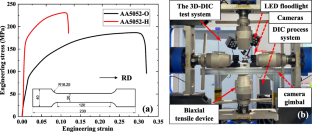
Firstly, two cruciform specimen schemes suitable for 1.2 mm sheet materials were proposed. The strain localization characteristics were estimated and thinning critical value in the central region was determined by simulations. Subsequently, through the 3D digital image correlation (DIC) test system, the strain path history of the initial fracture point was obtained. Finally, the fracture morphology characteristics were observed through SEM.
Results
The results showed that the initial fracture point could be located in the center of the specimen in both designs (Design-straight and Design-flaring). The specimens with slits showed a smaller strain gradient existed in the central region. Meanwhile, the initial point of fracture was closer to the equi-biaxial tensile strain path, and the strain limit was larger.
Conclusions
The two design methods could optimize forming limit value and realize the equi-proportional strain path history in central fracture point. The Design-straight and Design-flaring was more suitable for the AA5052-O and AA5052-H material respectively. It was related to the local stress concentration effect of the material.
期刊介绍:
Experimental Mechanics is the official journal of the Society for Experimental Mechanics that publishes papers in all areas of experimentation including its theoretical and computational analysis. The journal covers research in design and implementation of novel or improved experiments to characterize materials, structures and systems. Articles extending the frontiers of experimental mechanics at large and small scales are particularly welcome.
Coverage extends from research in solid and fluids mechanics to fields at the intersection of disciplines including physics, chemistry and biology. Development of new devices and technologies for metrology applications in a wide range of industrial sectors (e.g., manufacturing, high-performance materials, aerospace, information technology, medicine, energy and environmental technologies) is also covered.



 京公网安备 11010802042870号
京ICP备2023020795号-1
京公网安备 11010802042870号
京ICP备2023020795号-1

 分享
分享
 求助内容:
求助内容: 应助结果提醒方式:
 扫码关注我们
