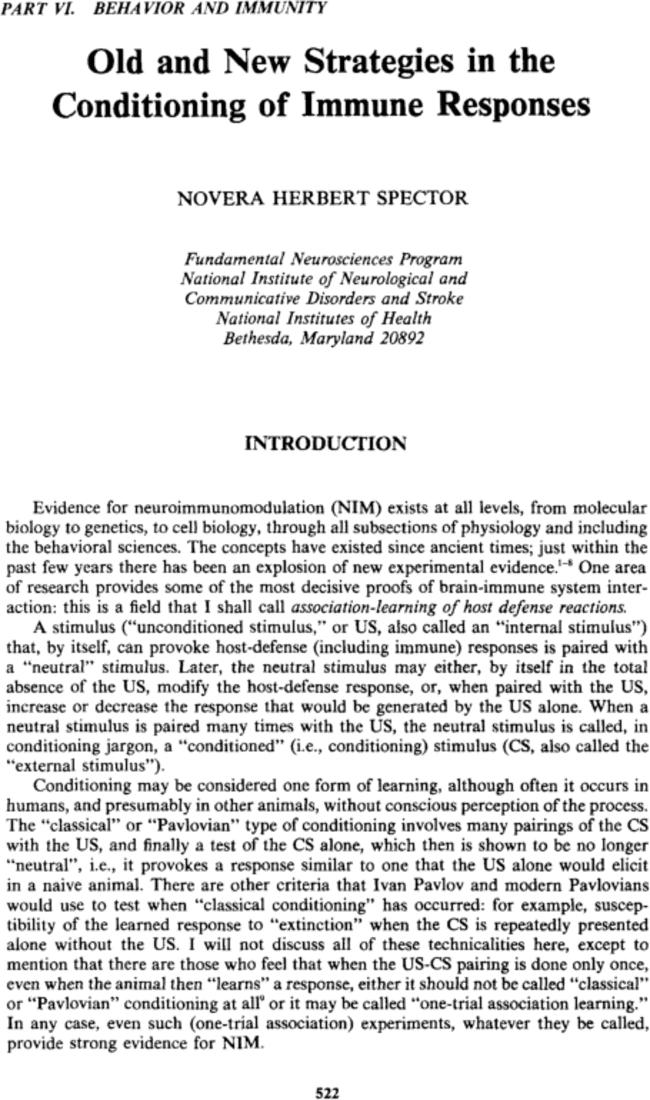
{"title":"Old and New Strategies in the Conditioning of Immune Responses","authors":"NOVERA HERBERT SPECTOR","doi":"10.1111/j.1749-6632.1987.tb35810.x","DOIUrl":null,"url":null,"abstract":"Classical (Pavlovian) conditioning of immune responses was demonstrated by Metal'nikov and his colleagues at the Pasteur Institute in Paris during the 1920s. These experiments, although controversial, were repeated and extended, largely in the Soviet Union, by Dolin, Krylov, Flerov, Luk'yanenko and many others during the 1950s and '60s. Both immunosuppression and immunoenhancement were reported, with many antigens and in several species including man. After a long hiatus, new interest in this subject was revived in the United States, starting with the work of Ader and Cohen on one-trial association learning leading to immunosuppression, and extending again to a new wave of reports from the United States, Canada, Germany and other countries on both conditioned suppression and conditioned enhancement of several host-defense systems, including natural killer cell activity. It already has been demonstrated that conditioning in mice can slow down the growth of tumors and, in some instances, even completely reverse tumor growth. This work is briefly discussed, with emphasis on some of the more recent findings. Applications to human subjects are suggested. The doors are just being opened: the possibilities for new research, for new discoveries, and for new clinical applications are endless.","PeriodicalId":8250,"journal":{"name":"Annals of the New York Academy of Sciences","volume":"496 1","pages":"522-531"},"PeriodicalIF":4.8000,"publicationDate":"1987-05-01","publicationTypes":"Journal Article","fieldsOfStudy":null,"isOpenAccess":false,"openAccessPdf":"https://sci-hub-pdf.com/10.1111/j.1749-6632.1987.tb35810.x","citationCount":"26","resultStr":null,"platform":"Semanticscholar","paperid":null,"PeriodicalName":"Annals of the New York Academy of Sciences","FirstCategoryId":"103","ListUrlMain":"https://onlinelibrary.wiley.com/doi/10.1111/j.1749-6632.1987.tb35810.x","RegionNum":3,"RegionCategory":"综合性期刊","ArticlePicture":[],"TitleCN":null,"AbstractTextCN":null,"PMCID":null,"EPubDate":"","PubModel":"","JCR":"Q1","JCRName":"MULTIDISCIPLINARY SCIENCES","Score":null,"Total":0}
引用次数: 26
Abstract
Classical (Pavlovian) conditioning of immune responses was demonstrated by Metal'nikov and his colleagues at the Pasteur Institute in Paris during the 1920s. These experiments, although controversial, were repeated and extended, largely in the Soviet Union, by Dolin, Krylov, Flerov, Luk'yanenko and many others during the 1950s and '60s. Both immunosuppression and immunoenhancement were reported, with many antigens and in several species including man. After a long hiatus, new interest in this subject was revived in the United States, starting with the work of Ader and Cohen on one-trial association learning leading to immunosuppression, and extending again to a new wave of reports from the United States, Canada, Germany and other countries on both conditioned suppression and conditioned enhancement of several host-defense systems, including natural killer cell activity. It already has been demonstrated that conditioning in mice can slow down the growth of tumors and, in some instances, even completely reverse tumor growth. This work is briefly discussed, with emphasis on some of the more recent findings. Applications to human subjects are suggested. The doors are just being opened: the possibilities for new research, for new discoveries, and for new clinical applications are endless.
期刊介绍:
Published on behalf of the New York Academy of Sciences, Annals of the New York Academy of Sciences provides multidisciplinary perspectives on research of current scientific interest with far-reaching implications for the wider scientific community and society at large. Each special issue assembles the best thinking of key contributors to a field of investigation at a time when emerging developments offer the promise of new insight. Individually themed, Annals special issues stimulate new ways to think about science by providing a neutral forum for discourse—within and across many institutions and fields.



 京公网安备 11010802042870号
京ICP备2023020795号-1
京公网安备 11010802042870号
京ICP备2023020795号-1

 分享
分享
 求助内容:
求助内容: 应助结果提醒方式:
 扫码关注我们
