P. K. Pandey, Y. K. Joshi, M. K. Khan, M. A. Iqbal, S. G. Ganpule
{"title":"Experimental Investigation of the Ballistic Response of Head Surrogate Against Fragment Simulating Projectiles","authors":"P. K. Pandey, Y. K. Joshi, M. K. Khan, M. A. Iqbal, S. G. Ganpule","doi":"10.1007/s11340-023-01010-4","DOIUrl":null,"url":null,"abstract":"<div><h3>Background</h3><p>Penetrating combat injuries by fragments are of concern during tactical warfare. The fragments generated from the explosive devices can cause lethal penetration in various organs, including the head. The response of the head against fragment impact is unknown.</p><h3>Objective</h3><p>To experimentally investigate the ballistic response of an open-shape head surrogate model against fragment impact. We hypothesize that the response of the head surrogate to the impact of small fragments is different than that of larger projectiles. The ballistic response of the head surrogate was evaluated in terms of ballistic limit velocities (V<sub>50</sub>), energies (E<sub>50</sub>), energy densities (E<sub>50</sub>/A) required for the penetration, and associated failure mechanisms in various layers of the head surrogate.</p><h3>Methods</h3><p>The head surrogate was prepared by stacking rectangle cross-sectioned skin, skull, and brain simulants. Chisel-nosed fragment simulating projectiles (FSPs) of 1.10-g and 2.79-g were impacted on the head surrogate using a pneumatic gas gun setup.</p><h3>Results</h3><p>V<sub>50</sub> and E<sub>50</sub>/A of the 2.79-g FSP were lower by ~ 50% than the 1.10-g FSP. The skin simulant failed by the combination of shearing and elastic hole enlargement. The skull simulant failed by a conoid fracture. In penetration cases, the FSP broke the fractured conoid of the skull simulant in smaller pieces and penetrated into the brain simulant. Interestingly, for the cases of non-penetration into the brain simulant, the brain simulant was damaged due to the moving conoid of the skull simulant.</p><h3>Conclusion</h3><p>The results demonstrated that V<sub>50</sub> and E<sub>50</sub>/A were influenced by the size of the FSP. For the investigated fragments, 15–25 J of energy was sufficient to cause various degrees of penetration into the brain simulant. All three layers of the head surrogate failed by distinguished mechanisms.</p></div>","PeriodicalId":552,"journal":{"name":"Experimental Mechanics","volume":"64 1","pages":"85 - 104"},"PeriodicalIF":2.4000,"publicationDate":"2023-10-30","publicationTypes":"Journal Article","fieldsOfStudy":null,"isOpenAccess":false,"openAccessPdf":"","citationCount":"0","resultStr":null,"platform":"Semanticscholar","paperid":null,"PeriodicalName":"Experimental Mechanics","FirstCategoryId":"5","ListUrlMain":"https://link.springer.com/article/10.1007/s11340-023-01010-4","RegionNum":3,"RegionCategory":"工程技术","ArticlePicture":[],"TitleCN":null,"AbstractTextCN":null,"PMCID":null,"EPubDate":"","PubModel":"","JCR":"Q2","JCRName":"MATERIALS SCIENCE, CHARACTERIZATION & TESTING","Score":null,"Total":0}
引用次数: 0
Abstract
Background
Penetrating combat injuries by fragments are of concern during tactical warfare. The fragments generated from the explosive devices can cause lethal penetration in various organs, including the head. The response of the head against fragment impact is unknown.
Objective
To experimentally investigate the ballistic response of an open-shape head surrogate model against fragment impact. We hypothesize that the response of the head surrogate to the impact of small fragments is different than that of larger projectiles. The ballistic response of the head surrogate was evaluated in terms of ballistic limit velocities (V50), energies (E50), energy densities (E50/A) required for the penetration, and associated failure mechanisms in various layers of the head surrogate.
Methods
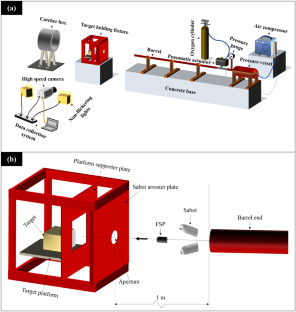
The head surrogate was prepared by stacking rectangle cross-sectioned skin, skull, and brain simulants. Chisel-nosed fragment simulating projectiles (FSPs) of 1.10-g and 2.79-g were impacted on the head surrogate using a pneumatic gas gun setup.
Results
V50 and E50/A of the 2.79-g FSP were lower by ~ 50% than the 1.10-g FSP. The skin simulant failed by the combination of shearing and elastic hole enlargement. The skull simulant failed by a conoid fracture. In penetration cases, the FSP broke the fractured conoid of the skull simulant in smaller pieces and penetrated into the brain simulant. Interestingly, for the cases of non-penetration into the brain simulant, the brain simulant was damaged due to the moving conoid of the skull simulant.
Conclusion
The results demonstrated that V50 and E50/A were influenced by the size of the FSP. For the investigated fragments, 15–25 J of energy was sufficient to cause various degrees of penetration into the brain simulant. All three layers of the head surrogate failed by distinguished mechanisms.
期刊介绍:
Experimental Mechanics is the official journal of the Society for Experimental Mechanics that publishes papers in all areas of experimentation including its theoretical and computational analysis. The journal covers research in design and implementation of novel or improved experiments to characterize materials, structures and systems. Articles extending the frontiers of experimental mechanics at large and small scales are particularly welcome.
Coverage extends from research in solid and fluids mechanics to fields at the intersection of disciplines including physics, chemistry and biology. Development of new devices and technologies for metrology applications in a wide range of industrial sectors (e.g., manufacturing, high-performance materials, aerospace, information technology, medicine, energy and environmental technologies) is also covered.




 京公网安备 11010802042870号
京ICP备2023020795号-1
京公网安备 11010802042870号
京ICP备2023020795号-1

 分享
分享
 求助内容:
求助内容: 应助结果提醒方式:
 扫码关注我们
