{"title":"Prediction of diesel generator performance and emissions using minimal sensor data and analysis of advanced machine learning techniques","authors":"Min-Ho Park , Jae-Jung Hur , Won-Ju Lee","doi":"10.1016/j.joes.2023.10.004","DOIUrl":null,"url":null,"abstract":"<div><div>To this day, diesel generator (DG) continues to play an indispensable role in all industries and smart engines and engines with eco-friendly technologies are being developed. However, with the advent of the unmanned automation era, countermeasures are required when DG sensors are non-functional. Therefore, an optimized AI model for backing up sensor data, which is necessary for the safety of smart engines equipped with eco-friendly facilities, was developed. To develop an AI model for this purpose, an experiment was conducted to obtain the engine and emission data to be used and 11 models were created. By predicting 16 variables related to the engine performance and emissions using a total of five sensor data, including three sensors essential for the engine safety, the proposed AI model could back up data when some sensors failed. Moreover, various hyperparameter tunings were applied and compared to maximize the model performance. Consequently, the decision tree (DT)-based models and genetic algorithm showed a good performance, and the weighted average of ensemble (DT) model showed the best performance with R<sup>2</sup> value of 0.9981, and a SMAPE value of 0.7244. Additionally, to confirm the generalization performance of the model, the prediction performance of the models was measured using new data, and the blending of ensemble (ALL) model had the best performance with R<sup>2</sup> value of 0.9266, and a SMAPE value of 5.585. Finally, the application of the concept used to develop the AI model and the future direction of the work were discussed.</div></div>","PeriodicalId":48514,"journal":{"name":"Journal of Ocean Engineering and Science","volume":"10 1","pages":"Pages 150-168"},"PeriodicalIF":11.8000,"publicationDate":"2025-02-01","publicationTypes":"Journal Article","fieldsOfStudy":null,"isOpenAccess":false,"openAccessPdf":"","citationCount":"0","resultStr":null,"platform":"Semanticscholar","paperid":null,"PeriodicalName":"Journal of Ocean Engineering and Science","FirstCategoryId":"5","ListUrlMain":"https://www.sciencedirect.com/science/article/pii/S2468013323000694","RegionNum":1,"RegionCategory":"工程技术","ArticlePicture":[],"TitleCN":null,"AbstractTextCN":null,"PMCID":null,"EPubDate":"","PubModel":"","JCR":"Q1","JCRName":"ENGINEERING, MARINE","Score":null,"Total":0}
引用次数: 0
Abstract
To this day, diesel generator (DG) continues to play an indispensable role in all industries and smart engines and engines with eco-friendly technologies are being developed. However, with the advent of the unmanned automation era, countermeasures are required when DG sensors are non-functional. Therefore, an optimized AI model for backing up sensor data, which is necessary for the safety of smart engines equipped with eco-friendly facilities, was developed. To develop an AI model for this purpose, an experiment was conducted to obtain the engine and emission data to be used and 11 models were created. By predicting 16 variables related to the engine performance and emissions using a total of five sensor data, including three sensors essential for the engine safety, the proposed AI model could back up data when some sensors failed. Moreover, various hyperparameter tunings were applied and compared to maximize the model performance. Consequently, the decision tree (DT)-based models and genetic algorithm showed a good performance, and the weighted average of ensemble (DT) model showed the best performance with R2 value of 0.9981, and a SMAPE value of 0.7244. Additionally, to confirm the generalization performance of the model, the prediction performance of the models was measured using new data, and the blending of ensemble (ALL) model had the best performance with R2 value of 0.9266, and a SMAPE value of 5.585. Finally, the application of the concept used to develop the AI model and the future direction of the work were discussed.
期刊介绍:
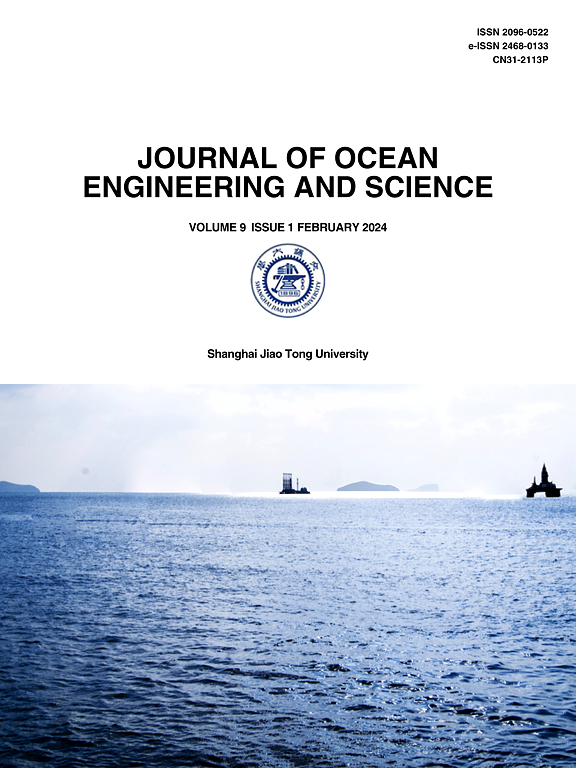
The Journal of Ocean Engineering and Science (JOES) serves as a platform for disseminating original research and advancements in the realm of ocean engineering and science.
JOES encourages the submission of papers covering various aspects of ocean engineering and science.



 京公网安备 11010802042870号
京ICP备2023020795号-1
京公网安备 11010802042870号
京ICP备2023020795号-1

 分享
分享
 求助内容:
求助内容: 应助结果提醒方式:
 扫码关注我们
