Ahmed M. Zayed, Bahaa S. Metwally, M. A. Masoud, Mahmoud F. Mubarak, Hussain Shendy, Mahmoud S. M. Abdel Wahed
{"title":"From non-conventional agricultural waste into sustainable and eco-friendly activated carbon through specified thermo-chemical protocol","authors":"Ahmed M. Zayed, Bahaa S. Metwally, M. A. Masoud, Mahmoud F. Mubarak, Hussain Shendy, Mahmoud S. M. Abdel Wahed","doi":"10.1007/s13204-023-02939-7","DOIUrl":null,"url":null,"abstract":"<div><p>The preparation of eco-friendly activated carbons (ACs) has gained significant attention due to their enhanced ability to remove a wide range of pollutants from water. Agricultural waste materials are promising precursors for the preparation of ACs due to their abundant availability and low cost. For the first time, this study is dedicated to preparing activated carbon from the useless leaves of sugar beet (LSB). This was conducted by thermo-chemical activation using H<sub>3</sub>PO<sub>4</sub> as a robust activating agent. The activation process was carried out in a programmable furnace at a fixed temperature of 550 °C for 2 h. Different ratios of H<sub>3</sub>PO<sub>4</sub> (85%) and pristine LSB (0.5:1, 1:1, 2:1, and 3:1) were used to produce four synthesized ACs, which were labeled as AC<sub>(0.5:1)</sub>, AC<sub>(1:1)</sub>, AC<sub>(2:1)</sub> and AC<sub>(3:1)</sub>, respectively, for evaluating the impact of the impregnation ratios on the properties of these synthesized ACs. The as-synthesized ACs were characterized by X-ray diffraction (XRD), scanning electron microscopy (SEM), energy-dispersive X-ray spectroscopy (EDS), Fourier-transform infrared spectroscopy (FTIR), and Brunauer–Emmett–Teller surface area (S<sub>BET</sub>) analysis. Among all the prepared ACs, AC<sub>(2:1)</sub> showed the highest degree of amorphicity, which resulted in the highest S<sub>BET</sub> value of 700.71 m<sup>2</sup>/g. This high surface area suggests a magnificent porous structure and surface chemistry of the synthesized AC, making it suitable for various environmental applications. The study shows that the thermo-chemical activation of sugar beet leaves with H<sub>3</sub>PO<sub>4</sub> can produce a highly competent AC with excellent characteristics that can be used in waste management, water purification, and other related applications. Overall, this study highlights the potential of using useless LSB as a sustainable source of AC production and provides new insights into the preparation and characterization of eco-friendly ACs.</p></div>","PeriodicalId":471,"journal":{"name":"Applied Nanoscience","volume":"14 1","pages":"21 - 32"},"PeriodicalIF":3.6740,"publicationDate":"2023-09-01","publicationTypes":"Journal Article","fieldsOfStudy":null,"isOpenAccess":false,"openAccessPdf":"","citationCount":"0","resultStr":null,"platform":"Semanticscholar","paperid":null,"PeriodicalName":"Applied Nanoscience","FirstCategoryId":"5","ListUrlMain":"https://link.springer.com/article/10.1007/s13204-023-02939-7","RegionNum":4,"RegionCategory":"工程技术","ArticlePicture":[],"TitleCN":null,"AbstractTextCN":null,"PMCID":null,"EPubDate":"","PubModel":"","JCR":"Q1","JCRName":"Engineering","Score":null,"Total":0}
引用次数: 0
Abstract
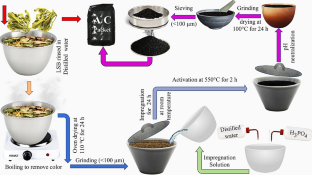
The preparation of eco-friendly activated carbons (ACs) has gained significant attention due to their enhanced ability to remove a wide range of pollutants from water. Agricultural waste materials are promising precursors for the preparation of ACs due to their abundant availability and low cost. For the first time, this study is dedicated to preparing activated carbon from the useless leaves of sugar beet (LSB). This was conducted by thermo-chemical activation using H3PO4 as a robust activating agent. The activation process was carried out in a programmable furnace at a fixed temperature of 550 °C for 2 h. Different ratios of H3PO4 (85%) and pristine LSB (0.5:1, 1:1, 2:1, and 3:1) were used to produce four synthesized ACs, which were labeled as AC(0.5:1), AC(1:1), AC(2:1) and AC(3:1), respectively, for evaluating the impact of the impregnation ratios on the properties of these synthesized ACs. The as-synthesized ACs were characterized by X-ray diffraction (XRD), scanning electron microscopy (SEM), energy-dispersive X-ray spectroscopy (EDS), Fourier-transform infrared spectroscopy (FTIR), and Brunauer–Emmett–Teller surface area (SBET) analysis. Among all the prepared ACs, AC(2:1) showed the highest degree of amorphicity, which resulted in the highest SBET value of 700.71 m2/g. This high surface area suggests a magnificent porous structure and surface chemistry of the synthesized AC, making it suitable for various environmental applications. The study shows that the thermo-chemical activation of sugar beet leaves with H3PO4 can produce a highly competent AC with excellent characteristics that can be used in waste management, water purification, and other related applications. Overall, this study highlights the potential of using useless LSB as a sustainable source of AC production and provides new insights into the preparation and characterization of eco-friendly ACs.
期刊介绍:
Applied Nanoscience is a hybrid journal that publishes original articles about state of the art nanoscience and the application of emerging nanotechnologies to areas fundamental to building technologically advanced and sustainable civilization, including areas as diverse as water science, advanced materials, energy, electronics, environmental science and medicine. The journal accepts original and review articles as well as book reviews for publication. All the manuscripts are single-blind peer-reviewed for scientific quality and acceptance.



 京公网安备 11010802042870号
京ICP备2023020795号-1
京公网安备 11010802042870号
京ICP备2023020795号-1

 分享
分享
 求助内容:
求助内容: 应助结果提醒方式:
 扫码关注我们
