Stephanie N. Spehar , Brent Loken , Yaya Rayadin , J. Andrew Royle
{"title":"Comparing spatial capture–recapture modeling and nest count methods to estimate orangutan densities in the Wehea Forest, East Kalimantan, Indonesia","authors":"Stephanie N. Spehar , Brent Loken , Yaya Rayadin , J. Andrew Royle","doi":"10.1016/j.biocon.2015.06.013","DOIUrl":null,"url":null,"abstract":"<div><p><span>Accurate information on the density and abundance of animal populations is essential for understanding species' ecology and for conservation planning, but is difficult to obtain. The endangered orangutan (</span><span><em>Pongo</em></span> spp.) is an example; due to its elusive behavior and low densities, researchers have relied on methods that convert nest counts to orangutan densities and require substantial effort for reliable results. Camera trapping and spatial capture–recapture (SCR) models could provide an alternative but have not been used for primates. We compared density estimates calculated using the two methods for orangutans in the Wehea Forest, East Kalimantan, Indonesia. Camera trapping/SCR modeling produced a density estimate of 0.16<!--> <!-->±<!--> <!-->0.09–0.29 indiv/km<sup>2</sup>, and nest counts produced a density estimate of 1.05<!--> <!-->±<!--> <!-->0.18–6.01 indiv/km<sup>2</sup>. The large confidence interval of the nest count estimate is probably due to high variance in nest encounter rates, indicating the need for larger sample size and the substantial effort required to produce reliable results using this method. The SCR estimate produced a very low density estimate and had a narrower but still fairly wide confidence interval. This was likely due to unmodeled heterogeneity and small sample size, specifically a low number of individual captures and recaptures. We propose methodological fixes that could address these issues and improve precision. A comparison of the overall costs and benefits of the two methods suggests that camera trapping/SCR modeling can potentially be a useful tool for assessing the densities of orangutans and other elusive primates, and warrant further investigation to determine broad applicability and methodological adjustments needed.</p></div>","PeriodicalId":55375,"journal":{"name":"Biological Conservation","volume":"191 ","pages":"Pages 185-193"},"PeriodicalIF":4.4000,"publicationDate":"2015-11-01","publicationTypes":"Journal Article","fieldsOfStudy":null,"isOpenAccess":false,"openAccessPdf":"https://sci-hub-pdf.com/10.1016/j.biocon.2015.06.013","citationCount":"21","resultStr":null,"platform":"Semanticscholar","paperid":null,"PeriodicalName":"Biological Conservation","FirstCategoryId":"93","ListUrlMain":"https://www.sciencedirect.com/science/article/pii/S0006320715002360","RegionNum":1,"RegionCategory":"环境科学与生态学","ArticlePicture":[],"TitleCN":null,"AbstractTextCN":null,"PMCID":null,"EPubDate":"","PubModel":"","JCR":"Q1","JCRName":"BIODIVERSITY CONSERVATION","Score":null,"Total":0}
引用次数: 21
Abstract
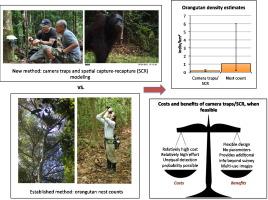
Accurate information on the density and abundance of animal populations is essential for understanding species' ecology and for conservation planning, but is difficult to obtain. The endangered orangutan (Pongo spp.) is an example; due to its elusive behavior and low densities, researchers have relied on methods that convert nest counts to orangutan densities and require substantial effort for reliable results. Camera trapping and spatial capture–recapture (SCR) models could provide an alternative but have not been used for primates. We compared density estimates calculated using the two methods for orangutans in the Wehea Forest, East Kalimantan, Indonesia. Camera trapping/SCR modeling produced a density estimate of 0.16 ± 0.09–0.29 indiv/km2, and nest counts produced a density estimate of 1.05 ± 0.18–6.01 indiv/km2. The large confidence interval of the nest count estimate is probably due to high variance in nest encounter rates, indicating the need for larger sample size and the substantial effort required to produce reliable results using this method. The SCR estimate produced a very low density estimate and had a narrower but still fairly wide confidence interval. This was likely due to unmodeled heterogeneity and small sample size, specifically a low number of individual captures and recaptures. We propose methodological fixes that could address these issues and improve precision. A comparison of the overall costs and benefits of the two methods suggests that camera trapping/SCR modeling can potentially be a useful tool for assessing the densities of orangutans and other elusive primates, and warrant further investigation to determine broad applicability and methodological adjustments needed.
期刊介绍:
Biological Conservation is an international leading journal in the discipline of conservation biology. The journal publishes articles spanning a diverse range of fields that contribute to the biological, sociological, and economic dimensions of conservation and natural resource management. The primary aim of Biological Conservation is the publication of high-quality papers that advance the science and practice of conservation, or which demonstrate the application of conservation principles for natural resource management and policy. Therefore it will be of interest to a broad international readership.



 京公网安备 11010802042870号
京ICP备2023020795号-1
京公网安备 11010802042870号
京ICP备2023020795号-1

 分享
分享
 求助内容:
求助内容: 应助结果提醒方式:
 扫码关注我们
