Sanjoy Kumar Das, K. Yuvaraja, Jasmina Khanam, Arunabha Nanda
{"title":"Formulation development and statistical optimization of ibuprofen-loaded polymethacrylate microspheres using response surface methodology","authors":"Sanjoy Kumar Das, K. Yuvaraja, Jasmina Khanam, Arunabha Nanda","doi":"10.1016/j.cherd.2015.01.014","DOIUrl":null,"url":null,"abstract":"<div><p>The present investigation was aimed at developing a controlled release dosage form of ‘ibuprofen-loaded polymethacrylate microspheres’ by optimization technique using software based response surface methodology. The microspheres were prepared by emulsion solvent evaporation method in which three process variables were of importantce such as drug:polymer ratio, stirring speed and emulsifier concentration. The desired responses are percentage yield, particle size, entrapment efficiency and <em>in vitro</em> drug release in 12<!--> <!-->h from the microspheres. Optimization was done by fitting experimental data to the software program (Design-Expert<sup>®</sup> 7 trial version). Product batches were subjected to various characterization tests which are mandatory for the development of dosage form. The optimized batch of formulation showed satisfactory yield (82.00<!--> <!-->±<!--> <!-->1.18%) and drug entrapment efficiency (82.15<!--> <!-->±<!--> <!-->1.35%). Particles were of spherical shape, smooth surface and good flowability, and its average particle size is 133.4<!--> <!-->±<!--> <!-->2.27<!--> <!-->μm. The developed optimized batch of microspheres ensured sustained release (>12<!--> <!-->h) of ibuprofen. No chemical interaction was observed between ibuprofen and polymer-Eudragit RSPO as evidenced by Fourier transform-infrared (FTIR) spectroscopy and differential scanning calorimetry (DSC) studies. In conclusion, development of controlled release drug delivery system of ibuprofen was successfully made.</p></div>","PeriodicalId":10019,"journal":{"name":"Chemical Engineering Research & Design","volume":"96 ","pages":"Pages 1-14"},"PeriodicalIF":3.9000,"publicationDate":"2015-04-01","publicationTypes":"Journal Article","fieldsOfStudy":null,"isOpenAccess":false,"openAccessPdf":"https://sci-hub-pdf.com/10.1016/j.cherd.2015.01.014","citationCount":"27","resultStr":null,"platform":"Semanticscholar","paperid":null,"PeriodicalName":"Chemical Engineering Research & Design","FirstCategoryId":"5","ListUrlMain":"https://www.sciencedirect.com/science/article/pii/S0263876215000337","RegionNum":3,"RegionCategory":"工程技术","ArticlePicture":[],"TitleCN":null,"AbstractTextCN":null,"PMCID":null,"EPubDate":"","PubModel":"","JCR":"Q2","JCRName":"ENGINEERING, CHEMICAL","Score":null,"Total":0}
引用次数: 27
Abstract
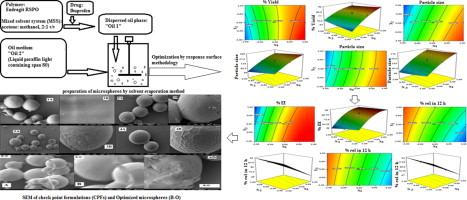
The present investigation was aimed at developing a controlled release dosage form of ‘ibuprofen-loaded polymethacrylate microspheres’ by optimization technique using software based response surface methodology. The microspheres were prepared by emulsion solvent evaporation method in which three process variables were of importantce such as drug:polymer ratio, stirring speed and emulsifier concentration. The desired responses are percentage yield, particle size, entrapment efficiency and in vitro drug release in 12 h from the microspheres. Optimization was done by fitting experimental data to the software program (Design-Expert® 7 trial version). Product batches were subjected to various characterization tests which are mandatory for the development of dosage form. The optimized batch of formulation showed satisfactory yield (82.00 ± 1.18%) and drug entrapment efficiency (82.15 ± 1.35%). Particles were of spherical shape, smooth surface and good flowability, and its average particle size is 133.4 ± 2.27 μm. The developed optimized batch of microspheres ensured sustained release (>12 h) of ibuprofen. No chemical interaction was observed between ibuprofen and polymer-Eudragit RSPO as evidenced by Fourier transform-infrared (FTIR) spectroscopy and differential scanning calorimetry (DSC) studies. In conclusion, development of controlled release drug delivery system of ibuprofen was successfully made.
期刊介绍:
ChERD aims to be the principal international journal for publication of high quality, original papers in chemical engineering.
Papers showing how research results can be used in chemical engineering design, and accounts of experimental or theoretical research work bringing new perspectives to established principles, highlighting unsolved problems or indicating directions for future research, are particularly welcome. Contributions that deal with new developments in plant or processes and that can be given quantitative expression are encouraged. The journal is especially interested in papers that extend the boundaries of traditional chemical engineering.