First tracking of declining Caspian terns Hydroprogne caspia breeding in the Baltic Sea reveals high migratory dispersion and disjunct annual ranges as obstacles to effective conservation
Cristina Rueda-Uribe, Ulrik Lötberg, Maria Ericsson, Sylvie V. M. Tesson, Susanne Åkesson
{"title":"First tracking of declining Caspian terns Hydroprogne caspia breeding in the Baltic Sea reveals high migratory dispersion and disjunct annual ranges as obstacles to effective conservation","authors":"Cristina Rueda-Uribe, Ulrik Lötberg, Maria Ericsson, Sylvie V. M. Tesson, Susanne Åkesson","doi":"10.1111/jav.02743","DOIUrl":null,"url":null,"abstract":"<p>The conservation of migratory species poses significant challenges that may be countered by detailed knowledge about the sites used by migrants throughout the annual cycle. We present the first GPS-tracking data on the migration of declining Caspian terns <i>Hydroprogne caspia</i> breeding in the Baltic Sea. For 39 Caspian terns from colonies along a latitudinal gradient from 57 to 65°N, we identified key migratory routes, stopovers and wintering areas. In autumn these seabirds migrated using coastal and freshwater stopovers along six routes to reach their wintering areas across the Sahel, the Nile River Basin and the southern Iberian Peninsula. In spring, adults returned to the breeding grounds in the Baltic using a time optimizing strategy by reducing time at stopover by 78%, whereas most subadults remained sedentary and some performed only partial return migrations. Of the stopover sites used in both seasons, 58% are protected and have a reported management plan. Conservation strategies in wintering areas, stopover sites that are not protected or had not been previously recognized, and the inclusion of the species in important migratory flyways across Europe and Africa will be important to prevent further population declines of a species that depends on aquatic habitats.</p>","PeriodicalId":15278,"journal":{"name":"Journal of Avian Biology","volume":"52 9","pages":""},"PeriodicalIF":1.8000,"publicationDate":"2021-07-27","publicationTypes":"Journal Article","fieldsOfStudy":null,"isOpenAccess":false,"openAccessPdf":"https://sci-hub-pdf.com/10.1111/jav.02743","citationCount":"0","resultStr":null,"platform":"Semanticscholar","paperid":null,"PeriodicalName":"Journal of Avian Biology","FirstCategoryId":"99","ListUrlMain":"https://onlinelibrary.wiley.com/doi/10.1111/jav.02743","RegionNum":3,"RegionCategory":"生物学","ArticlePicture":[],"TitleCN":null,"AbstractTextCN":null,"PMCID":null,"EPubDate":"","PubModel":"","JCR":"Q1","JCRName":"ORNITHOLOGY","Score":null,"Total":0}
引用次数: 0
Abstract
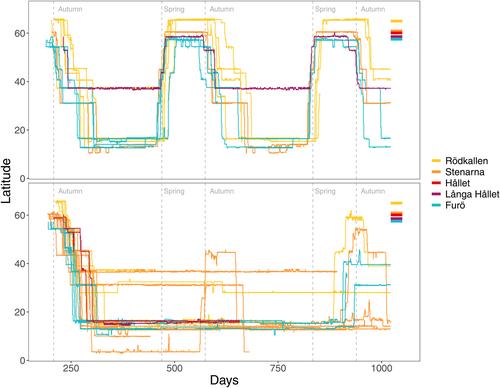
The conservation of migratory species poses significant challenges that may be countered by detailed knowledge about the sites used by migrants throughout the annual cycle. We present the first GPS-tracking data on the migration of declining Caspian terns Hydroprogne caspia breeding in the Baltic Sea. For 39 Caspian terns from colonies along a latitudinal gradient from 57 to 65°N, we identified key migratory routes, stopovers and wintering areas. In autumn these seabirds migrated using coastal and freshwater stopovers along six routes to reach their wintering areas across the Sahel, the Nile River Basin and the southern Iberian Peninsula. In spring, adults returned to the breeding grounds in the Baltic using a time optimizing strategy by reducing time at stopover by 78%, whereas most subadults remained sedentary and some performed only partial return migrations. Of the stopover sites used in both seasons, 58% are protected and have a reported management plan. Conservation strategies in wintering areas, stopover sites that are not protected or had not been previously recognized, and the inclusion of the species in important migratory flyways across Europe and Africa will be important to prevent further population declines of a species that depends on aquatic habitats.
期刊介绍:
Journal of Avian Biology publishes empirical and theoretical research in all areas of ornithology, with an emphasis on behavioural ecology, evolution and conservation.



 京公网安备 11010802042870号
京ICP备2023020795号-1
京公网安备 11010802042870号
京ICP备2023020795号-1

 分享
分享
 求助内容:
求助内容: 应助结果提醒方式:
 扫码关注我们
