{"title":"Contribution of peripheral vision to attentional learning","authors":"Chen Chen, Vanessa G. Lee","doi":"10.3758/s13414-023-02808-z","DOIUrl":null,"url":null,"abstract":"<div><p>Attention is tuned towards locations that frequently contain a visual search target (location probability learning; LPL). Peripheral vision, covering a larger field than the fovea, often receives information about the target. Yet what is the role of peripheral vision in attentional learning? Using gaze-contingent eye tracking, we examined the impact of simulated peripheral vision loss on location probability learning. Participants searched for a target T among distractor Ls. Unbeknownst to them, the T appeared disproportionately often in one quadrant. Participants searched with either intact vision or “tunnel vision,” restricting the visible search items to the central 6.7º (in diameter) of the current gaze. When trained with tunnel vision, participants in Experiment 1 acquired LPL, but only if they became explicitly aware of the target’s location probability. The unaware participants were not faster finding the target in high-probability than in low-probability locations. When trained with intact vision, participants in Experiment 2 successfully acquired LPL, regardless of whether they were aware of the target’s location probability. Thus, whereas explicit learning may proceed with central vision alone, implicit LPL is strengthened by peripheral vision. Consistent with Guided Search (Wolfe, 2021), peripheral vision supports a nonselective pathway to guide visual search.</p></div>","PeriodicalId":55433,"journal":{"name":"Attention Perception & Psychophysics","volume":"86 1","pages":"95 - 108"},"PeriodicalIF":1.7000,"publicationDate":"2023-11-20","publicationTypes":"Journal Article","fieldsOfStudy":null,"isOpenAccess":false,"openAccessPdf":"","citationCount":"0","resultStr":null,"platform":"Semanticscholar","paperid":null,"PeriodicalName":"Attention Perception & Psychophysics","FirstCategoryId":"102","ListUrlMain":"https://link.springer.com/article/10.3758/s13414-023-02808-z","RegionNum":4,"RegionCategory":"心理学","ArticlePicture":[],"TitleCN":null,"AbstractTextCN":null,"PMCID":null,"EPubDate":"","PubModel":"","JCR":"Q3","JCRName":"PSYCHOLOGY","Score":null,"Total":0}
引用次数: 0
Abstract
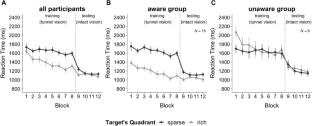
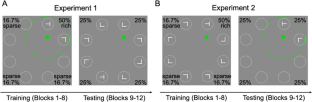
Attention is tuned towards locations that frequently contain a visual search target (location probability learning; LPL). Peripheral vision, covering a larger field than the fovea, often receives information about the target. Yet what is the role of peripheral vision in attentional learning? Using gaze-contingent eye tracking, we examined the impact of simulated peripheral vision loss on location probability learning. Participants searched for a target T among distractor Ls. Unbeknownst to them, the T appeared disproportionately often in one quadrant. Participants searched with either intact vision or “tunnel vision,” restricting the visible search items to the central 6.7º (in diameter) of the current gaze. When trained with tunnel vision, participants in Experiment 1 acquired LPL, but only if they became explicitly aware of the target’s location probability. The unaware participants were not faster finding the target in high-probability than in low-probability locations. When trained with intact vision, participants in Experiment 2 successfully acquired LPL, regardless of whether they were aware of the target’s location probability. Thus, whereas explicit learning may proceed with central vision alone, implicit LPL is strengthened by peripheral vision. Consistent with Guided Search (Wolfe, 2021), peripheral vision supports a nonselective pathway to guide visual search.
期刊介绍:
The journal Attention, Perception, & Psychophysics is an official journal of the Psychonomic Society. It spans all areas of research in sensory processes, perception, attention, and psychophysics. Most articles published are reports of experimental work; the journal also presents theoretical, integrative, and evaluative reviews. Commentary on issues of importance to researchers appears in a special section of the journal. Founded in 1966 as Perception & Psychophysics, the journal assumed its present name in 2009.



 京公网安备 11010802042870号
京ICP备2023020795号-1
京公网安备 11010802042870号
京ICP备2023020795号-1

 分享
分享
 求助内容:
求助内容: 应助结果提醒方式:
 扫码关注我们
