Yang Wang, Jiaping Zhou, Xiaojing Tian*, Lei Bai, Chenwei Ma, Yuan Chen, Yu Li* and Wenhang Wang*,
{"title":"Effects of Covalent or Noncovalent Binding of Different Polyphenols to Acid-Soluble Collagen on Protein Structure, Functionality, and Digestibility","authors":"Yang Wang, Jiaping Zhou, Xiaojing Tian*, Lei Bai, Chenwei Ma, Yuan Chen, Yu Li* and Wenhang Wang*, ","doi":"10.1021/acs.jafc.3c06510","DOIUrl":null,"url":null,"abstract":"<p >In this study, the structure, function, and digestibility of noncovalent complexes and covalent conjugates formed by acid-soluble collagen with polyphenols of different structures (quercetin, epicatechin, gallic acid, chlorogenic acid, procyanidin, and tannic acid) were investigated. Sodium dodecyl sulfate–polyacrylamide gel electrophoresis (SDS-PAGE) showed that polyphenols were covalently bound to collagen by laccase catalytic oxidation. Biolayer interferometry revealed that the noncovalent binding strength of polyphenols to collagen from high to low was quercetin > gallic acid > chlorogenic acid > epicatechin, which was consistent with the trend of covalent polyphenol binding. Procyanidin and tannic acid had strong noncovalent binding, but their covalent binding ability was weak. Compared with the pure collagen, the complexes improved emulsification and antioxidant properties (more than 2.5 times), and the conjugates exhibited better thermal stability (99.4–106.8 °C) and antidigestion ability (reduced by more than 37%). The finding sheds new light on the use of collagen as a functional food ingredient in the food industry.</p>","PeriodicalId":41,"journal":{"name":"Journal of Agricultural and Food Chemistry","volume":"71 48","pages":"19020–19032"},"PeriodicalIF":6.2000,"publicationDate":"2023-11-22","publicationTypes":"Journal Article","fieldsOfStudy":null,"isOpenAccess":false,"openAccessPdf":"","citationCount":"0","resultStr":null,"platform":"Semanticscholar","paperid":null,"PeriodicalName":"Journal of Agricultural and Food Chemistry","FirstCategoryId":"97","ListUrlMain":"https://pubs.acs.org/doi/10.1021/acs.jafc.3c06510","RegionNum":1,"RegionCategory":"农林科学","ArticlePicture":[],"TitleCN":null,"AbstractTextCN":null,"PMCID":null,"EPubDate":"","PubModel":"","JCR":"Q1","JCRName":"AGRICULTURE, MULTIDISCIPLINARY","Score":null,"Total":0}
引用次数: 0
Abstract
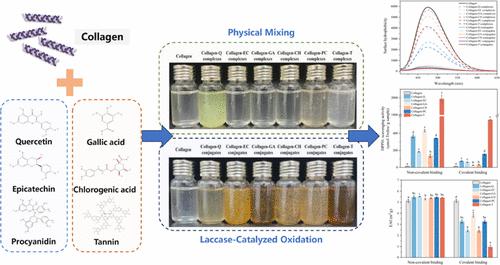
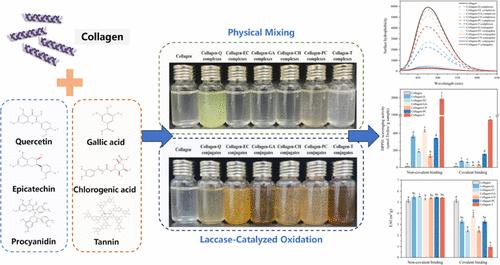
In this study, the structure, function, and digestibility of noncovalent complexes and covalent conjugates formed by acid-soluble collagen with polyphenols of different structures (quercetin, epicatechin, gallic acid, chlorogenic acid, procyanidin, and tannic acid) were investigated. Sodium dodecyl sulfate–polyacrylamide gel electrophoresis (SDS-PAGE) showed that polyphenols were covalently bound to collagen by laccase catalytic oxidation. Biolayer interferometry revealed that the noncovalent binding strength of polyphenols to collagen from high to low was quercetin > gallic acid > chlorogenic acid > epicatechin, which was consistent with the trend of covalent polyphenol binding. Procyanidin and tannic acid had strong noncovalent binding, but their covalent binding ability was weak. Compared with the pure collagen, the complexes improved emulsification and antioxidant properties (more than 2.5 times), and the conjugates exhibited better thermal stability (99.4–106.8 °C) and antidigestion ability (reduced by more than 37%). The finding sheds new light on the use of collagen as a functional food ingredient in the food industry.
期刊介绍:
The Journal of Agricultural and Food Chemistry publishes high-quality, cutting edge original research representing complete studies and research advances dealing with the chemistry and biochemistry of agriculture and food. The Journal also encourages papers with chemistry and/or biochemistry as a major component combined with biological/sensory/nutritional/toxicological evaluation related to agriculture and/or food.



 京公网安备 11010802042870号
京ICP备2023020795号-1
京公网安备 11010802042870号
京ICP备2023020795号-1

 分享
分享
 求助内容:
求助内容: 应助结果提醒方式:
 扫码关注我们
