{"title":"Spatiotemporal tracking of building materials and their related environmental impacts.","authors":"Endrit Hoxha, Nicolas Francart, Buket Tozan, Emilie Brisson Stapel, Srinivasa Raghavendra Bhuvan Gummidi, Harpa Birgisdottir","doi":"10.1016/j.scitotenv.2023.168853","DOIUrl":null,"url":null,"abstract":"<p><p>Urban development will increase the demand for new buildings expected to cause significant environmental impacts in the coming decades. Spatiotemporal prediction for new buildings, their typologies, resource quantities and types required for construction, and the associated impacts are crucial to effectively tackle strategies to reduce the related greenhouse gas emissions. Within the context of Denmark, this study establishes a prognosis of expected yearly embedded impacts across the country towards 2050 based on Business as Usual (frozen policy) trends. Through the Holt-Winters method's additive version, the study forecasted the future amount of building types in each Danish municipality. The embedded impacts disaggregated into building types, components, materials, and life cycle stages are calculated from the material intensity coefficients of real projects. Considering a 'business as usual' scenario, the prediction shows an increase in demand by 6.5 % for new gross floor areas compared to the number of current buildings constructed in the past years. The GHGs from the upstream processing of materials correspond to 7 % of current consumption-based yearly emissions in Denmark. To strive for sustainable development, the findings of the study help inform stakeholders in the built environment to better correlate the material mechanism 'supply-demand' for circularity and where efforts to minimize the impacts should be prioritized.</p>","PeriodicalId":422,"journal":{"name":"Science of the Total Environment","volume":" ","pages":"168853"},"PeriodicalIF":8.0000,"publicationDate":"2024-02-20","publicationTypes":"Journal Article","fieldsOfStudy":null,"isOpenAccess":false,"openAccessPdf":"","citationCount":"0","resultStr":null,"platform":"Semanticscholar","paperid":null,"PeriodicalName":"Science of the Total Environment","FirstCategoryId":"93","ListUrlMain":"https://doi.org/10.1016/j.scitotenv.2023.168853","RegionNum":1,"RegionCategory":"环境科学与生态学","ArticlePicture":[],"TitleCN":null,"AbstractTextCN":null,"PMCID":null,"EPubDate":"2023/11/29 0:00:00","PubModel":"Epub","JCR":"Q1","JCRName":"ENVIRONMENTAL SCIENCES","Score":null,"Total":0}
引用次数: 0
Abstract
Urban development will increase the demand for new buildings expected to cause significant environmental impacts in the coming decades. Spatiotemporal prediction for new buildings, their typologies, resource quantities and types required for construction, and the associated impacts are crucial to effectively tackle strategies to reduce the related greenhouse gas emissions. Within the context of Denmark, this study establishes a prognosis of expected yearly embedded impacts across the country towards 2050 based on Business as Usual (frozen policy) trends. Through the Holt-Winters method's additive version, the study forecasted the future amount of building types in each Danish municipality. The embedded impacts disaggregated into building types, components, materials, and life cycle stages are calculated from the material intensity coefficients of real projects. Considering a 'business as usual' scenario, the prediction shows an increase in demand by 6.5 % for new gross floor areas compared to the number of current buildings constructed in the past years. The GHGs from the upstream processing of materials correspond to 7 % of current consumption-based yearly emissions in Denmark. To strive for sustainable development, the findings of the study help inform stakeholders in the built environment to better correlate the material mechanism 'supply-demand' for circularity and where efforts to minimize the impacts should be prioritized.
期刊介绍:
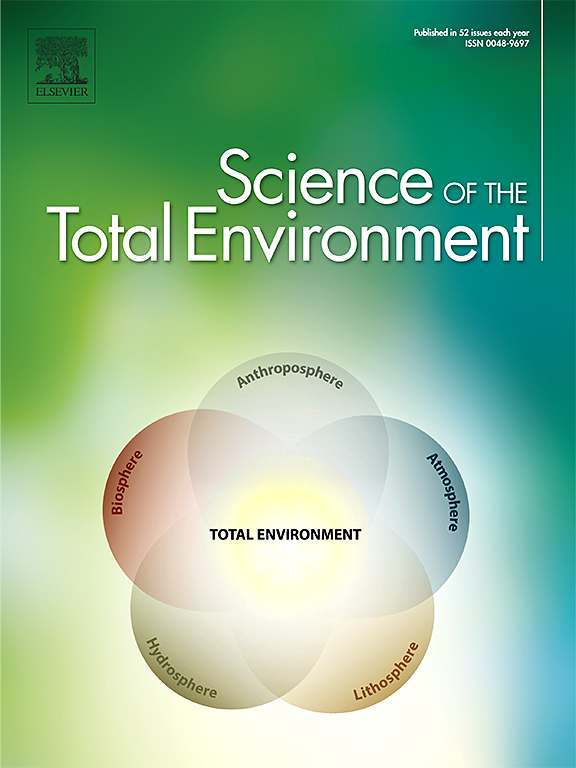
The Science of the Total Environment is an international journal dedicated to scientific research on the environment and its interaction with humanity. It covers a wide range of disciplines and seeks to publish innovative, hypothesis-driven, and impactful research that explores the entire environment, including the atmosphere, lithosphere, hydrosphere, biosphere, and anthroposphere.
The journal's updated Aims & Scope emphasizes the importance of interdisciplinary environmental research with broad impact. Priority is given to studies that advance fundamental understanding and explore the interconnectedness of multiple environmental spheres. Field studies are preferred, while laboratory experiments must demonstrate significant methodological advancements or mechanistic insights with direct relevance to the environment.



 京公网安备 11010802042870号
京ICP备2023020795号-1
京公网安备 11010802042870号
京ICP备2023020795号-1

 分享
分享
 求助内容:
求助内容: 应助结果提醒方式:
 扫码关注我们
