Sofia Lövestam, David Li, Jane L. Wagstaff, Abhay Kotecha, Dari Kimanius, Stephen H. McLaughlin, Alexey G. Murzin, Stefan M. V. Freund, Michel Goedert, Sjors H. W. Scheres
{"title":"Disease-specific tau filaments assemble via polymorphic intermediates","authors":"Sofia Lövestam, David Li, Jane L. Wagstaff, Abhay Kotecha, Dari Kimanius, Stephen H. McLaughlin, Alexey G. Murzin, Stefan M. V. Freund, Michel Goedert, Sjors H. W. Scheres","doi":"10.1038/s41586-023-06788-w","DOIUrl":null,"url":null,"abstract":"Intermediate species in the assembly of amyloid filaments are believed to play a central role in neurodegenerative diseases and may constitute important targets for therapeutic intervention1,2. However, structural information about intermediate species has been scarce and the molecular mechanisms by which amyloids assemble remain largely unknown. Here we use time-resolved cryogenic electron microscopy to study the in vitro assembly of recombinant truncated tau (amino acid residues 297–391) into paired helical filaments of Alzheimer’s disease or into filaments of chronic traumatic encephalopathy3. We report the formation of a shared first intermediate amyloid filament, with an ordered core comprising residues 302–316. Nuclear magnetic resonance indicates that the same residues adopt rigid, β-strand-like conformations in monomeric tau. At later time points, the first intermediate amyloid disappears and we observe many different intermediate amyloid filaments, with structures that depend on the reaction conditions. At the end of both assembly reactions, most intermediate amyloids disappear and filaments with the same ordered cores as those from human brains remain. Our results provide structural insights into the processes of primary and secondary nucleation of amyloid assembly, with implications for the design of new therapies. A time-resolved cryogenic electron microscopy analysis provides structural information on the processes of primary and secondary nucleation of tau amyloid formation, with implications for the development of new therapies.","PeriodicalId":18787,"journal":{"name":"Nature","volume":"625 7993","pages":"119-125"},"PeriodicalIF":48.5000,"publicationDate":"2023-11-29","publicationTypes":"Journal Article","fieldsOfStudy":null,"isOpenAccess":false,"openAccessPdf":"https://www.nature.com/articles/s41586-023-06788-w.pdf","citationCount":"0","resultStr":null,"platform":"Semanticscholar","paperid":null,"PeriodicalName":"Nature","FirstCategoryId":"103","ListUrlMain":"https://www.nature.com/articles/s41586-023-06788-w","RegionNum":1,"RegionCategory":"综合性期刊","ArticlePicture":[],"TitleCN":null,"AbstractTextCN":null,"PMCID":null,"EPubDate":"","PubModel":"","JCR":"Q1","JCRName":"MULTIDISCIPLINARY SCIENCES","Score":null,"Total":0}
引用次数: 0
Abstract
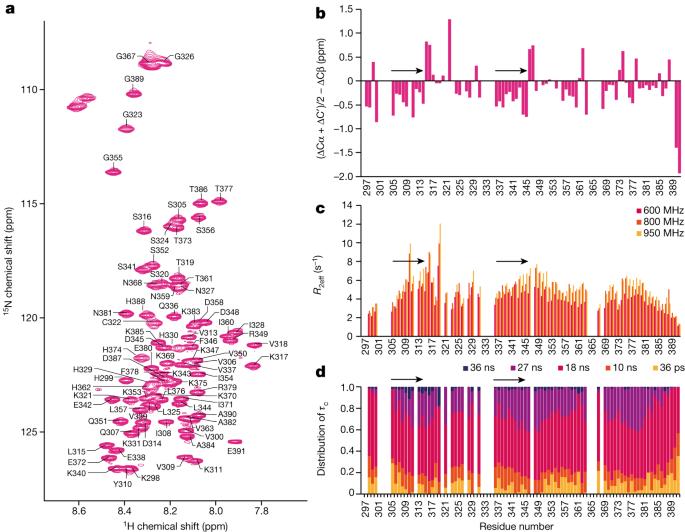
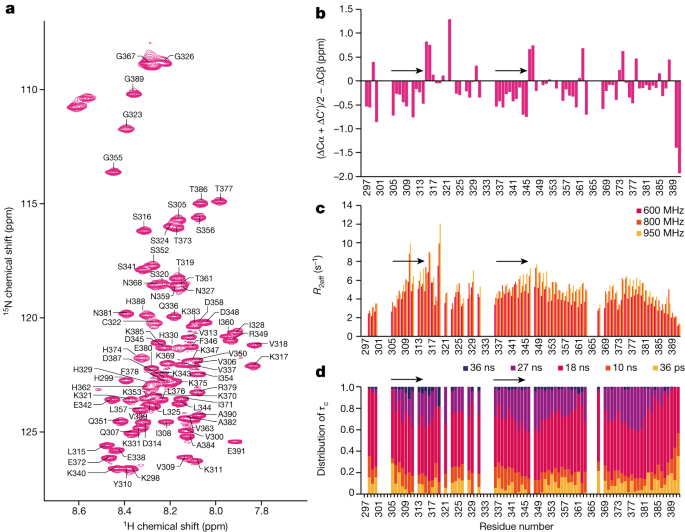
Intermediate species in the assembly of amyloid filaments are believed to play a central role in neurodegenerative diseases and may constitute important targets for therapeutic intervention1,2. However, structural information about intermediate species has been scarce and the molecular mechanisms by which amyloids assemble remain largely unknown. Here we use time-resolved cryogenic electron microscopy to study the in vitro assembly of recombinant truncated tau (amino acid residues 297–391) into paired helical filaments of Alzheimer’s disease or into filaments of chronic traumatic encephalopathy3. We report the formation of a shared first intermediate amyloid filament, with an ordered core comprising residues 302–316. Nuclear magnetic resonance indicates that the same residues adopt rigid, β-strand-like conformations in monomeric tau. At later time points, the first intermediate amyloid disappears and we observe many different intermediate amyloid filaments, with structures that depend on the reaction conditions. At the end of both assembly reactions, most intermediate amyloids disappear and filaments with the same ordered cores as those from human brains remain. Our results provide structural insights into the processes of primary and secondary nucleation of amyloid assembly, with implications for the design of new therapies. A time-resolved cryogenic electron microscopy analysis provides structural information on the processes of primary and secondary nucleation of tau amyloid formation, with implications for the development of new therapies.
期刊介绍:
Nature is a prestigious international journal that publishes peer-reviewed research in various scientific and technological fields. The selection of articles is based on criteria such as originality, importance, interdisciplinary relevance, timeliness, accessibility, elegance, and surprising conclusions. In addition to showcasing significant scientific advances, Nature delivers rapid, authoritative, insightful news, and interpretation of current and upcoming trends impacting science, scientists, and the broader public. The journal serves a dual purpose: firstly, to promptly share noteworthy scientific advances and foster discussions among scientists, and secondly, to ensure the swift dissemination of scientific results globally, emphasizing their significance for knowledge, culture, and daily life.



 京公网安备 11010802042870号
京ICP备2023020795号-1
京公网安备 11010802042870号
京ICP备2023020795号-1

 分享
分享
 求助内容:
求助内容: 应助结果提醒方式:
 扫码关注我们
