Effect of the cross-linking of polyorganosiloxane on highly thermally conductive silicone rubber's mechanical, dielectric, and thermally conductive properties and thermal reliability
Jianping Liu , Zhiming Fang , Jinliang An , Chenlu Bao
{"title":"Effect of the cross-linking of polyorganosiloxane on highly thermally conductive silicone rubber's mechanical, dielectric, and thermally conductive properties and thermal reliability","authors":"Jianping Liu , Zhiming Fang , Jinliang An , Chenlu Bao","doi":"10.1016/j.coco.2023.101781","DOIUrl":null,"url":null,"abstract":"<div><p>With the rapid development of thermal management techniques, there is an urgent need for thermally conductive silicone<span><span> rubber (TCSR) which has high softness, high electrical insulation, high thermal conductivity, and high reliability. Currently, the reliability problem has received little attention in the academic reports. Herein, the effect of the cross-linking of polyorganosiloxane on TCSR's mechanical, </span>dielectric<span>, and thermal properties and thermal reliability has been studied. It is found that the cross-linking has great impacts on the thermal reliability of mechanical and oil bleeding properties, and slight impacts on the thermal reliability of dielectric and thermally conductive properties. When the content of hydrogen-terminated silicone oil<span> is 2–4 phr and the content of hydrogen-side silicone oil is 1.5–1.8 phr, the resultant TCSR has high properties, including high softness (Shore OO hardness 55−68), high compression ratio (20−40 % @ 20 psi), high dielectric strength (5.3−5.7 kV/mm), high thermal conductivity (4.3−4.8 W/mK), and high thermal reliability (less than 10 % variation for most properties after thermal aging). Possible mechanisms have been discussed.</span></span></span></p></div>","PeriodicalId":10533,"journal":{"name":"Composites Communications","volume":"45 ","pages":"Article 101781"},"PeriodicalIF":7.7000,"publicationDate":"2023-11-28","publicationTypes":"Journal Article","fieldsOfStudy":null,"isOpenAccess":false,"openAccessPdf":"","citationCount":"0","resultStr":null,"platform":"Semanticscholar","paperid":null,"PeriodicalName":"Composites Communications","FirstCategoryId":"88","ListUrlMain":"https://www.sciencedirect.com/science/article/pii/S2452213923002899","RegionNum":2,"RegionCategory":"材料科学","ArticlePicture":[],"TitleCN":null,"AbstractTextCN":null,"PMCID":null,"EPubDate":"","PubModel":"","JCR":"Q1","JCRName":"MATERIALS SCIENCE, COMPOSITES","Score":null,"Total":0}
引用次数: 0
Abstract
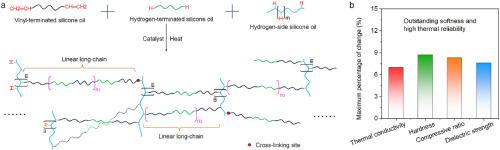
With the rapid development of thermal management techniques, there is an urgent need for thermally conductive silicone rubber (TCSR) which has high softness, high electrical insulation, high thermal conductivity, and high reliability. Currently, the reliability problem has received little attention in the academic reports. Herein, the effect of the cross-linking of polyorganosiloxane on TCSR's mechanical, dielectric, and thermal properties and thermal reliability has been studied. It is found that the cross-linking has great impacts on the thermal reliability of mechanical and oil bleeding properties, and slight impacts on the thermal reliability of dielectric and thermally conductive properties. When the content of hydrogen-terminated silicone oil is 2–4 phr and the content of hydrogen-side silicone oil is 1.5–1.8 phr, the resultant TCSR has high properties, including high softness (Shore OO hardness 55−68), high compression ratio (20−40 % @ 20 psi), high dielectric strength (5.3−5.7 kV/mm), high thermal conductivity (4.3−4.8 W/mK), and high thermal reliability (less than 10 % variation for most properties after thermal aging). Possible mechanisms have been discussed.
期刊介绍:
Composites Communications (Compos. Commun.) is a peer-reviewed journal publishing short communications and letters on the latest advances in composites science and technology. With a rapid review and publication process, its goal is to disseminate new knowledge promptly within the composites community. The journal welcomes manuscripts presenting creative concepts and new findings in design, state-of-the-art approaches in processing, synthesis, characterization, and mechanics modeling. In addition to traditional fiber-/particulate-reinforced engineering composites, it encourages submissions on composites with exceptional physical, mechanical, and fracture properties, as well as those with unique functions and significant application potential. This includes biomimetic and bio-inspired composites for biomedical applications, functional nano-composites for thermal management and energy applications, and composites designed for extreme service environments.



 京公网安备 11010802042870号
京ICP备2023020795号-1
京公网安备 11010802042870号
京ICP备2023020795号-1

 分享
分享
 求助内容:
求助内容: 应助结果提醒方式:
 扫码关注我们
