Somayeh Taghavi , Elena Ghedini , Markus Peurla , Giuseppe Cruciani , Federica Menegazzo , Dmitry Yu. Murzin , Michela Signoretto
{"title":"Activated biochars as sustainable and effective supports for hydrogenations","authors":"Somayeh Taghavi , Elena Ghedini , Markus Peurla , Giuseppe Cruciani , Federica Menegazzo , Dmitry Yu. Murzin , Michela Signoretto","doi":"10.1016/j.cartre.2023.100316","DOIUrl":null,"url":null,"abstract":"<div><p>Activated biochars were obtained from pyrolysis and CO<sub>2</sub>-physical activation of four different biomasses including tannery shaving waste (T), vine wood waste (W), barley waste (B) and Sargassum, brown macroalgae of Venice lagoon (A). The potential of obtained carbonaceous materials as the supports of Ni,Al catalysts was investigated in levulinic acid (LA) conversion to γ-valerolactone (GVL) as a model hydrogenation reaction. Al-containing species as the Lewis acid sites for the dehydration step were incorporated to the supports using wet impregnation or precipitation. Ni as a hydrogenation active phase was added to the supports via wet impregnation. Biochar-based supports and catalysts were characterized by AAS, elemental analysis, FTIR, N<sub>2</sub> physisorption, XRD, SEM, EDS, TEM, He-TPD, NH<sub>3</sub>-TPD and TPR techniques. The catalysts were tested for LA hydrogenation to GVL in a batch system and aqueous medium. The results showed that Ni supported on activated biochar was not active due to a lack of Lewis acid sites for dehydration. Precipitated Al-containing species on the biochar-based supports demonstrated a better catalytic performance in the reaction compared to impregnated one because of different interactions with the support and Ni species. Among different supports, the activated biochars obtained from T and W acted as the best ones. A higher catalytic efficiency was strongly influenced by the chemical (aromaticity and stability, presence of N,O-doped and functional groups), textural (the porous texture and surface area), and morphological (higher dispersion of active phases) properties of activated biochars obtained from different biomasses with different natures.</p></div>","PeriodicalId":52629,"journal":{"name":"Carbon Trends","volume":"13 ","pages":"Article 100316"},"PeriodicalIF":3.9000,"publicationDate":"2023-12-01","publicationTypes":"Journal Article","fieldsOfStudy":null,"isOpenAccess":false,"openAccessPdf":"https://www.sciencedirect.com/science/article/pii/S2667056923000718/pdfft?md5=6247a6c8e07f4bf6be21ed8c0c576a4f&pid=1-s2.0-S2667056923000718-main.pdf","citationCount":"0","resultStr":null,"platform":"Semanticscholar","paperid":null,"PeriodicalName":"Carbon Trends","FirstCategoryId":"1085","ListUrlMain":"https://www.sciencedirect.com/science/article/pii/S2667056923000718","RegionNum":0,"RegionCategory":null,"ArticlePicture":[],"TitleCN":null,"AbstractTextCN":null,"PMCID":null,"EPubDate":"2023/11/26 0:00:00","PubModel":"Epub","JCR":"Q2","JCRName":"MATERIALS SCIENCE, MULTIDISCIPLINARY","Score":null,"Total":0}
引用次数: 0
Abstract
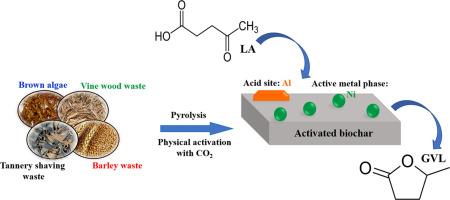
Activated biochars were obtained from pyrolysis and CO2-physical activation of four different biomasses including tannery shaving waste (T), vine wood waste (W), barley waste (B) and Sargassum, brown macroalgae of Venice lagoon (A). The potential of obtained carbonaceous materials as the supports of Ni,Al catalysts was investigated in levulinic acid (LA) conversion to γ-valerolactone (GVL) as a model hydrogenation reaction. Al-containing species as the Lewis acid sites for the dehydration step were incorporated to the supports using wet impregnation or precipitation. Ni as a hydrogenation active phase was added to the supports via wet impregnation. Biochar-based supports and catalysts were characterized by AAS, elemental analysis, FTIR, N2 physisorption, XRD, SEM, EDS, TEM, He-TPD, NH3-TPD and TPR techniques. The catalysts were tested for LA hydrogenation to GVL in a batch system and aqueous medium. The results showed that Ni supported on activated biochar was not active due to a lack of Lewis acid sites for dehydration. Precipitated Al-containing species on the biochar-based supports demonstrated a better catalytic performance in the reaction compared to impregnated one because of different interactions with the support and Ni species. Among different supports, the activated biochars obtained from T and W acted as the best ones. A higher catalytic efficiency was strongly influenced by the chemical (aromaticity and stability, presence of N,O-doped and functional groups), textural (the porous texture and surface area), and morphological (higher dispersion of active phases) properties of activated biochars obtained from different biomasses with different natures.



 京公网安备 11010802042870号
京ICP备2023020795号-1
京公网安备 11010802042870号
京ICP备2023020795号-1

 分享
分享
 求助内容:
求助内容: 应助结果提醒方式:
 扫码关注我们
