Lu Nie, Runhua Gao, Mengtian Zhang, Yanfei Zhu, Xinru Wu, Zhoujie Lao, Guangmin Zhou
{"title":"Integration of Porous High-Loading Electrode and Gel Polymer Electrolyte for High-Performance Quasi-Solid-State Battery","authors":"Lu Nie, Runhua Gao, Mengtian Zhang, Yanfei Zhu, Xinru Wu, Zhoujie Lao, Guangmin Zhou","doi":"10.1002/aenm.202302476","DOIUrl":null,"url":null,"abstract":"<p>The practical applications of lithium-ion batteries (LIBs) are challenged by safety concerns using liquid electrolytes (LEs). The gel polymer electrolytes (GPEs) are considered as a promising candidate to solve this safety issue. In addition, using high-mass loading electrodes is essential to achieve high energy density. However, poor interfacial contact between electrode and electrolyte remains a challenging issue, particularly for the high-mass-loading electrode. Here, porous channels are constructed in electrodes with high active material loading using the melamine formaldehyde sponge, and then the GPE is penetrated into porous channels of electrodes through an in-situ thermal induced polymerization. The porous electrode structure with sufficient surface area improves electrolyte percolation and fast ion diffusion kinetics, which enables a uniform distribution of Li-ion flux and effectively homogenizes the local current density to realize uniform Li deposition. The half cells and anode-free full cells using the integration of porous electrodes and in-situ polymerized GPEs exhibit excellent discharge capacity and cycle stability. This integration method is applicable for fabricating batteries with high energy density and safety.</p>","PeriodicalId":111,"journal":{"name":"Advanced Energy Materials","volume":"14 4","pages":""},"PeriodicalIF":26.0000,"publicationDate":"2023-12-03","publicationTypes":"Journal Article","fieldsOfStudy":null,"isOpenAccess":false,"openAccessPdf":"","citationCount":"0","resultStr":null,"platform":"Semanticscholar","paperid":null,"PeriodicalName":"Advanced Energy Materials","FirstCategoryId":"88","ListUrlMain":"https://advanced.onlinelibrary.wiley.com/doi/10.1002/aenm.202302476","RegionNum":1,"RegionCategory":"材料科学","ArticlePicture":[],"TitleCN":null,"AbstractTextCN":null,"PMCID":null,"EPubDate":"","PubModel":"","JCR":"Q1","JCRName":"CHEMISTRY, PHYSICAL","Score":null,"Total":0}
引用次数: 0
Abstract
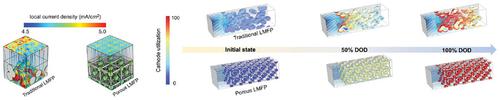
The practical applications of lithium-ion batteries (LIBs) are challenged by safety concerns using liquid electrolytes (LEs). The gel polymer electrolytes (GPEs) are considered as a promising candidate to solve this safety issue. In addition, using high-mass loading electrodes is essential to achieve high energy density. However, poor interfacial contact between electrode and electrolyte remains a challenging issue, particularly for the high-mass-loading electrode. Here, porous channels are constructed in electrodes with high active material loading using the melamine formaldehyde sponge, and then the GPE is penetrated into porous channels of electrodes through an in-situ thermal induced polymerization. The porous electrode structure with sufficient surface area improves electrolyte percolation and fast ion diffusion kinetics, which enables a uniform distribution of Li-ion flux and effectively homogenizes the local current density to realize uniform Li deposition. The half cells and anode-free full cells using the integration of porous electrodes and in-situ polymerized GPEs exhibit excellent discharge capacity and cycle stability. This integration method is applicable for fabricating batteries with high energy density and safety.
期刊介绍:
Established in 2011, Advanced Energy Materials is an international, interdisciplinary, English-language journal that focuses on materials used in energy harvesting, conversion, and storage. It is regarded as a top-quality journal alongside Advanced Materials, Advanced Functional Materials, and Small.
With a 2022 Impact Factor of 27.8, Advanced Energy Materials is considered a prime source for the best energy-related research. The journal covers a wide range of topics in energy-related research, including organic and inorganic photovoltaics, batteries and supercapacitors, fuel cells, hydrogen generation and storage, thermoelectrics, water splitting and photocatalysis, solar fuels and thermosolar power, magnetocalorics, and piezoelectronics.
The readership of Advanced Energy Materials includes materials scientists, chemists, physicists, and engineers in both academia and industry. The journal is indexed in various databases and collections, such as Advanced Technologies & Aerospace Database, FIZ Karlsruhe, INSPEC (IET), Science Citation Index Expanded, Technology Collection, and Web of Science, among others.



 京公网安备 11010802042870号
京ICP备2023020795号-1
京公网安备 11010802042870号
京ICP备2023020795号-1

 分享
分享
 求助内容:
求助内容: 应助结果提醒方式:
 扫码关注我们
