Carlos M. Baez-Cotto , Jason R. Pfeilsticker , Haoran Yu , Tim Van Cleve , Bertrand Tremolet de Villers , C. Firat Cetinbas , Nancy N. Kariuki , Jae Hyung Park , James Young , Deborah J. Myers , David A. Cullen , K.C. Neyerlin , Michael Ulsh , Scott Mauger
{"title":"Impact of polymer additives on crack mitigation of rod-coated fuel cell cathode catalyst layers","authors":"Carlos M. Baez-Cotto , Jason R. Pfeilsticker , Haoran Yu , Tim Van Cleve , Bertrand Tremolet de Villers , C. Firat Cetinbas , Nancy N. Kariuki , Jae Hyung Park , James Young , Deborah J. Myers , David A. Cullen , K.C. Neyerlin , Michael Ulsh , Scott Mauger","doi":"10.1016/j.jpowsour.2023.233852","DOIUrl":null,"url":null,"abstract":"<div><p><span>Cracks in catalyst layers<span> (CLs) are a potential source of long-term failure in a fuel cell membrane electrode assembly (MEA). While modifications to the CL ink formulation can affect the degree of cracking, these changes may lead to lower initial performance than their cracked analogues due to the established link between formulation and performance. In this work, we explored the use of polymeric additives to mitigate CL cracks. Small quantities of poly (acrylic acid), poly (ethylene oxide), poly (methyl methacrylate), or poly (vinyl alcohol) – 5 wt% relative to </span></span>ionomer<span><span> mass – were added to the ink prior to its final mixing. Poly (vinyl alcohol) resulted in crack–free CLs, whereas the other polymers resulted in CLs with similar crack percentages as the control CL. Through a combination of transmission electron microscopy<span>, X-ray computed tomography, and infrared spectroscopy<span>, we ascribed the crack–mitigating mechanism of poly (vinyl alcohol) to its ability to hydrogen–bond with Nafion, the ion conducting </span></span></span>polymer binder in the catalyst ink. Initial performance of this non–cracked electrode exhibited nearly identical electrochemical behavior to its cracked counterpart, demonstrating that PVA additives successfully reduce cracks while maintaining cell initial performance.</span></p></div>","PeriodicalId":377,"journal":{"name":"Journal of Power Sources","volume":"592 ","pages":"Article 233852"},"PeriodicalIF":7.9000,"publicationDate":"2023-12-05","publicationTypes":"Journal Article","fieldsOfStudy":null,"isOpenAccess":false,"openAccessPdf":"","citationCount":"0","resultStr":null,"platform":"Semanticscholar","paperid":null,"PeriodicalName":"Journal of Power Sources","FirstCategoryId":"5","ListUrlMain":"https://www.sciencedirect.com/science/article/pii/S0378775323012284","RegionNum":2,"RegionCategory":"工程技术","ArticlePicture":[],"TitleCN":null,"AbstractTextCN":null,"PMCID":null,"EPubDate":"","PubModel":"","JCR":"Q1","JCRName":"CHEMISTRY, PHYSICAL","Score":null,"Total":0}
引用次数: 0
Abstract
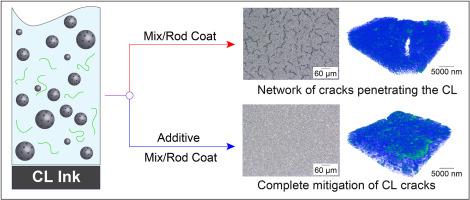
Cracks in catalyst layers (CLs) are a potential source of long-term failure in a fuel cell membrane electrode assembly (MEA). While modifications to the CL ink formulation can affect the degree of cracking, these changes may lead to lower initial performance than their cracked analogues due to the established link between formulation and performance. In this work, we explored the use of polymeric additives to mitigate CL cracks. Small quantities of poly (acrylic acid), poly (ethylene oxide), poly (methyl methacrylate), or poly (vinyl alcohol) – 5 wt% relative to ionomer mass – were added to the ink prior to its final mixing. Poly (vinyl alcohol) resulted in crack–free CLs, whereas the other polymers resulted in CLs with similar crack percentages as the control CL. Through a combination of transmission electron microscopy, X-ray computed tomography, and infrared spectroscopy, we ascribed the crack–mitigating mechanism of poly (vinyl alcohol) to its ability to hydrogen–bond with Nafion, the ion conducting polymer binder in the catalyst ink. Initial performance of this non–cracked electrode exhibited nearly identical electrochemical behavior to its cracked counterpart, demonstrating that PVA additives successfully reduce cracks while maintaining cell initial performance.
期刊介绍:
The Journal of Power Sources is a publication catering to researchers and technologists interested in various aspects of the science, technology, and applications of electrochemical power sources. It covers original research and reviews on primary and secondary batteries, fuel cells, supercapacitors, and photo-electrochemical cells.
Topics considered include the research, development and applications of nanomaterials and novel componentry for these devices. Examples of applications of these electrochemical power sources include:
• Portable electronics
• Electric and Hybrid Electric Vehicles
• Uninterruptible Power Supply (UPS) systems
• Storage of renewable energy
• Satellites and deep space probes
• Boats and ships, drones and aircrafts
• Wearable energy storage systems



 京公网安备 11010802042870号
京ICP备2023020795号-1
京公网安备 11010802042870号
京ICP备2023020795号-1

 分享
分享
 求助内容:
求助内容: 应助结果提醒方式:
 扫码关注我们
