V. O. Samoilov, T. I. Stolonogova, D. N. Ramazanov, E. V. Tyurina, M. U. Sultanova, V. A. Lavrent’ev, S. S. Krasnoshtanova, E. A. Chernysheva, V. M. Kapustin
{"title":"tert-Butyl Ethers of Renewable Diols as Oxygenate Additives to Automobile Gasolines. Part II: Ethers of Ethylene Glycol and 2,3-Butanediol","authors":"V. O. Samoilov, T. I. Stolonogova, D. N. Ramazanov, E. V. Tyurina, M. U. Sultanova, V. A. Lavrent’ev, S. S. Krasnoshtanova, E. A. Chernysheva, V. M. Kapustin","doi":"10.1134/S0965544123060154","DOIUrl":null,"url":null,"abstract":"<p>The results obtained in the second part of the study of vicinal (<i>tert-</i>butoxy)alkanols as additives to automobile gasolines are presented. Mono-<i>tert-</i>butyl ethers of ethylene glycol (ETBE) and 2,3-butanediol (BTBE) were prepared by direct acid-catalyzed alkylation of the corresponding diols with <i>tert-</i>butanol. The substances obtained were characterized by main physical properties (density, viscosity, boiling point, crystallization point, specific heat of combustion) and were studied as additives to automobile gasolines. The effect of ether additives on the main physicochemical properties of gasolines (fractional composition, saturated vapor pressure, concentration of actual resins, knock resistance), including ethanol-containing gasolines, was studied. The mean research/motor blending octane numbers for ETBE and BTBE were 130/103 and 115/97, respectively. Inclusion of ETBE/BTBE into the formulations of ethanol-containing gasolines allowed the cloud point to be considerably reduced without unambiguous synergistic effect on the knock resistance.</p>","PeriodicalId":725,"journal":{"name":"Petroleum Chemistry","volume":"63 8","pages":"949 - 958"},"PeriodicalIF":1.1000,"publicationDate":"2023-12-07","publicationTypes":"Journal Article","fieldsOfStudy":null,"isOpenAccess":false,"openAccessPdf":"https://link.springer.com/content/pdf/10.1134/S0965544123060154.pdf","citationCount":"0","resultStr":null,"platform":"Semanticscholar","paperid":null,"PeriodicalName":"Petroleum Chemistry","FirstCategoryId":"5","ListUrlMain":"https://link.springer.com/article/10.1134/S0965544123060154","RegionNum":4,"RegionCategory":"工程技术","ArticlePicture":[],"TitleCN":null,"AbstractTextCN":null,"PMCID":null,"EPubDate":"","PubModel":"","JCR":"Q3","JCRName":"CHEMISTRY, ORGANIC","Score":null,"Total":0}
引用次数: 0
Abstract
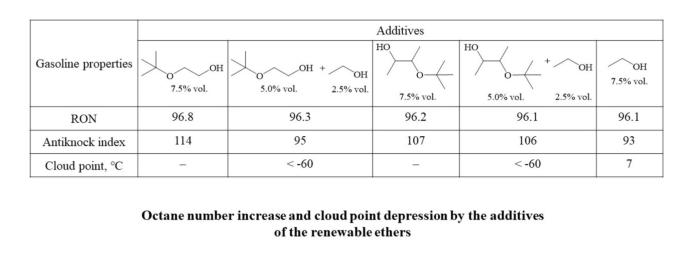
The results obtained in the second part of the study of vicinal (tert-butoxy)alkanols as additives to automobile gasolines are presented. Mono-tert-butyl ethers of ethylene glycol (ETBE) and 2,3-butanediol (BTBE) were prepared by direct acid-catalyzed alkylation of the corresponding diols with tert-butanol. The substances obtained were characterized by main physical properties (density, viscosity, boiling point, crystallization point, specific heat of combustion) and were studied as additives to automobile gasolines. The effect of ether additives on the main physicochemical properties of gasolines (fractional composition, saturated vapor pressure, concentration of actual resins, knock resistance), including ethanol-containing gasolines, was studied. The mean research/motor blending octane numbers for ETBE and BTBE were 130/103 and 115/97, respectively. Inclusion of ETBE/BTBE into the formulations of ethanol-containing gasolines allowed the cloud point to be considerably reduced without unambiguous synergistic effect on the knock resistance.
期刊介绍:
Petroleum Chemistry (Neftekhimiya), founded in 1961, offers original papers on and reviews of theoretical and experimental studies concerned with current problems of petroleum chemistry and processing such as chemical composition of crude oils and natural gas liquids; petroleum refining (cracking, hydrocracking, and catalytic reforming); catalysts for petrochemical processes (hydrogenation, isomerization, oxidation, hydroformylation, etc.); activation and catalytic transformation of hydrocarbons and other components of petroleum, natural gas, and other complex organic mixtures; new petrochemicals including lubricants and additives; environmental problems; and information on scientific meetings relevant to these areas.
Petroleum Chemistry publishes articles on these topics from members of the scientific community of the former Soviet Union.



 京公网安备 11010802042870号
京ICP备2023020795号-1
京公网安备 11010802042870号
京ICP备2023020795号-1

 分享
分享
 求助内容:
求助内容: 应助结果提醒方式:
 扫码关注我们
