{"title":"Divorce is linked with extra-pair paternity in a monogamous passerine","authors":"Jamie Dunning, Terry Burke, Julia Schroeder","doi":"10.1111/jav.03171","DOIUrl":null,"url":null,"abstract":"<p>The question of why socially monogamous females engage in extra-pair behaviour is long-standing in evolutionary biology. Due to a lack of empirical support among passerine birds, recent work has moved away from the indirect-benefits hypothesis to explain extra-pair mating behaviour by females, instead favouring the hypothesis that this is the result of a pleiotropic effect. That is, a trait under strong positive selection in either or both sexes are genetically linked with another, potentially unrelated, trait. For example, genes beneficial to female fecundity (that promote within-pair solicitation of mating from a male partner) might also lead to extra-pair behaviour (by also promoting solicited copulations from extra-pair males). Here, we test two predictions from this hypothesis: We test the prediction that female divorce, measured as the number of social mates within a given year, is linked with 1) the number of extra-pair males engaged by the female and 2) the proportion of the female's offspring that are extra-pair. Our results show that females who divorce their social partner are more likely to produce extra-pair offspring than those who maintain social monogamy, supporting the pleiotropy hypothesis. However, those females did not also have a higher proportion of extra-pair offspring. The number of broods initiated was also positively correlated with the number of extra-pair males that sired a female's offspring, probably through increased opportunity for extra-pair males to sire offspring over a longer breeding season. Our results support the intrasexual pleiotropy hypothesis as a driver of female extra-pair behaviour.</p>","PeriodicalId":15278,"journal":{"name":"Journal of Avian Biology","volume":"2024 3-4","pages":""},"PeriodicalIF":1.8000,"publicationDate":"2023-11-17","publicationTypes":"Journal Article","fieldsOfStudy":null,"isOpenAccess":false,"openAccessPdf":"https://onlinelibrary.wiley.com/doi/epdf/10.1111/jav.03171","citationCount":"0","resultStr":null,"platform":"Semanticscholar","paperid":null,"PeriodicalName":"Journal of Avian Biology","FirstCategoryId":"99","ListUrlMain":"https://nsojournals.onlinelibrary.wiley.com/doi/10.1111/jav.03171","RegionNum":3,"RegionCategory":"生物学","ArticlePicture":[],"TitleCN":null,"AbstractTextCN":null,"PMCID":null,"EPubDate":"","PubModel":"","JCR":"Q1","JCRName":"ORNITHOLOGY","Score":null,"Total":0}
引用次数: 0
Abstract
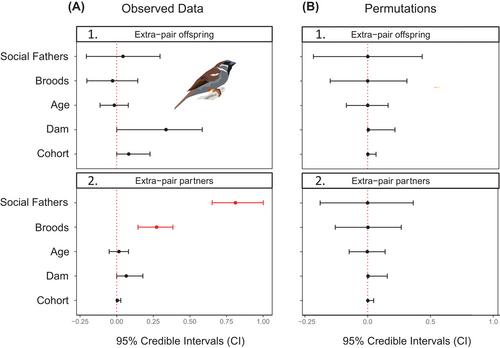
The question of why socially monogamous females engage in extra-pair behaviour is long-standing in evolutionary biology. Due to a lack of empirical support among passerine birds, recent work has moved away from the indirect-benefits hypothesis to explain extra-pair mating behaviour by females, instead favouring the hypothesis that this is the result of a pleiotropic effect. That is, a trait under strong positive selection in either or both sexes are genetically linked with another, potentially unrelated, trait. For example, genes beneficial to female fecundity (that promote within-pair solicitation of mating from a male partner) might also lead to extra-pair behaviour (by also promoting solicited copulations from extra-pair males). Here, we test two predictions from this hypothesis: We test the prediction that female divorce, measured as the number of social mates within a given year, is linked with 1) the number of extra-pair males engaged by the female and 2) the proportion of the female's offspring that are extra-pair. Our results show that females who divorce their social partner are more likely to produce extra-pair offspring than those who maintain social monogamy, supporting the pleiotropy hypothesis. However, those females did not also have a higher proportion of extra-pair offspring. The number of broods initiated was also positively correlated with the number of extra-pair males that sired a female's offspring, probably through increased opportunity for extra-pair males to sire offspring over a longer breeding season. Our results support the intrasexual pleiotropy hypothesis as a driver of female extra-pair behaviour.
期刊介绍:
Journal of Avian Biology publishes empirical and theoretical research in all areas of ornithology, with an emphasis on behavioural ecology, evolution and conservation.




 京公网安备 11010802042870号
京ICP备2023020795号-1
京公网安备 11010802042870号
京ICP备2023020795号-1

 分享
分享
 求助内容:
求助内容: 应助结果提醒方式:
 扫码关注我们
