Lan-Tian Zhang , Ying-Ying Liu , Sha Chen , Han-Bing Li , Su-Mei Li , Ke-Jun Jiang , Ji Gao
{"title":"Quantitative evaluation framework and application for regional water sustainability under local energy transition","authors":"Lan-Tian Zhang , Ying-Ying Liu , Sha Chen , Han-Bing Li , Su-Mei Li , Ke-Jun Jiang , Ji Gao","doi":"10.1016/j.accre.2023.11.005","DOIUrl":null,"url":null,"abstract":"<div><div>Quantitatively analysing the impacts on regional water sustainability under the energy transition is vital to regional water management and specific technology selection, which is also relevant to dealing with climate change. This study proposed a new multi-indicator evaluation framework for regional water sustainability under local energy transition to quantitatively evaluate the water withdrawal and water environment during the energy transition from a lifecycle perspective. An integrated regional energy‒water evaluation model was also developed based on the Low Emissions Analysis Platform with a combination of lifecycle assessment and water footprint analysis. Shaanxi province in China was then taken as a case study, and the impacts of its energy transition on regional water environmental sustainability, including quantity and quality, were investigated under five scenarios. Results showed that the large-scale application of carbon capture, utilisation and storage technology and bio-energy equipped with carbon capture and storage technology could have additional advantages regarding CO<sub>2</sub> emissions. However, such technologies exhibit a minimal effect on improving water environmental quality and reducing water demand for the first time due to the leakage of absorbents, CO<sub>2</sub> and other risky substances during capture, transportation and storage from a lifecycle perspective. This finding drives the innovation of related breakthrough technologies with the promotion of water and end-treatment technologies in the future.</div></div>","PeriodicalId":48628,"journal":{"name":"Advances in Climate Change Research","volume":"14 6","pages":"Pages 976-987"},"PeriodicalIF":5.2000,"publicationDate":"2023-12-01","publicationTypes":"Journal Article","fieldsOfStudy":null,"isOpenAccess":false,"openAccessPdf":"","citationCount":"0","resultStr":null,"platform":"Semanticscholar","paperid":null,"PeriodicalName":"Advances in Climate Change Research","FirstCategoryId":"89","ListUrlMain":"https://www.sciencedirect.com/science/article/pii/S1674927823001429","RegionNum":1,"RegionCategory":"地球科学","ArticlePicture":[],"TitleCN":null,"AbstractTextCN":null,"PMCID":null,"EPubDate":"","PubModel":"","JCR":"Q1","JCRName":"ENVIRONMENTAL SCIENCES","Score":null,"Total":0}
引用次数: 0
Abstract
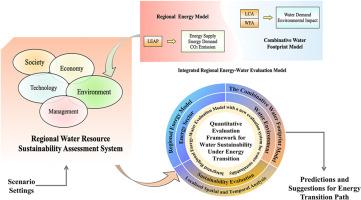
Quantitatively analysing the impacts on regional water sustainability under the energy transition is vital to regional water management and specific technology selection, which is also relevant to dealing with climate change. This study proposed a new multi-indicator evaluation framework for regional water sustainability under local energy transition to quantitatively evaluate the water withdrawal and water environment during the energy transition from a lifecycle perspective. An integrated regional energy‒water evaluation model was also developed based on the Low Emissions Analysis Platform with a combination of lifecycle assessment and water footprint analysis. Shaanxi province in China was then taken as a case study, and the impacts of its energy transition on regional water environmental sustainability, including quantity and quality, were investigated under five scenarios. Results showed that the large-scale application of carbon capture, utilisation and storage technology and bio-energy equipped with carbon capture and storage technology could have additional advantages regarding CO2 emissions. However, such technologies exhibit a minimal effect on improving water environmental quality and reducing water demand for the first time due to the leakage of absorbents, CO2 and other risky substances during capture, transportation and storage from a lifecycle perspective. This finding drives the innovation of related breakthrough technologies with the promotion of water and end-treatment technologies in the future.
期刊介绍:
Advances in Climate Change Research publishes scientific research and analyses on climate change and the interactions of climate change with society. This journal encompasses basic science and economic, social, and policy research, including studies on mitigation and adaptation to climate change.
Advances in Climate Change Research attempts to promote research in climate change and provide an impetus for the application of research achievements in numerous aspects, such as socioeconomic sustainable development, responses to the adaptation and mitigation of climate change, diplomatic negotiations of climate and environment policies, and the protection and exploitation of natural resources.



 京公网安备 11010802042870号
京ICP备2023020795号-1
京公网安备 11010802042870号
京ICP备2023020795号-1

 分享
分享
 求助内容:
求助内容: 应助结果提醒方式:
 扫码关注我们
