Jin-Lei Chen , Shi-Chang Kang , A-Dan Wu , Di-Di Hu
{"title":"Impacts of 1.5 °C global warming on hydrological conditions of navigation along the Northern Sea Route and Northwest Passage","authors":"Jin-Lei Chen , Shi-Chang Kang , A-Dan Wu , Di-Di Hu","doi":"10.1016/j.accre.2023.11.010","DOIUrl":null,"url":null,"abstract":"<div><div>Arctic navigability is crucial to the global economy and landscape, while there is an omission in understanding how Arctic navigability changes as a function of 1.5 °C of the Paris Agreement. This study investigated the impact of 1.5 °C global warming above the preindustrial level on sea ice conditions and accessibility of the Northern Sea Route (NSR) and Northwest Passage (NWP) with the Polar Operational Limit Assessment Risk Indexing System and new risk demarcation criteria. The Arctic is colder on the Canadian side than on the European side under 1.5 °C warming. Sea ice is mostly less than three years old, and the younger, thinner and less concentrated ice is mainly in the seas along the NSR. Ships above Polar Class (PC) 6 might be unimpeded along two passages all the year. Besides, the NSR and NWP have great potential for PC6 ships in October–December, while it is only the NSR for PC7 ships. Caution is still required when navigating the western East Siberian Sea, its surrounding straits, and the Parry Channel. These changes in hydrological conditions are important for global shipping, and this work is helpful for supporting coordinated international decision-making.</div></div>","PeriodicalId":48628,"journal":{"name":"Advances in Climate Change Research","volume":"14 6","pages":"Pages 904-912"},"PeriodicalIF":5.2000,"publicationDate":"2023-12-01","publicationTypes":"Journal Article","fieldsOfStudy":null,"isOpenAccess":false,"openAccessPdf":"","citationCount":"0","resultStr":null,"platform":"Semanticscholar","paperid":null,"PeriodicalName":"Advances in Climate Change Research","FirstCategoryId":"89","ListUrlMain":"https://www.sciencedirect.com/science/article/pii/S1674927823001478","RegionNum":1,"RegionCategory":"地球科学","ArticlePicture":[],"TitleCN":null,"AbstractTextCN":null,"PMCID":null,"EPubDate":"","PubModel":"","JCR":"Q1","JCRName":"ENVIRONMENTAL SCIENCES","Score":null,"Total":0}
引用次数: 0
Abstract
Arctic navigability is crucial to the global economy and landscape, while there is an omission in understanding how Arctic navigability changes as a function of 1.5 °C of the Paris Agreement. This study investigated the impact of 1.5 °C global warming above the preindustrial level on sea ice conditions and accessibility of the Northern Sea Route (NSR) and Northwest Passage (NWP) with the Polar Operational Limit Assessment Risk Indexing System and new risk demarcation criteria. The Arctic is colder on the Canadian side than on the European side under 1.5 °C warming. Sea ice is mostly less than three years old, and the younger, thinner and less concentrated ice is mainly in the seas along the NSR. Ships above Polar Class (PC) 6 might be unimpeded along two passages all the year. Besides, the NSR and NWP have great potential for PC6 ships in October–December, while it is only the NSR for PC7 ships. Caution is still required when navigating the western East Siberian Sea, its surrounding straits, and the Parry Channel. These changes in hydrological conditions are important for global shipping, and this work is helpful for supporting coordinated international decision-making.
期刊介绍:
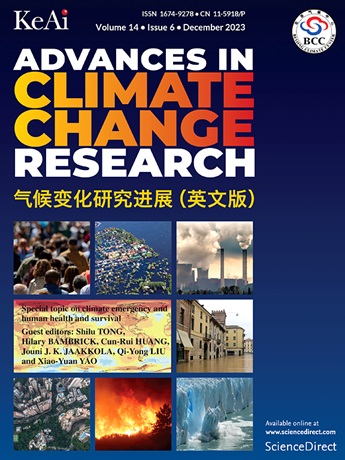
Advances in Climate Change Research publishes scientific research and analyses on climate change and the interactions of climate change with society. This journal encompasses basic science and economic, social, and policy research, including studies on mitigation and adaptation to climate change.
Advances in Climate Change Research attempts to promote research in climate change and provide an impetus for the application of research achievements in numerous aspects, such as socioeconomic sustainable development, responses to the adaptation and mitigation of climate change, diplomatic negotiations of climate and environment policies, and the protection and exploitation of natural resources.



 京公网安备 11010802042870号
京ICP备2023020795号-1
京公网安备 11010802042870号
京ICP备2023020795号-1

 分享
分享
 求助内容:
求助内容: 应助结果提醒方式:
 扫码关注我们
