Anthony Kisanga, Kathy Vassos Stamidis, Samuel Rumbe, Doris Lamunu, Adil Ben, Gena Ruocco Thomas, Jean Berchmans
{"title":"Leveraging the CORE Group Partners Project Polio Infrastructure to Integrate COVID-19 Vaccination and Routine Immunization in South Sudan.","authors":"Anthony Kisanga, Kathy Vassos Stamidis, Samuel Rumbe, Doris Lamunu, Adil Ben, Gena Ruocco Thomas, Jean Berchmans","doi":"10.9745/GHSP-D-23-00178","DOIUrl":null,"url":null,"abstract":"<p><strong>Introduction: </strong>Countries with fragile health systems like South Sudan experienced significant impacts on routine immunization during the COVID-19 pandemic. Routine immunization in children aged younger than 1 year declined due to pandemic-related constraints and was compounded by the introduction of the COVID-19 vaccine, which was met with hesitancy and reluctance. When South Sudan reported the first COVID-19 case in March 2020, the CORE Group Partners Project (CGPP) rapidly integrated the COVID-19 outbreak response into its ongoing polio eradication activities, leveraging the existing polio infrastructure and human resources. We describe the integration process, results, and challenges and detail the impact of the integration on coverage for both routine immunization and COVID-19 vaccinations.</p><p><strong>Methods: </strong>Efforts to integrate COVID-19 vaccination and routine immunization service delivery were implemented in 5 phases: assessing the need, developing multisector collaborations, developing a service delivery plan, assessing implementation readiness, and implementing and evaluating the service delivery plan. Integration efforts prioritized coordination, training vaccinators and volunteers, development of microplans, data management, and last-mile vaccine delivery. Integrated service delivery was implemented through \"one-stop shop\" sessions where communities accessed routine immunizations for children, COVID-19 vaccinations for adults, and other primary health services.</p><p><strong>Results: </strong>Integrating health service delivery contributed to improved routine immunization coverage among children, improved COVID-19 vaccination coverage among adults, reduced cost for service delivery, and increased access to more comprehensive health services in hard-to-reach communities. COVID-19 vaccinations were delivered at US$4.70 per dose, a cost substantially lower than other reported delivery mechanisms.</p><p><strong>Conclusion: </strong>Integration can yield positive results and improve access to vaccination and other health services for communities. However, it requires clear policy guidelines, commitment, and strong collaboration. Challenges included resistance from stakeholders, overstretched human resources, and diversion of funding and attention from program areas, which were overcome through deliberate high-level advocacy, partnership, and intensified community engagement.</p>","PeriodicalId":12692,"journal":{"name":"Global Health: Science and Practice","volume":" ","pages":""},"PeriodicalIF":2.5000,"publicationDate":"2024-02-20","publicationTypes":"Journal Article","fieldsOfStudy":null,"isOpenAccess":false,"openAccessPdf":"https://www.ncbi.nlm.nih.gov/pmc/articles/PMC10948123/pdf/","citationCount":"0","resultStr":null,"platform":"Semanticscholar","paperid":null,"PeriodicalName":"Global Health: Science and Practice","FirstCategoryId":"3","ListUrlMain":"https://doi.org/10.9745/GHSP-D-23-00178","RegionNum":3,"RegionCategory":"医学","ArticlePicture":[],"TitleCN":null,"AbstractTextCN":null,"PMCID":null,"EPubDate":"","PubModel":"","JCR":"Q2","JCRName":"PUBLIC, ENVIRONMENTAL & OCCUPATIONAL HEALTH","Score":null,"Total":0}
引用次数: 0
Abstract
Introduction: Countries with fragile health systems like South Sudan experienced significant impacts on routine immunization during the COVID-19 pandemic. Routine immunization in children aged younger than 1 year declined due to pandemic-related constraints and was compounded by the introduction of the COVID-19 vaccine, which was met with hesitancy and reluctance. When South Sudan reported the first COVID-19 case in March 2020, the CORE Group Partners Project (CGPP) rapidly integrated the COVID-19 outbreak response into its ongoing polio eradication activities, leveraging the existing polio infrastructure and human resources. We describe the integration process, results, and challenges and detail the impact of the integration on coverage for both routine immunization and COVID-19 vaccinations.
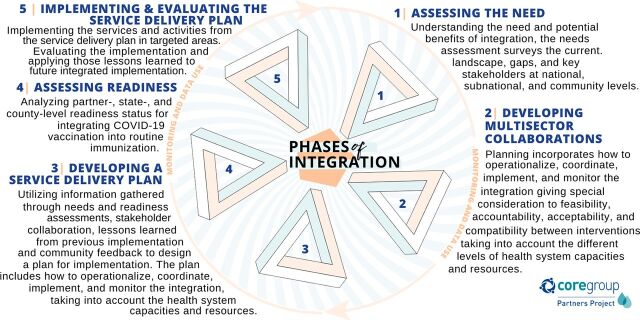
Methods: Efforts to integrate COVID-19 vaccination and routine immunization service delivery were implemented in 5 phases: assessing the need, developing multisector collaborations, developing a service delivery plan, assessing implementation readiness, and implementing and evaluating the service delivery plan. Integration efforts prioritized coordination, training vaccinators and volunteers, development of microplans, data management, and last-mile vaccine delivery. Integrated service delivery was implemented through "one-stop shop" sessions where communities accessed routine immunizations for children, COVID-19 vaccinations for adults, and other primary health services.
Results: Integrating health service delivery contributed to improved routine immunization coverage among children, improved COVID-19 vaccination coverage among adults, reduced cost for service delivery, and increased access to more comprehensive health services in hard-to-reach communities. COVID-19 vaccinations were delivered at US$4.70 per dose, a cost substantially lower than other reported delivery mechanisms.
Conclusion: Integration can yield positive results and improve access to vaccination and other health services for communities. However, it requires clear policy guidelines, commitment, and strong collaboration. Challenges included resistance from stakeholders, overstretched human resources, and diversion of funding and attention from program areas, which were overcome through deliberate high-level advocacy, partnership, and intensified community engagement.
期刊介绍:
Global Health: Science and Practice (GHSP) is a no-fee, open-access, peer-reviewed, online journal aimed to improve health practice, especially in low- and middle-income countries. Our goal is to reach those who design, implement, manage, evaluate, and otherwise support health programs. We are especially interested in advancing knowledge on practical program implementation issues, with information on what programs entail and how they are implemented. GHSP is currently indexed in PubMed, PubMed Central, POPLINE, EBSCO, SCOPUS,. the Web of Science Emerging Sources Citation Index, and the USAID Development Experience Clearinghouse (DEC).
TOPICS:
Issued four times a year, GHSP will include articles on all global health topics, covering diverse programming models and a wide range of cross-cutting issues that impact and support health systems. Examples include but are not limited to:
Health:
Addiction and harm reduction,
Child Health,
Communicable and Emerging Diseases,
Disaster Preparedness and Response,
Environmental Health,
Family Planning/Reproductive Health,
HIV/AIDS,
Malaria,
Maternal Health,
Neglected Tropical Diseases,
Non-Communicable Diseases/Injuries,
Nutrition,
Tuberculosis,
Water and Sanitation.
Cross-Cutting Issues:
Epidemiology,
Gender,
Health Communication/Healthy Behavior,
Health Policy and Advocacy,
Health Systems,
Human Resources/Training,
Knowledge Management,
Logistics and Supply Chain Management,
Management and Governance,
mHealth/eHealth/digital health,
Monitoring and Evaluation,
Scale Up,
Youth.





 京公网安备 11010802042870号
京ICP备2023020795号-1
京公网安备 11010802042870号
京ICP备2023020795号-1

 分享
分享
 求助内容:
求助内容: 应助结果提醒方式:
 扫码关注我们
