{"title":"Investigation of Corrosion Behavior of Stir-Cast Hybrid Aluminum Composite Reinforced with CeO2 and GNPs Nanoparticles","authors":"Dinesh Kumar, Surjit Angra, Satnam Singh","doi":"10.1134/S2070205123701186","DOIUrl":null,"url":null,"abstract":"<p>This study investigates the corrosion behavior of stir-cast hybrid aluminum composite reinforced with CeO<sub>2</sub> and graphene nanoplatelets (GNPs) nanoparticles used as cylinder liner material in the engines (Automotive, aerospace, and aircraft industries). The composites were prepared using the stir-casting technique, and their microstructure and corrosion behavior was evaluated using scanning electron microscopy (SEM) and Potentiodynamic polarization test, respectively. The results showed that the addition of CeO<sub>2</sub> and GNPs improved the corrosion resistance of the composites, and the optimal combination of these two nanoparticles was found to be 3 wt % CeO<sub>2</sub> and 3 wt % GNPs. The enhanced corrosion resistance was attributed to the formation of a protective layer on the surface of the composite, as well as the effective dispersion and uniform distribution of nanoparticles in the matrix. The 0.031362 was noted as the lowest corrosion rate (mmpy) was noticed in V04 sample at room temperature and at elevated temperatures, the corrosion rate (mmpy) was observed as 0.060081 and 0.063627 at 45 and 75°C, respectively. In the vast majority of the published research publications, either cerium oxide or graphene nanoplatelets were utilized as a single reinforcement or in conjunction with other types of reinforcement such as alumina, silicon carbide, carbon nano-tubes, tungsten carbide, etc, but on the combination of the CeO<sub>2</sub> and GNPs as reinforcements have very-2 less literature, with 2 wt % each only. The prepared hybrid aluminum composite (with reinforcing 1 to 3 wt % in Al-6061 alloy) was considered for replacing the cylinder liner material in the piston-cylinder arrangement.</p>","PeriodicalId":745,"journal":{"name":"Protection of Metals and Physical Chemistry of Surfaces","volume":"59 6","pages":"1210 - 1218"},"PeriodicalIF":0.8000,"publicationDate":"2023-12-29","publicationTypes":"Journal Article","fieldsOfStudy":null,"isOpenAccess":false,"openAccessPdf":"","citationCount":"0","resultStr":null,"platform":"Semanticscholar","paperid":null,"PeriodicalName":"Protection of Metals and Physical Chemistry of Surfaces","FirstCategoryId":"88","ListUrlMain":"https://link.springer.com/article/10.1134/S2070205123701186","RegionNum":4,"RegionCategory":"材料科学","ArticlePicture":[],"TitleCN":null,"AbstractTextCN":null,"PMCID":null,"EPubDate":"","PubModel":"","JCR":"Q3","JCRName":"METALLURGY & METALLURGICAL ENGINEERING","Score":null,"Total":0}
引用次数: 0
Abstract
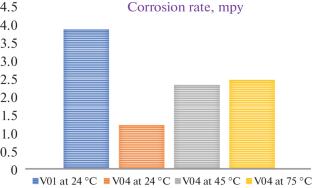
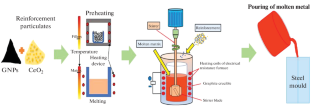
This study investigates the corrosion behavior of stir-cast hybrid aluminum composite reinforced with CeO2 and graphene nanoplatelets (GNPs) nanoparticles used as cylinder liner material in the engines (Automotive, aerospace, and aircraft industries). The composites were prepared using the stir-casting technique, and their microstructure and corrosion behavior was evaluated using scanning electron microscopy (SEM) and Potentiodynamic polarization test, respectively. The results showed that the addition of CeO2 and GNPs improved the corrosion resistance of the composites, and the optimal combination of these two nanoparticles was found to be 3 wt % CeO2 and 3 wt % GNPs. The enhanced corrosion resistance was attributed to the formation of a protective layer on the surface of the composite, as well as the effective dispersion and uniform distribution of nanoparticles in the matrix. The 0.031362 was noted as the lowest corrosion rate (mmpy) was noticed in V04 sample at room temperature and at elevated temperatures, the corrosion rate (mmpy) was observed as 0.060081 and 0.063627 at 45 and 75°C, respectively. In the vast majority of the published research publications, either cerium oxide or graphene nanoplatelets were utilized as a single reinforcement or in conjunction with other types of reinforcement such as alumina, silicon carbide, carbon nano-tubes, tungsten carbide, etc, but on the combination of the CeO2 and GNPs as reinforcements have very-2 less literature, with 2 wt % each only. The prepared hybrid aluminum composite (with reinforcing 1 to 3 wt % in Al-6061 alloy) was considered for replacing the cylinder liner material in the piston-cylinder arrangement.
期刊介绍:
Protection of Metals and Physical Chemistry of Surfaces is an international peer reviewed journal that publishes articles covering all aspects of the physical chemistry of materials and interfaces in various environments. The journal covers all related problems of modern physical chemistry and materials science, including: physicochemical processes at interfaces; adsorption phenomena; complexing from molecular and supramolecular structures at the interfaces to new substances, materials and coatings; nanoscale and nanostructured materials and coatings, composed and dispersed materials; physicochemical problems of corrosion, degradation and protection; investigation methods for surface and interface systems, processes, structures, materials and coatings. No principe restrictions exist related systems, types of processes, methods of control and study. The journal welcomes conceptual, theoretical, experimental, methodological, instrumental, environmental, and all other possible studies.



 京公网安备 11010802042870号
京ICP备2023020795号-1
京公网安备 11010802042870号
京ICP备2023020795号-1

 分享
分享
 求助内容:
求助内容: 应助结果提醒方式:
 扫码关注我们
