Ylva Lekberg, Jan Jansa, Morgan McLeod, Mary Ellyn DuPre, William E. Holben, David Johnson, Roger T. Koide, Alanna Shaw, Catherine Zabinski, Laura Aldrich-Wolfe
{"title":"Carbon and phosphorus exchange rates in arbuscular mycorrhizas depend on environmental context and differ among co-occurring plants","authors":"Ylva Lekberg, Jan Jansa, Morgan McLeod, Mary Ellyn DuPre, William E. Holben, David Johnson, Roger T. Koide, Alanna Shaw, Catherine Zabinski, Laura Aldrich-Wolfe","doi":"10.1111/nph.19501","DOIUrl":null,"url":null,"abstract":"<p>\n \n </p>","PeriodicalId":214,"journal":{"name":"New Phytologist","volume":"242 4","pages":"1576-1588"},"PeriodicalIF":8.1000,"publicationDate":"2024-01-03","publicationTypes":"Journal Article","fieldsOfStudy":null,"isOpenAccess":false,"openAccessPdf":"https://onlinelibrary.wiley.com/doi/epdf/10.1111/nph.19501","citationCount":"0","resultStr":null,"platform":"Semanticscholar","paperid":null,"PeriodicalName":"New Phytologist","FirstCategoryId":"99","ListUrlMain":"https://nph.onlinelibrary.wiley.com/doi/10.1111/nph.19501","RegionNum":1,"RegionCategory":"生物学","ArticlePicture":[],"TitleCN":null,"AbstractTextCN":null,"PMCID":null,"EPubDate":"","PubModel":"","JCR":"Q1","JCRName":"PLANT SCIENCES","Score":null,"Total":0}
磷(P)与碳(C)的交换是丛枝菌根(AM)的关键功能,但这种交换如何随土壤中P的可用性以及复杂群落中共生植物之间的P的可用性而变化在很大程度上仍是未知数。我们在两个地区采集了完整的植物群落,这两个地区的可溶性无机碳含量相差约 10 倍。经过 2 个月的温室培养后,我们测量了 32 个 P 从 AM 真菌(AMF)转移到嫩枝,并使用 AMF 特有的脂肪酸测量了 13 个 C 从嫩枝转移到 AMF。我们还使用分子方法对 AMF 群落进行了评估。在高磷土壤的群落中,尽管根系和土壤中的 13 C 分配给 AMF 的比例相似,但 AMF 在嫩枝总磷中所占的比例更大。在群落内,禾本科植物根中的 13 C 浓度始终高于毯草(Gaillardia aristata Pursh)根中的 13 C 浓度,也就是说,禾本科植物的钾成本似乎更高。这与 AMF 类群组成的差异以及禾本科植物根中液泡(储藏结构)较多而节管(交换结构)较少的趋势相吻合。此外,32 P-13 C 交换比率随土壤中 P 的增加而增加,对于毯草而非禾本科植物而言是如此。与预测相反,在高磷土壤群落中,AMF 向植物转移的磷比例更高。不过,共生植物之间的 32 P-13 C 交换率有所不同,这表明 AM 共生的调节方式存在差异。
期刊介绍:
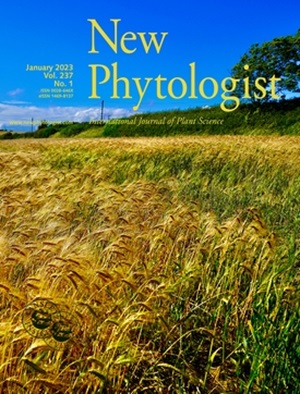
New Phytologist is an international electronic journal published 24 times a year. It is owned by the New Phytologist Foundation, a non-profit-making charitable organization dedicated to promoting plant science. The journal publishes excellent, novel, rigorous, and timely research and scholarship in plant science and its applications. The articles cover topics in five sections: Physiology & Development, Environment, Interaction, Evolution, and Transformative Plant Biotechnology. These sections encompass intracellular processes, global environmental change, and encourage cross-disciplinary approaches. The journal recognizes the use of techniques from molecular and cell biology, functional genomics, modeling, and system-based approaches in plant science. Abstracting and Indexing Information for New Phytologist includes Academic Search, AgBiotech News & Information, Agroforestry Abstracts, Biochemistry & Biophysics Citation Index, Botanical Pesticides, CAB Abstracts®, Environment Index, Global Health, and Plant Breeding Abstracts, and others.




 京公网安备 11010802042870号
京ICP备2023020795号-1
京公网安备 11010802042870号
京ICP备2023020795号-1

 分享
分享
 求助内容:
求助内容: 应助结果提醒方式:
 扫码关注我们
