{"title":"Sediment-associated microplastics in Chilika lake, India: Highlighting their prevalence, polymer types, possible sources, and ecological risks","authors":"Mohit Kumar , Dinesh Kumar Naik , Dusmant Maharana , Moumita Das , Ekta Jaiswal , Amiya Shankar Naik , Neha Kumari","doi":"10.1016/j.scitotenv.2023.169707","DOIUrl":null,"url":null,"abstract":"<div><p><span><span>The primary objective of this research was to assess microplastics (MPs) in the sediments of Chilika lake. MPs were extracted from 22 sediment samples using the density separation method combined with vacuum pump filtration. A stereo-zoom microscope and </span>Raman spectroscopy were employed to identify the sediment-associated MPs. The total MPs collected from all 22 sites was 440 ± 3.53 particles kg</span><sup>−1</sup> wet sediments, with sizes ranging between 50 and 500 μm. In terms of morphology, fibers and fragments emerged as the dominant MP types, with counts of 210 ± 1.66 and 175 ± 1.76 particles kg<sup>−1</sup><span><span><span><span> wet sediments, respectively. Raman spectroscopy verified the presence of various MP polymers in the sediments, predominantly HDPE (37 %), followed by PS (20 %), </span>PET (18 %), PA (11 %), </span>PP (7 %), and </span>PC (7 %). A notable color variation was observed in MPs; black being the most prevalent (38.8 %), succeeded by blue (19.5 %), green (11.8 %), white (11.5 %), red (10.6 %), and transparent (7.5 %). ANOVA results indicated significant (</span><em>p</em><span> > 0.05) variations in MP abundance across the 22 sampling locations. However, principal component analysis (PCA) and multiple regression analysis indicated that water quality parameters did not significantly influence MP abundance, yet it was found that MP retention was higher in fine-grained sediments like clay and silt. The leading sources of MPs in Chilika lake were found to be aquafarming, trailed by river and sewage discharges, fishing activities, antifouling coatings and tourism. Additionally, the pollution load index (PLI) was employed to gauge the ecological risks, categorizing the lake under risk category 1, which implies a minimal level of MPs pollution. This research aims to serve as an early warning system for MPs pollution in productive brackish water habitats globally, including Chilika lake, guiding policymakers towards appropriate management strategies and preventive measures.</span></p></div>","PeriodicalId":422,"journal":{"name":"Science of the Total Environment","volume":"914 ","pages":"Article 169707"},"PeriodicalIF":8.0000,"publicationDate":"2024-01-04","publicationTypes":"Journal Article","fieldsOfStudy":null,"isOpenAccess":false,"openAccessPdf":"","citationCount":"0","resultStr":null,"platform":"Semanticscholar","paperid":null,"PeriodicalName":"Science of the Total Environment","FirstCategoryId":"93","ListUrlMain":"https://www.sciencedirect.com/science/article/pii/S0048969723083377","RegionNum":1,"RegionCategory":"环境科学与生态学","ArticlePicture":[],"TitleCN":null,"AbstractTextCN":null,"PMCID":null,"EPubDate":"","PubModel":"","JCR":"Q1","JCRName":"ENVIRONMENTAL SCIENCES","Score":null,"Total":0}
引用次数: 0
Abstract
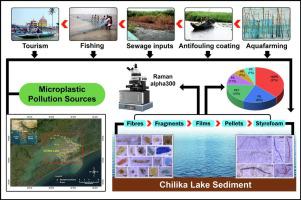
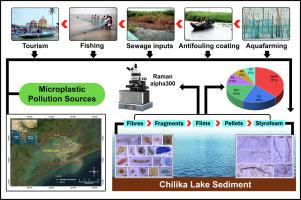
The primary objective of this research was to assess microplastics (MPs) in the sediments of Chilika lake. MPs were extracted from 22 sediment samples using the density separation method combined with vacuum pump filtration. A stereo-zoom microscope and Raman spectroscopy were employed to identify the sediment-associated MPs. The total MPs collected from all 22 sites was 440 ± 3.53 particles kg−1 wet sediments, with sizes ranging between 50 and 500 μm. In terms of morphology, fibers and fragments emerged as the dominant MP types, with counts of 210 ± 1.66 and 175 ± 1.76 particles kg−1 wet sediments, respectively. Raman spectroscopy verified the presence of various MP polymers in the sediments, predominantly HDPE (37 %), followed by PS (20 %), PET (18 %), PA (11 %), PP (7 %), and PC (7 %). A notable color variation was observed in MPs; black being the most prevalent (38.8 %), succeeded by blue (19.5 %), green (11.8 %), white (11.5 %), red (10.6 %), and transparent (7.5 %). ANOVA results indicated significant (p > 0.05) variations in MP abundance across the 22 sampling locations. However, principal component analysis (PCA) and multiple regression analysis indicated that water quality parameters did not significantly influence MP abundance, yet it was found that MP retention was higher in fine-grained sediments like clay and silt. The leading sources of MPs in Chilika lake were found to be aquafarming, trailed by river and sewage discharges, fishing activities, antifouling coatings and tourism. Additionally, the pollution load index (PLI) was employed to gauge the ecological risks, categorizing the lake under risk category 1, which implies a minimal level of MPs pollution. This research aims to serve as an early warning system for MPs pollution in productive brackish water habitats globally, including Chilika lake, guiding policymakers towards appropriate management strategies and preventive measures.
期刊介绍:
The Science of the Total Environment is an international journal dedicated to scientific research on the environment and its interaction with humanity. It covers a wide range of disciplines and seeks to publish innovative, hypothesis-driven, and impactful research that explores the entire environment, including the atmosphere, lithosphere, hydrosphere, biosphere, and anthroposphere.
The journal's updated Aims & Scope emphasizes the importance of interdisciplinary environmental research with broad impact. Priority is given to studies that advance fundamental understanding and explore the interconnectedness of multiple environmental spheres. Field studies are preferred, while laboratory experiments must demonstrate significant methodological advancements or mechanistic insights with direct relevance to the environment.



 京公网安备 11010802042870号
京ICP备2023020795号-1
京公网安备 11010802042870号
京ICP备2023020795号-1

 分享
分享
 求助内容:
求助内容: 应助结果提醒方式:
 扫码关注我们
