Le Zhang, Changjiang Liu, Hui Cao, Andrew J. Erwin, Dillon D. Fong, Anand Bhattacharya, Luping Yu, Liliana Stan, Chongwen Zou, Matthew V. Tirrell, Hua Zhou, Wei Chen
{"title":"Redox Gating for Colossal Carrier Modulation and Unique Phase Control","authors":"Le Zhang, Changjiang Liu, Hui Cao, Andrew J. Erwin, Dillon D. Fong, Anand Bhattacharya, Luping Yu, Liliana Stan, Chongwen Zou, Matthew V. Tirrell, Hua Zhou, Wei Chen","doi":"10.1002/adma.202308871","DOIUrl":null,"url":null,"abstract":"<p>Redox gating, a novel approach distinct from conventional electrolyte gating, combines reversible redox functionalities with common ionic electrolyte moieties to engineer charge transport, enabling power-efficient electronic phase control. This study achieves a colossal sheet carrier density modulation beyond 10<sup>16</sup> cm<sup>−2</sup>, sustainable over thousands of cycles, all within the sub-volt regime for functional oxide thin films. The key advantage of this method lies in the controlled injection of a large quantity of carriers from the electrolyte into the channel material without the deleterious effects associated with traditional electrolyte gating processes such as the production of ionic defects or intercalated species. The redox gating approach offers a simple and practical means of decoupling electrical and structural phase transitions, enabling the isostructural metal-insulator transition and improved device endurance. The versatility of redox gating extends across multiple materials, irrespective of their crystallinity, crystallographic orientation, or carrier type (n- or p-type). This inclusivity encompasses functional heterostructures and low-dimensional quantum materials composed of sustainable elements, highlighting the broad applicability and potential of the technique in electronic devices.</p>","PeriodicalId":114,"journal":{"name":"Advanced Materials","volume":"36 16","pages":""},"PeriodicalIF":26.8000,"publicationDate":"2024-01-06","publicationTypes":"Journal Article","fieldsOfStudy":null,"isOpenAccess":false,"openAccessPdf":"https://onlinelibrary.wiley.com/doi/epdf/10.1002/adma.202308871","citationCount":"0","resultStr":null,"platform":"Semanticscholar","paperid":null,"PeriodicalName":"Advanced Materials","FirstCategoryId":"88","ListUrlMain":"https://advanced.onlinelibrary.wiley.com/doi/10.1002/adma.202308871","RegionNum":1,"RegionCategory":"材料科学","ArticlePicture":[],"TitleCN":null,"AbstractTextCN":null,"PMCID":null,"EPubDate":"","PubModel":"","JCR":"Q1","JCRName":"CHEMISTRY, MULTIDISCIPLINARY","Score":null,"Total":0}
引用次数: 0
Abstract
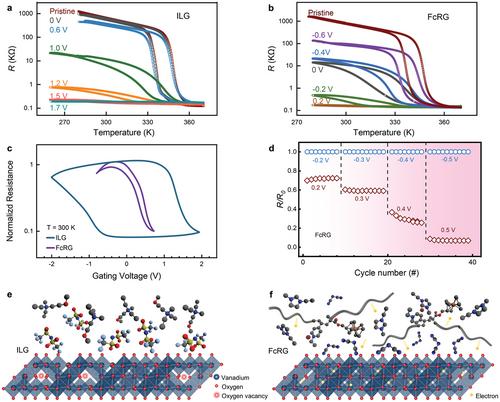
Redox gating, a novel approach distinct from conventional electrolyte gating, combines reversible redox functionalities with common ionic electrolyte moieties to engineer charge transport, enabling power-efficient electronic phase control. This study achieves a colossal sheet carrier density modulation beyond 1016 cm−2, sustainable over thousands of cycles, all within the sub-volt regime for functional oxide thin films. The key advantage of this method lies in the controlled injection of a large quantity of carriers from the electrolyte into the channel material without the deleterious effects associated with traditional electrolyte gating processes such as the production of ionic defects or intercalated species. The redox gating approach offers a simple and practical means of decoupling electrical and structural phase transitions, enabling the isostructural metal-insulator transition and improved device endurance. The versatility of redox gating extends across multiple materials, irrespective of their crystallinity, crystallographic orientation, or carrier type (n- or p-type). This inclusivity encompasses functional heterostructures and low-dimensional quantum materials composed of sustainable elements, highlighting the broad applicability and potential of the technique in electronic devices.
期刊介绍:
Advanced Materials, one of the world's most prestigious journals and the foundation of the Advanced portfolio, is the home of choice for best-in-class materials science for more than 30 years. Following this fast-growing and interdisciplinary field, we are considering and publishing the most important discoveries on any and all materials from materials scientists, chemists, physicists, engineers as well as health and life scientists and bringing you the latest results and trends in modern materials-related research every week.




 京公网安备 11010802042870号
京ICP备2023020795号-1
京公网安备 11010802042870号
京ICP备2023020795号-1

 分享
分享
 求助内容:
求助内容: 应助结果提醒方式:
 扫码关注我们
