A. Khuzaim Alzahrani, Ahmed A. Alsheikhy, Tawfeeq Shawly, Mohammad Barr, Hossam E. Ahmed
{"title":"A New Artificial Intelligence-Based Model for Amyotrophic Lateral Sclerosis Prediction","authors":"A. Khuzaim Alzahrani, Ahmed A. Alsheikhy, Tawfeeq Shawly, Mohammad Barr, Hossam E. Ahmed","doi":"10.1155/2023/1172288","DOIUrl":null,"url":null,"abstract":"<div>\n <p>Currently, amyotrophic lateral sclerosis (ALS) disease is considered fatal since it affects the central nervous system with no cure or clear treatments. This disease affects the spinal cord, more specifically, the lower motor neurons (LMNs) and the upper motor neurons (UMNs) inside the brain along with their networks. Various solutions have been developed to predict ALS. Some of these solutions were implemented using different deep-learning methods (DLMs). Nevertheless, this disease is considered a tough task and a huge challenge. This article proposes a reliable model to predict ALS disease based on a deep-learning tool (DLT). The developed DLT is designed using a UNET architecture. The proposed approach is evaluated for different performance quantities on a dataset and provides promising results. An average obtained accuracy ranged between 82% and 87% with around 86% of the <i>F</i>-score. The obtained outcomes can open the door to applying DLMs to predict and identify ALS disease.</p>\n </div>","PeriodicalId":14089,"journal":{"name":"International Journal of Intelligent Systems","volume":"2023 1","pages":""},"PeriodicalIF":3.7000,"publicationDate":"2023-12-31","publicationTypes":"Journal Article","fieldsOfStudy":null,"isOpenAccess":false,"openAccessPdf":"https://onlinelibrary.wiley.com/doi/epdf/10.1155/2023/1172288","citationCount":"0","resultStr":null,"platform":"Semanticscholar","paperid":null,"PeriodicalName":"International Journal of Intelligent Systems","FirstCategoryId":"94","ListUrlMain":"https://onlinelibrary.wiley.com/doi/10.1155/2023/1172288","RegionNum":2,"RegionCategory":"计算机科学","ArticlePicture":[],"TitleCN":null,"AbstractTextCN":null,"PMCID":null,"EPubDate":"","PubModel":"","JCR":"Q1","JCRName":"COMPUTER SCIENCE, ARTIFICIAL INTELLIGENCE","Score":null,"Total":0}
引用次数: 0
Abstract
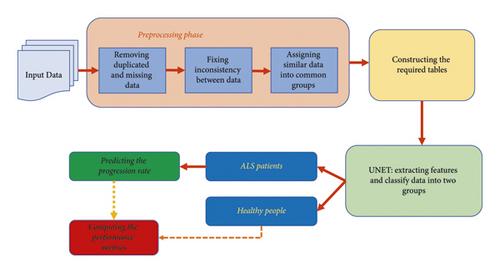
Currently, amyotrophic lateral sclerosis (ALS) disease is considered fatal since it affects the central nervous system with no cure or clear treatments. This disease affects the spinal cord, more specifically, the lower motor neurons (LMNs) and the upper motor neurons (UMNs) inside the brain along with their networks. Various solutions have been developed to predict ALS. Some of these solutions were implemented using different deep-learning methods (DLMs). Nevertheless, this disease is considered a tough task and a huge challenge. This article proposes a reliable model to predict ALS disease based on a deep-learning tool (DLT). The developed DLT is designed using a UNET architecture. The proposed approach is evaluated for different performance quantities on a dataset and provides promising results. An average obtained accuracy ranged between 82% and 87% with around 86% of the F-score. The obtained outcomes can open the door to applying DLMs to predict and identify ALS disease.
期刊介绍:
The International Journal of Intelligent Systems serves as a forum for individuals interested in tapping into the vast theories based on intelligent systems construction. With its peer-reviewed format, the journal explores several fascinating editorials written by today''s experts in the field. Because new developments are being introduced each day, there''s much to be learned — examination, analysis creation, information retrieval, man–computer interactions, and more. The International Journal of Intelligent Systems uses charts and illustrations to demonstrate these ground-breaking issues, and encourages readers to share their thoughts and experiences.





 京公网安备 11010802042870号
京ICP备2023020795号-1
京公网安备 11010802042870号
京ICP备2023020795号-1

 分享
分享
 求助内容:
求助内容: 应助结果提醒方式:
 扫码关注我们
