{"title":"Hypertension in the elderly","authors":"John L.C. Dall M.D.","doi":"10.1016/0002-9343(89)90504-4","DOIUrl":null,"url":null,"abstract":"<div><p>The relation between hypertension, cerebrovascular disease, and heart failure in the elderly is well established. The concept that this was entirely due to hardening of the arteries and, therefore, an essential feature of aging has been revised in the last 15 years to show that there are groups of elderly people in whom hypertension is not a problem, and in this group stroke disease and heart failure are relatively uncommon. The treatment of hypertension in the elderly attracts increasing attention. The successful lowering of blood pressure in the elderly has now been reported by many authors with a variety of therapeutic agents. The case for treatment has been demonstrated in those up to 80 years of age by the European Working Party in Hypertension in the Elderly, and relevant data on compliance are also available in the older age group in the Sub-Group Analysis of the Hypertension Detection and Follow-up Programme. A similar reduction of blood pressure, both systolic and diastolic, can be safely achieved with thiazides, beta-blockade, calcium channel blockade, angiotensin-converting enzyme inhibitors, and centrally acting drugs. The differentiation between these groups is largely a matter of the side effects that occur and any concurrent existing illness from which the patient suffers, e.g., diabetes, bronchitis, heart failure, and so on. From the information available to date, the problem of choice of the most suitable drug remains a clinical decision for the prescribing doctor.</p></div>","PeriodicalId":50807,"journal":{"name":"American Journal of Medicine","volume":"87 3","pages":"Pages S38-S40"},"PeriodicalIF":5.3000,"publicationDate":"1989-09-18","publicationTypes":"Journal Article","fieldsOfStudy":null,"isOpenAccess":false,"openAccessPdf":"https://sci-hub-pdf.com/10.1016/0002-9343(89)90504-4","citationCount":"2","resultStr":null,"platform":"Semanticscholar","paperid":null,"PeriodicalName":"American Journal of Medicine","FirstCategoryId":"3","ListUrlMain":"https://www.sciencedirect.com/science/article/pii/0002934389905044","RegionNum":3,"RegionCategory":"医学","ArticlePicture":[],"TitleCN":null,"AbstractTextCN":null,"PMCID":null,"EPubDate":"","PubModel":"","JCR":"Q1","JCRName":"MEDICINE, GENERAL & INTERNAL","Score":null,"Total":0}
引用次数: 2
Abstract
The relation between hypertension, cerebrovascular disease, and heart failure in the elderly is well established. The concept that this was entirely due to hardening of the arteries and, therefore, an essential feature of aging has been revised in the last 15 years to show that there are groups of elderly people in whom hypertension is not a problem, and in this group stroke disease and heart failure are relatively uncommon. The treatment of hypertension in the elderly attracts increasing attention. The successful lowering of blood pressure in the elderly has now been reported by many authors with a variety of therapeutic agents. The case for treatment has been demonstrated in those up to 80 years of age by the European Working Party in Hypertension in the Elderly, and relevant data on compliance are also available in the older age group in the Sub-Group Analysis of the Hypertension Detection and Follow-up Programme. A similar reduction of blood pressure, both systolic and diastolic, can be safely achieved with thiazides, beta-blockade, calcium channel blockade, angiotensin-converting enzyme inhibitors, and centrally acting drugs. The differentiation between these groups is largely a matter of the side effects that occur and any concurrent existing illness from which the patient suffers, e.g., diabetes, bronchitis, heart failure, and so on. From the information available to date, the problem of choice of the most suitable drug remains a clinical decision for the prescribing doctor.
期刊介绍:
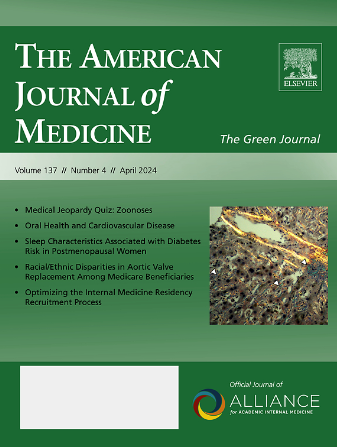
The American Journal of Medicine - "The Green Journal" - publishes original clinical research of interest to physicians in internal medicine, both in academia and community-based practice. AJM is the official journal of the Alliance for Academic Internal Medicine, a prestigious group comprising internal medicine department chairs at more than 125 medical schools across the U.S. Each issue carries useful reviews as well as seminal articles of immediate interest to the practicing physician, including peer-reviewed, original scientific studies that have direct clinical significance and position papers on health care issues, medical education, and public policy.



 京公网安备 11010802042870号
京ICP备2023020795号-1
京公网安备 11010802042870号
京ICP备2023020795号-1

 分享
分享
 求助内容:
求助内容: 应助结果提醒方式:
 扫码关注我们
