Ju Young Kwon, Ji Eun Kim, Jong Sung Kim, Suk Yeop Chun, Keunho Soh, Jung Ho Yoon
{"title":"Artificial sensory system based on memristive devices","authors":"Ju Young Kwon, Ji Eun Kim, Jong Sung Kim, Suk Yeop Chun, Keunho Soh, Jung Ho Yoon","doi":"10.1002/EXP.20220162","DOIUrl":null,"url":null,"abstract":"<p>In the biological nervous system, the integration and cooperation of parallel system of receptors, neurons, and synapses allow efficient detection and processing of intricate and disordered external information. Such systems acquire and process environmental data in real-time, efficiently handling complex tasks with minimal energy consumption. Memristors can mimic typical biological receptors, neurons, and synapses by implementing key features of neuronal signal-processing functions such as selective adaption in receptors, leaky integrate-and-fire in neurons, and synaptic plasticity in synapses. External stimuli are sensitively detected and filtered by “artificial receptors,” encoded into spike signals via “artificial neurons,” and integrated and stored through “artificial synapses.” The high operational speed, low power consumption, and superior scalability of memristive devices make their integration with high-performance sensors a promising approach for creating integrated artificial sensory systems. These integrated systems can extract useful data from a large volume of raw data, facilitating real-time detection and processing of environmental information. This review explores the recent advances in memristor-based artificial sensory systems. The authors begin with the requirements of artificial sensory elements and then present an in-depth review of such elements demonstrated by memristive devices. Finally, the major challenges and opportunities in the development of memristor-based artificial sensory systems are discussed.</p>","PeriodicalId":72997,"journal":{"name":"Exploration (Beijing, China)","volume":"4 1","pages":""},"PeriodicalIF":22.5000,"publicationDate":"2023-11-20","publicationTypes":"Journal Article","fieldsOfStudy":null,"isOpenAccess":false,"openAccessPdf":"https://onlinelibrary.wiley.com/doi/epdf/10.1002/EXP.20220162","citationCount":"0","resultStr":null,"platform":"Semanticscholar","paperid":null,"PeriodicalName":"Exploration (Beijing, China)","FirstCategoryId":"1085","ListUrlMain":"https://onlinelibrary.wiley.com/doi/10.1002/EXP.20220162","RegionNum":0,"RegionCategory":null,"ArticlePicture":[],"TitleCN":null,"AbstractTextCN":null,"PMCID":null,"EPubDate":"","PubModel":"","JCR":"","JCRName":"","Score":null,"Total":0}
引用次数: 0
Abstract
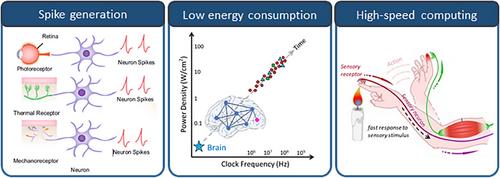
In the biological nervous system, the integration and cooperation of parallel system of receptors, neurons, and synapses allow efficient detection and processing of intricate and disordered external information. Such systems acquire and process environmental data in real-time, efficiently handling complex tasks with minimal energy consumption. Memristors can mimic typical biological receptors, neurons, and synapses by implementing key features of neuronal signal-processing functions such as selective adaption in receptors, leaky integrate-and-fire in neurons, and synaptic plasticity in synapses. External stimuli are sensitively detected and filtered by “artificial receptors,” encoded into spike signals via “artificial neurons,” and integrated and stored through “artificial synapses.” The high operational speed, low power consumption, and superior scalability of memristive devices make their integration with high-performance sensors a promising approach for creating integrated artificial sensory systems. These integrated systems can extract useful data from a large volume of raw data, facilitating real-time detection and processing of environmental information. This review explores the recent advances in memristor-based artificial sensory systems. The authors begin with the requirements of artificial sensory elements and then present an in-depth review of such elements demonstrated by memristive devices. Finally, the major challenges and opportunities in the development of memristor-based artificial sensory systems are discussed.



 京公网安备 11010802042870号
京ICP备2023020795号-1
京公网安备 11010802042870号
京ICP备2023020795号-1

 分享
分享

 求助内容:
求助内容: 应助结果提醒方式:
 扫码关注我们
