Cheng Zhao , Yong-Hong Li , Shilu Tong , Rong Wang , Yu Wang , Yi-Bin Cheng , Yi-Ran Lyu , Yu-Shu Huang , Jiang He , Jia Guo , Xiao-Yuan Yao
{"title":"Economic burden of premature deaths attributable to different heatwaves in China: A multi-site study, 2014–2019","authors":"Cheng Zhao , Yong-Hong Li , Shilu Tong , Rong Wang , Yu Wang , Yi-Bin Cheng , Yi-Ran Lyu , Yu-Shu Huang , Jiang He , Jia Guo , Xiao-Yuan Yao","doi":"10.1016/j.accre.2023.11.003","DOIUrl":null,"url":null,"abstract":"<div><div>It has been well documented that heatwaves are linked to elevated mortality and morbidity. However, the selection of optimal heatwave definitions for subsequent risk assessment has been inconsistent and there is no full picture of the effects of heatwaves with different intensities on economic losses due to mortality, which can provide important insights for public health considerations. Hence, we used a two-stage time series analysis, combined with values of statistical life (<em>V</em><sub>SL</sub>) based on the value of a statistical life year to assess the economic burden of deaths associated with heatwaves of different intensities and durations and to identify the vulnerable populations and regions. We further conducted stratified analyses by age, sex, and region. We found 2.9% (95%CI: 0.0%, 6.5%)‒20.0% (95%CI: 2.9%, 34.2%) of <em>V</em><sub>SL</sub> were attributable to heatwaves, corresponding to attributable economic losses (AELs) of 2.20 (95%CI: 0.32, 3.77)‒4.77 (95%CI: 1.53, 7.63) billion CNY. The economic burden of death was most sensitive to heatwave H99P_2D (99th percentile, at last 2 consecutive days), while H97·5P_2D (97.5th percentile, at last 2 consecutive days) caused the highest attributable economic losses. Females and elderly people aged ≥ 65 years were more sensitive. The AELs in the temperate zone and northern regions were larger than those in subtropical zone and southern regions during relatively low-intensity heatwaves, respectively. By contrast, the AELs in subtropical zone and southern regions were relatively higher than those in temperate zone and northern regions during relatively high-intensity heatwaves, respectively. The AELs were larger in urban areas than in rural areas. Tailored intervention strategies, primarily focusing on vulnerable populations and regions, should be formulated to reduce the economic loss due to heatwaves in the context of climate change.</div></div>","PeriodicalId":48628,"journal":{"name":"Advances in Climate Change Research","volume":"14 6","pages":"Pages 836-846"},"PeriodicalIF":5.2000,"publicationDate":"2023-12-01","publicationTypes":"Journal Article","fieldsOfStudy":null,"isOpenAccess":false,"openAccessPdf":"","citationCount":"0","resultStr":null,"platform":"Semanticscholar","paperid":null,"PeriodicalName":"Advances in Climate Change Research","FirstCategoryId":"89","ListUrlMain":"https://www.sciencedirect.com/science/article/pii/S1674927823001405","RegionNum":1,"RegionCategory":"地球科学","ArticlePicture":[],"TitleCN":null,"AbstractTextCN":null,"PMCID":null,"EPubDate":"2023/11/24 0:00:00","PubModel":"Epub","JCR":"Q1","JCRName":"ENVIRONMENTAL SCIENCES","Score":null,"Total":0}
引用次数: 0
Abstract
It has been well documented that heatwaves are linked to elevated mortality and morbidity. However, the selection of optimal heatwave definitions for subsequent risk assessment has been inconsistent and there is no full picture of the effects of heatwaves with different intensities on economic losses due to mortality, which can provide important insights for public health considerations. Hence, we used a two-stage time series analysis, combined with values of statistical life (VSL) based on the value of a statistical life year to assess the economic burden of deaths associated with heatwaves of different intensities and durations and to identify the vulnerable populations and regions. We further conducted stratified analyses by age, sex, and region. We found 2.9% (95%CI: 0.0%, 6.5%)‒20.0% (95%CI: 2.9%, 34.2%) of VSL were attributable to heatwaves, corresponding to attributable economic losses (AELs) of 2.20 (95%CI: 0.32, 3.77)‒4.77 (95%CI: 1.53, 7.63) billion CNY. The economic burden of death was most sensitive to heatwave H99P_2D (99th percentile, at last 2 consecutive days), while H97·5P_2D (97.5th percentile, at last 2 consecutive days) caused the highest attributable economic losses. Females and elderly people aged ≥ 65 years were more sensitive. The AELs in the temperate zone and northern regions were larger than those in subtropical zone and southern regions during relatively low-intensity heatwaves, respectively. By contrast, the AELs in subtropical zone and southern regions were relatively higher than those in temperate zone and northern regions during relatively high-intensity heatwaves, respectively. The AELs were larger in urban areas than in rural areas. Tailored intervention strategies, primarily focusing on vulnerable populations and regions, should be formulated to reduce the economic loss due to heatwaves in the context of climate change.
期刊介绍:
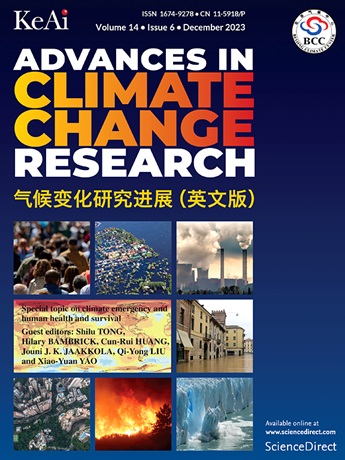
Advances in Climate Change Research publishes scientific research and analyses on climate change and the interactions of climate change with society. This journal encompasses basic science and economic, social, and policy research, including studies on mitigation and adaptation to climate change.
Advances in Climate Change Research attempts to promote research in climate change and provide an impetus for the application of research achievements in numerous aspects, such as socioeconomic sustainable development, responses to the adaptation and mitigation of climate change, diplomatic negotiations of climate and environment policies, and the protection and exploitation of natural resources.



 京公网安备 11010802042870号
京ICP备2023020795号-1
京公网安备 11010802042870号
京ICP备2023020795号-1

 分享
分享
 求助内容:
求助内容: 应助结果提醒方式:
 扫码关注我们
