Investigating computer science students' intentions towards the use of an online educational platform using an extended technology acceptance model (e-TAM): An empirical study at a public university in Tunisia
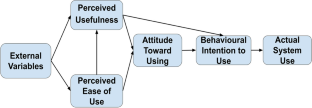
{"title":"Investigating computer science students' intentions towards the use of an online educational platform using an extended technology acceptance model (e-TAM): An empirical study at a public university in Tunisia","authors":"Yassine Adouani, Mohamed Ali Khenissi","doi":"10.1007/s10639-023-12437-6","DOIUrl":null,"url":null,"abstract":"<p>In recent years, online educational platforms have become an increasingly popular tool for delivering online learning experiences. One such platform is the Tunisian educational platform provided by the Virtual University of Tunis. The acceptance and adoption of these platforms by students are crucial for their successful integration into the educational system. This study investigates students’ intentions towards the use of the Tunisian educational platform using the proposed Extended Technology Acceptance Model (e-TAM). An empirical study was conducted involving 108 undergraduate computer science students from a Tunisian public university, providing insights into students' intentions and contributing to a deeper understanding into the factors driving the adoption of educational technology. The findings of this study contribute to the literature by validating an extension of TAM in the Tunisian context and providing valuable insights for educators, policymakers, and platform developers to improve the design, usability, and effectiveness of these platforms.</p>","PeriodicalId":51494,"journal":{"name":"Education and Information Technologies","volume":"5 1","pages":""},"PeriodicalIF":7.2000,"publicationDate":"2024-01-09","publicationTypes":"Journal Article","fieldsOfStudy":null,"isOpenAccess":false,"openAccessPdf":"","citationCount":"0","resultStr":null,"platform":"Semanticscholar","paperid":null,"PeriodicalName":"Education and Information Technologies","FirstCategoryId":"95","ListUrlMain":"https://doi.org/10.1007/s10639-023-12437-6","RegionNum":2,"RegionCategory":"教育学","ArticlePicture":[],"TitleCN":null,"AbstractTextCN":null,"PMCID":null,"EPubDate":"","PubModel":"","JCR":"Q1","JCRName":"EDUCATION & EDUCATIONAL RESEARCH","Score":null,"Total":0}
引用次数: 0
Abstract
In recent years, online educational platforms have become an increasingly popular tool for delivering online learning experiences. One such platform is the Tunisian educational platform provided by the Virtual University of Tunis. The acceptance and adoption of these platforms by students are crucial for their successful integration into the educational system. This study investigates students’ intentions towards the use of the Tunisian educational platform using the proposed Extended Technology Acceptance Model (e-TAM). An empirical study was conducted involving 108 undergraduate computer science students from a Tunisian public university, providing insights into students' intentions and contributing to a deeper understanding into the factors driving the adoption of educational technology. The findings of this study contribute to the literature by validating an extension of TAM in the Tunisian context and providing valuable insights for educators, policymakers, and platform developers to improve the design, usability, and effectiveness of these platforms.
近年来,在线教育平台日益成为提供在线学习体验的流行工具。突尼斯虚拟大学提供的突尼斯教育平台就是这样一个平台。学生对这些平台的接受和采用对其成功融入教育系统至关重要。本研究利用提出的扩展技术接受模型(e-TAM)调查了学生使用突尼斯教育平台的意向。这项实证研究涉及突尼斯一所公立大学的 108 名计算机科学专业本科生,有助于深入了解学生的意向,并有助于深入理解推动采用教育技术的因素。本研究的结果为相关文献做出了贡献,验证了 TAM 在突尼斯背景下的扩展,并为教育工作者、政策制定者和平台开发者提供了宝贵的见解,以改进这些平台的设计、可用性和有效性。
期刊介绍:
The Journal of Education and Information Technologies (EAIT) is a platform for the range of debates and issues in the field of Computing Education as well as the many uses of information and communication technology (ICT) across many educational subjects and sectors. It probes the use of computing to improve education and learning in a variety of settings, platforms and environments.
The journal aims to provide perspectives at all levels, from the micro level of specific pedagogical approaches in Computing Education and applications or instances of use in classrooms, to macro concerns of national policies and major projects; from pre-school classes to adults in tertiary institutions; from teachers and administrators to researchers and designers; from institutions to online and lifelong learning. The journal is embedded in the research and practice of professionals within the contemporary global context and its breadth and scope encourage debate on fundamental issues at all levels and from different research paradigms and learning theories. The journal does not proselytize on behalf of the technologies (whether they be mobile, desktop, interactive, virtual, games-based or learning management systems) but rather provokes debate on all the complex relationships within and between computing and education, whether they are in informal or formal settings. It probes state of the art technologies in Computing Education and it also considers the design and evaluation of digital educational artefacts. The journal aims to maintain and expand its international standing by careful selection on merit of the papers submitted, thus providing a credible ongoing forum for debate and scholarly discourse. Special Issues are occasionally published to cover particular issues in depth. EAIT invites readers to submit papers that draw inferences, probe theory and create new knowledge that informs practice, policy and scholarship. Readers are also invited to comment and reflect upon the argument and opinions published. EAIT is the official journal of the Technical Committee on Education of the International Federation for Information Processing (IFIP) in partnership with UNESCO.




 京公网安备 11010802042870号
京ICP备2023020795号-1
京公网安备 11010802042870号
京ICP备2023020795号-1

 分享
分享
 求助内容:
求助内容: 应助结果提醒方式:
 扫码关注我们
