Li-Xia Liang , Li-Zi Lin , Mohammed Zeeshan , Yang Zhou , Yong-Xiang Tang , Chu Chu , Yun-Ting Zhang , Ru-Qing Liu , Wenru Feng , Guang-Hui Dong
{"title":"Relationship of single and co-exposure of per-and polyfluoroalkyl substances and their alternatives with uric acid: A community-based study in China","authors":"Li-Xia Liang , Li-Zi Lin , Mohammed Zeeshan , Yang Zhou , Yong-Xiang Tang , Chu Chu , Yun-Ting Zhang , Ru-Qing Liu , Wenru Feng , Guang-Hui Dong","doi":"10.1016/j.jhazmat.2024.133500","DOIUrl":null,"url":null,"abstract":"<div><p><span>Numerous studies have suggested per-and polyfluoroalkyl substances (PFASs) are related to uric acid levels, but evidence related to PFAS alternatives is limited. Moreover, the effect of the combined exposure to PFASs and their alternatives on uric acid has not been reported. Hence, we conducted a cross-sectional study involving 1312 adults in Guangzhou, China. Generalized linear regression model was adopted to explore the effect of single PFAS exposure on serum uric acid levels. Further, multi-pollutant models such as Bayesian kernel machine regression, weighted </span>quantile sum, and quantile G-computation were employed to investigate the combined association of PFASs and alternatives with serum uric acid levels. We performed molecular docking to understand the potential interaction of PFAS with Organic Anion Transporters (OATs), involved in the secretion of uric acid. Per log serum 6:2 Cl-PFESA and PFOA increases were accompanied with an increase of serum uric acid with statistical significance (for 6:2 Cl-PFESA: beta: 0.19 ng/mL, 95% CI 0.11–0.26 and for PFOA: beta: 0.43 ng/mL, 95% CI 0.34–0.52). The associations were strongest among overweight and elderly. Multi-pollutant models also revealed a positive association. These positive associations may be PFASs can competitively combine with OAT1 and OAT3, leading to the increase of serum uric acid.</p></div>","PeriodicalId":361,"journal":{"name":"Journal of Hazardous Materials","volume":"466 ","pages":"Article 133500"},"PeriodicalIF":10.6000,"publicationDate":"2024-03-15","publicationTypes":"Journal Article","fieldsOfStudy":null,"isOpenAccess":false,"openAccessPdf":"","citationCount":"0","resultStr":null,"platform":"Semanticscholar","paperid":null,"PeriodicalName":"Journal of Hazardous Materials","FirstCategoryId":"93","ListUrlMain":"https://www.sciencedirect.com/science/article/pii/S0304389424000785","RegionNum":1,"RegionCategory":"环境科学与生态学","ArticlePicture":[],"TitleCN":null,"AbstractTextCN":null,"PMCID":null,"EPubDate":"2024/1/11 0:00:00","PubModel":"Epub","JCR":"Q1","JCRName":"ENGINEERING, ENVIRONMENTAL","Score":null,"Total":0}
引用次数: 0
Abstract
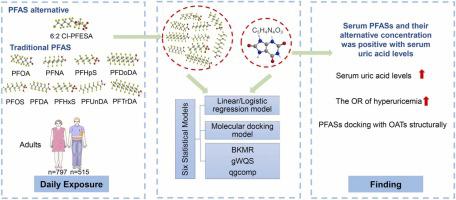
Numerous studies have suggested per-and polyfluoroalkyl substances (PFASs) are related to uric acid levels, but evidence related to PFAS alternatives is limited. Moreover, the effect of the combined exposure to PFASs and their alternatives on uric acid has not been reported. Hence, we conducted a cross-sectional study involving 1312 adults in Guangzhou, China. Generalized linear regression model was adopted to explore the effect of single PFAS exposure on serum uric acid levels. Further, multi-pollutant models such as Bayesian kernel machine regression, weighted quantile sum, and quantile G-computation were employed to investigate the combined association of PFASs and alternatives with serum uric acid levels. We performed molecular docking to understand the potential interaction of PFAS with Organic Anion Transporters (OATs), involved in the secretion of uric acid. Per log serum 6:2 Cl-PFESA and PFOA increases were accompanied with an increase of serum uric acid with statistical significance (for 6:2 Cl-PFESA: beta: 0.19 ng/mL, 95% CI 0.11–0.26 and for PFOA: beta: 0.43 ng/mL, 95% CI 0.34–0.52). The associations were strongest among overweight and elderly. Multi-pollutant models also revealed a positive association. These positive associations may be PFASs can competitively combine with OAT1 and OAT3, leading to the increase of serum uric acid.
期刊介绍:
The Journal of Hazardous Materials serves as a global platform for promoting cutting-edge research in the field of Environmental Science and Engineering. Our publication features a wide range of articles, including full-length research papers, review articles, and perspectives, with the aim of enhancing our understanding of the dangers and risks associated with various materials concerning public health and the environment. It is important to note that the term "environmental contaminants" refers specifically to substances that pose hazardous effects through contamination, while excluding those that do not have such impacts on the environment or human health. Moreover, we emphasize the distinction between wastes and hazardous materials in order to provide further clarity on the scope of the journal. We have a keen interest in exploring specific compounds and microbial agents that have adverse effects on the environment.




 京公网安备 11010802042870号
京ICP备2023020795号-1
京公网安备 11010802042870号
京ICP备2023020795号-1

 分享
分享
 求助内容:
求助内容: 应助结果提醒方式:
 扫码关注我们
