Xiaoxiang Ren, Jian Wang, Yan Wu, Yuan Zhang, Jieyuan Zhang, Long Bai, Jinlong Liu, Guangfeng Li, Peiran Song, Zhongmin Shi, Jiacan Su
{"title":"One-pot synthesis of hydroxyapatite hybrid bioinks for digital light processing 3D printing in bone regeneration","authors":"Xiaoxiang Ren, Jian Wang, Yan Wu, Yuan Zhang, Jieyuan Zhang, Long Bai, Jinlong Liu, Guangfeng Li, Peiran Song, Zhongmin Shi, Jiacan Su","doi":"10.1016/j.jmst.2024.01.001","DOIUrl":null,"url":null,"abstract":"<p>Three-dimensional (3D) bioprinting has revolutionized tissue engineering by enabling precise fabrication with bioinks. Among these techniques, digital light processing (DLP) stands out due to its exceptional resolution, speed, and biocompatibility. However, the progress of DLP is hindered by the limited availability of suitable bioinks. Currently, some studies involve simple mixing of different materials, resulting in bioinks that lack uniformity and photopolymerization characteristics. To address this challenge, we present an innovative one-pot synthesis method for bioinks based on methacrylated gelatin/alginate with hydroxyapatite (HAP). This approach offers significant advantages in terms of efficiency and uniformity. The synthesized bioinks demonstrate excellent printability, stability, and notably enhanced mechanical properties, facilitating optimal <em>in vitro</em> compatibility. Additionally, the HAP-hybrid bioinks printed scaffolds demonstrated impressive bone repair capabilities <em>in vivo</em> compared with pure organic bioinks. In conclusion, the Gel/Alg/HAP bioinks presented herein offer an innovative solution for DLP bioprinting within the field of bone tissue engineering. Their multifaceted advantages help overcome the limitations of restricted bioink choices, pushing forward the boundaries of bioprinting technology and contributing to the progress of regenerative medicine and tissue engineering.</p>","PeriodicalId":16154,"journal":{"name":"Journal of Materials Science & Technology","volume":"21 1","pages":""},"PeriodicalIF":14.3000,"publicationDate":"2024-01-14","publicationTypes":"Journal Article","fieldsOfStudy":null,"isOpenAccess":false,"openAccessPdf":"","citationCount":"0","resultStr":null,"platform":"Semanticscholar","paperid":null,"PeriodicalName":"Journal of Materials Science & Technology","FirstCategoryId":"88","ListUrlMain":"https://doi.org/10.1016/j.jmst.2024.01.001","RegionNum":1,"RegionCategory":"材料科学","ArticlePicture":[],"TitleCN":null,"AbstractTextCN":null,"PMCID":null,"EPubDate":"","PubModel":"","JCR":"Q1","JCRName":"MATERIALS SCIENCE, MULTIDISCIPLINARY","Score":null,"Total":0}
引用次数: 0
Abstract
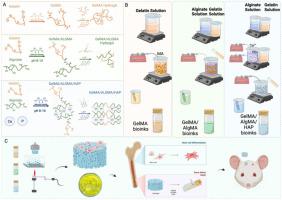
Three-dimensional (3D) bioprinting has revolutionized tissue engineering by enabling precise fabrication with bioinks. Among these techniques, digital light processing (DLP) stands out due to its exceptional resolution, speed, and biocompatibility. However, the progress of DLP is hindered by the limited availability of suitable bioinks. Currently, some studies involve simple mixing of different materials, resulting in bioinks that lack uniformity and photopolymerization characteristics. To address this challenge, we present an innovative one-pot synthesis method for bioinks based on methacrylated gelatin/alginate with hydroxyapatite (HAP). This approach offers significant advantages in terms of efficiency and uniformity. The synthesized bioinks demonstrate excellent printability, stability, and notably enhanced mechanical properties, facilitating optimal in vitro compatibility. Additionally, the HAP-hybrid bioinks printed scaffolds demonstrated impressive bone repair capabilities in vivo compared with pure organic bioinks. In conclusion, the Gel/Alg/HAP bioinks presented herein offer an innovative solution for DLP bioprinting within the field of bone tissue engineering. Their multifaceted advantages help overcome the limitations of restricted bioink choices, pushing forward the boundaries of bioprinting technology and contributing to the progress of regenerative medicine and tissue engineering.
期刊介绍:
Journal of Materials Science & Technology strives to promote global collaboration in the field of materials science and technology. It primarily publishes original research papers, invited review articles, letters, research notes, and summaries of scientific achievements. The journal covers a wide range of materials science and technology topics, including metallic materials, inorganic nonmetallic materials, and composite materials.



 京公网安备 11010802042870号
京ICP备2023020795号-1
京公网安备 11010802042870号
京ICP备2023020795号-1

 分享
分享
 求助内容:
求助内容: 应助结果提醒方式:
 扫码关注我们
