Enhancement of ester biosynthesis in blueberry wines through co-fermentation via cell–cell contact between Torulaspora delbrueckii and Saccharomyces cerevisiae
{"title":"Enhancement of ester biosynthesis in blueberry wines through co-fermentation via cell–cell contact between Torulaspora delbrueckii and Saccharomyces cerevisiae","authors":"Yu Wang , Yu Fu , Qi Zhang, Yue Zhu, Qin Yang, Chen Bian, Lu-Lu Zhao, Qi Chen, Hai-Jun Bi, Xiao-Hui Yang, Xue-Ling Gao","doi":"10.1016/j.foodres.2024.114029","DOIUrl":null,"url":null,"abstract":"<div><p>This study investigated the effects of co-fermentation of <em>T. delbrueckii</em> and <em>S. cerevisiae</em> on the volatile composition and sensory characteristics of blueberry wines. Mixed fermentation led to higher levels of terpenes, higher alcohols, and esters compared to wines fermented with each yeast individually. Conversely, when <em>T. delbrueckii</em> were physically separated from <em>S. cerevisiae</em> in the double-compartment fermenter, contrasting outcomes emerged. The stronger fruity aroma induced by mixed fermentation were linked to higher ester concentrations, including isoamyl acetate, ethyl isovalerate, ethyl hexanoate, and diethyl succinate. The enhanced esters in mixed fermentation can be attributed to the upregulated alcohol acyltransferase activity and the expressions of <em>ACC1</em>, <em>FAS2</em>, <em>ELO1</em> and <em>ATF1</em> genes in late fermentation stage via the cell–cell contact between <em>T. delbrueckii</em> and <em>S. cerevisiae</em>. These findings can deepen the understanding of the interaction between non-<em>Saccharomyces</em> and <em>S. cerevisiae</em> in ester production, assisting wineries in effectively controlling wine aroma through mixed fermentations.</p></div>","PeriodicalId":323,"journal":{"name":"Food Research International","volume":"179 ","pages":"Article 114029"},"PeriodicalIF":8.0000,"publicationDate":"2024-01-17","publicationTypes":"Journal Article","fieldsOfStudy":null,"isOpenAccess":false,"openAccessPdf":"","citationCount":"0","resultStr":null,"platform":"Semanticscholar","paperid":null,"PeriodicalName":"Food Research International","FirstCategoryId":"97","ListUrlMain":"https://www.sciencedirect.com/science/article/pii/S0963996924000991","RegionNum":1,"RegionCategory":"农林科学","ArticlePicture":[],"TitleCN":null,"AbstractTextCN":null,"PMCID":null,"EPubDate":"","PubModel":"","JCR":"Q1","JCRName":"FOOD SCIENCE & TECHNOLOGY","Score":null,"Total":0}
引用次数: 0
Abstract
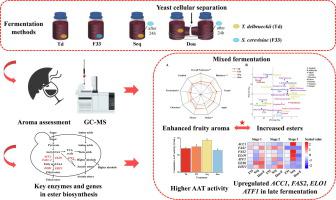
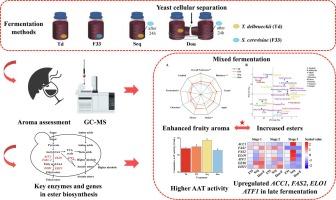
This study investigated the effects of co-fermentation of T. delbrueckii and S. cerevisiae on the volatile composition and sensory characteristics of blueberry wines. Mixed fermentation led to higher levels of terpenes, higher alcohols, and esters compared to wines fermented with each yeast individually. Conversely, when T. delbrueckii were physically separated from S. cerevisiae in the double-compartment fermenter, contrasting outcomes emerged. The stronger fruity aroma induced by mixed fermentation were linked to higher ester concentrations, including isoamyl acetate, ethyl isovalerate, ethyl hexanoate, and diethyl succinate. The enhanced esters in mixed fermentation can be attributed to the upregulated alcohol acyltransferase activity and the expressions of ACC1, FAS2, ELO1 and ATF1 genes in late fermentation stage via the cell–cell contact between T. delbrueckii and S. cerevisiae. These findings can deepen the understanding of the interaction between non-Saccharomyces and S. cerevisiae in ester production, assisting wineries in effectively controlling wine aroma through mixed fermentations.
期刊介绍:
Food Research International serves as a rapid dissemination platform for significant and impactful research in food science, technology, engineering, and nutrition. The journal focuses on publishing novel, high-quality, and high-impact review papers, original research papers, and letters to the editors across various disciplines in the science and technology of food. Additionally, it follows a policy of publishing special issues on topical and emergent subjects in food research or related areas. Selected, peer-reviewed papers from scientific meetings, workshops, and conferences on the science, technology, and engineering of foods are also featured in special issues.



 京公网安备 11010802042870号
京ICP备2023020795号-1
京公网安备 11010802042870号
京ICP备2023020795号-1

 分享
分享
 求助内容:
求助内容: 应助结果提醒方式:
 扫码关注我们
