City-scale assessment of the material and environmental footprint of buildings using an advanced building information model: A case study from Canberra, Australia
{"title":"City-scale assessment of the material and environmental footprint of buildings using an advanced building information model: A case study from Canberra, Australia","authors":"Natthanij Soonsawad, Raymundo Marcos-Martinez, Heinz Schandl","doi":"10.1111/jiec.13456","DOIUrl":null,"url":null,"abstract":"<p>As cities grow, demand for urban materials is set to rise. Meeting sustainability targets will require transformative changes to how cities are constructed. Yet, accurate information on embodied building materials and their environmental impacts at the city scale is still lacking. We use Light Detection and Ranging data, building archetype information, and statistical models to estimate the embodied materials in buildings in Canberra, Australia, and their energy, carbon, and water footprint. In 2015, 57 million tonnes (Mt) of materials were embodied in 140,805 buildings. By weight, concrete was the most used material (44%), followed by sand and stone (32%), and ceramics (11%). Current population growth and building construction trends indicate a need for 2.4 times the building materials stock of 2015 by 2060. Producing such materials would require 1.6 thousand TJ of energy and 793 thousand megaliters of water and emit 48 Mt of CO<sub>2</sub>e—an environmental footprint 1.6 times the one in 2015. If the additional population were to live only in new single houses, material demand would be 4% higher than under current trends and the environmental footprint 5% higher. Housing new residents in low-rise apartments would reduce from current trends the material demand by 5% and the environmental footprint by 12%. Using only apartments of four or more stories would reduce material demand by 28% and the environmental footprint by 14%. This research can inform circular economy efforts to improve building materials management by helping estimate the implications of alternative configurations of the urban built environment.</p>","PeriodicalId":16050,"journal":{"name":"Journal of Industrial Ecology","volume":"28 2","pages":"247-261"},"PeriodicalIF":5.4000,"publicationDate":"2024-01-22","publicationTypes":"Journal Article","fieldsOfStudy":null,"isOpenAccess":false,"openAccessPdf":"https://onlinelibrary.wiley.com/doi/epdf/10.1111/jiec.13456","citationCount":"0","resultStr":null,"platform":"Semanticscholar","paperid":null,"PeriodicalName":"Journal of Industrial Ecology","FirstCategoryId":"93","ListUrlMain":"https://onlinelibrary.wiley.com/doi/10.1111/jiec.13456","RegionNum":3,"RegionCategory":"环境科学与生态学","ArticlePicture":[],"TitleCN":null,"AbstractTextCN":null,"PMCID":null,"EPubDate":"","PubModel":"","JCR":"Q2","JCRName":"ENGINEERING, ENVIRONMENTAL","Score":null,"Total":0}
引用次数: 0
Abstract
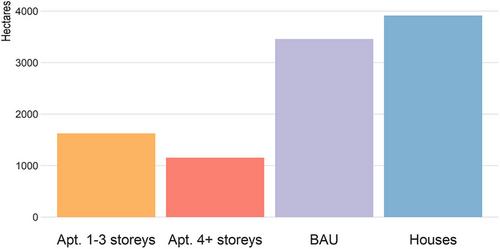
As cities grow, demand for urban materials is set to rise. Meeting sustainability targets will require transformative changes to how cities are constructed. Yet, accurate information on embodied building materials and their environmental impacts at the city scale is still lacking. We use Light Detection and Ranging data, building archetype information, and statistical models to estimate the embodied materials in buildings in Canberra, Australia, and their energy, carbon, and water footprint. In 2015, 57 million tonnes (Mt) of materials were embodied in 140,805 buildings. By weight, concrete was the most used material (44%), followed by sand and stone (32%), and ceramics (11%). Current population growth and building construction trends indicate a need for 2.4 times the building materials stock of 2015 by 2060. Producing such materials would require 1.6 thousand TJ of energy and 793 thousand megaliters of water and emit 48 Mt of CO2e—an environmental footprint 1.6 times the one in 2015. If the additional population were to live only in new single houses, material demand would be 4% higher than under current trends and the environmental footprint 5% higher. Housing new residents in low-rise apartments would reduce from current trends the material demand by 5% and the environmental footprint by 12%. Using only apartments of four or more stories would reduce material demand by 28% and the environmental footprint by 14%. This research can inform circular economy efforts to improve building materials management by helping estimate the implications of alternative configurations of the urban built environment.
期刊介绍:
The Journal of Industrial Ecology addresses a series of related topics:
material and energy flows studies (''industrial metabolism'')
technological change
dematerialization and decarbonization
life cycle planning, design and assessment
design for the environment
extended producer responsibility (''product stewardship'')
eco-industrial parks (''industrial symbiosis'')
product-oriented environmental policy
eco-efficiency
Journal of Industrial Ecology is open to and encourages submissions that are interdisciplinary in approach. In addition to more formal academic papers, the journal seeks to provide a forum for continuing exchange of information and opinions through contributions from scholars, environmental managers, policymakers, advocates and others involved in environmental science, management and policy.



 京公网安备 11010802042870号
京ICP备2023020795号-1
京公网安备 11010802042870号
京ICP备2023020795号-1

 分享
分享
 求助内容:
求助内容: 应助结果提醒方式:
 扫码关注我们
