{"title":"How Does Rating Specific Features of an Experience Alter Consumers’ Overall Evaluations of That Experience?","authors":"Katie S Mehr, Joseph P Simmons","doi":"10.1093/jcr/ucae005","DOIUrl":null,"url":null,"abstract":"\n How does the way companies elicit ratings from consumers affect the ratings that they receive? In 10 pre-registered experiments, we find that consumers rate subpar experiences more positively overall when they are also asked to rate specific aspects of those experiences (e.g., a restaurant’s food, service, and ambiance). Studies 1–4 established the basic effect across different scenarios and experiences. Study 5 found that the effect is limited to being asked to rate specific features of an experience, rather than providing open-ended comments about those features. Studies 6–9 provided evidence that the effect does not emerge because rating positive aspects of a subpar experience reminds consumers that their experiences had some good features. Rather, it emerges because consumers want to avoid incorporating negative information into both the overall and the attribute ratings. Lastly, study 10 found that asking consumers to rate attributes of a subpar experience reduces the predictive validity of their overall rating. We discuss implications of this work and reconcile it with conflicting findings in the literature.","PeriodicalId":5,"journal":{"name":"ACS Applied Materials & Interfaces","volume":"42 4","pages":""},"PeriodicalIF":8.2000,"publicationDate":"2024-01-23","publicationTypes":"Journal Article","fieldsOfStudy":null,"isOpenAccess":false,"openAccessPdf":"","citationCount":"0","resultStr":null,"platform":"Semanticscholar","paperid":null,"PeriodicalName":"ACS Applied Materials & Interfaces","FirstCategoryId":"91","ListUrlMain":"https://doi.org/10.1093/jcr/ucae005","RegionNum":2,"RegionCategory":"材料科学","ArticlePicture":[],"TitleCN":null,"AbstractTextCN":null,"PMCID":null,"EPubDate":"","PubModel":"","JCR":"Q1","JCRName":"MATERIALS SCIENCE, MULTIDISCIPLINARY","Score":null,"Total":0}
引用次数: 0
Abstract
How does the way companies elicit ratings from consumers affect the ratings that they receive? In 10 pre-registered experiments, we find that consumers rate subpar experiences more positively overall when they are also asked to rate specific aspects of those experiences (e.g., a restaurant’s food, service, and ambiance). Studies 1–4 established the basic effect across different scenarios and experiences. Study 5 found that the effect is limited to being asked to rate specific features of an experience, rather than providing open-ended comments about those features. Studies 6–9 provided evidence that the effect does not emerge because rating positive aspects of a subpar experience reminds consumers that their experiences had some good features. Rather, it emerges because consumers want to avoid incorporating negative information into both the overall and the attribute ratings. Lastly, study 10 found that asking consumers to rate attributes of a subpar experience reduces the predictive validity of their overall rating. We discuss implications of this work and reconcile it with conflicting findings in the literature.
期刊介绍:
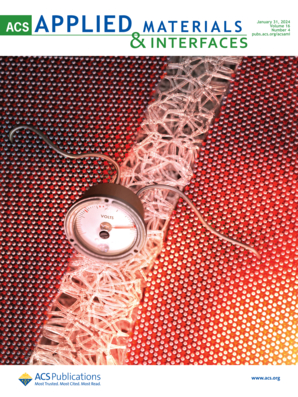
ACS Applied Materials & Interfaces is a leading interdisciplinary journal that brings together chemists, engineers, physicists, and biologists to explore the development and utilization of newly-discovered materials and interfacial processes for specific applications. Our journal has experienced remarkable growth since its establishment in 2009, both in terms of the number of articles published and the impact of the research showcased. We are proud to foster a truly global community, with the majority of published articles originating from outside the United States, reflecting the rapid growth of applied research worldwide.




 京公网安备 11010802042870号
京ICP备2023020795号-1
京公网安备 11010802042870号
京ICP备2023020795号-1

 分享
分享
 求助内容:
求助内容: 应助结果提醒方式:
 扫码关注我们
