Christopher F. Karpowitz, J. Q. Monson, J. Preece, Alejandra Aldridge
{"title":"Selecting for Masculinity: Women’s Under-Representation in the Republican Party","authors":"Christopher F. Karpowitz, J. Q. Monson, J. Preece, Alejandra Aldridge","doi":"10.1017/s0003055423000783","DOIUrl":null,"url":null,"abstract":"The gap between women’s representation in the Democratic and Republican parties has grown significantly in the last three decades. We argue existing explanations undervalue voters’ contributions to this trend by focusing on voter responses to candidate sex rather than candidate gender. We theorize that Republican voters (especially the most conservative) prefer masculine candidates in intraparty and entry-level elections. Because sex and gender are correlated, this limits the number of Republican women who advance through the political pipeline. Experimental vignettes from two rounds of the Cooperative Congressional Election Study (N = 2,000) and two large surveys of Republicans (N > 10,000) show that Republican (but not Democratic) voters penalize candidates with “feminine” self-presentation regardless of the candidate’s sex. Original data on the self-presentation of Republican candidates for entry-level office (N = 459) confirm Republican candidates often present themselves in gender-stereotypical ways. In short, voters play an underappreciated role in the partisan gap in women’s representation.","PeriodicalId":5,"journal":{"name":"ACS Applied Materials & Interfaces","volume":" 6","pages":""},"PeriodicalIF":8.2000,"publicationDate":"2024-01-16","publicationTypes":"Journal Article","fieldsOfStudy":null,"isOpenAccess":false,"openAccessPdf":"","citationCount":"0","resultStr":null,"platform":"Semanticscholar","paperid":null,"PeriodicalName":"ACS Applied Materials & Interfaces","FirstCategoryId":"90","ListUrlMain":"https://doi.org/10.1017/s0003055423000783","RegionNum":2,"RegionCategory":"材料科学","ArticlePicture":[],"TitleCN":null,"AbstractTextCN":null,"PMCID":null,"EPubDate":"","PubModel":"","JCR":"Q1","JCRName":"MATERIALS SCIENCE, MULTIDISCIPLINARY","Score":null,"Total":0}
引用次数: 0
Abstract
The gap between women’s representation in the Democratic and Republican parties has grown significantly in the last three decades. We argue existing explanations undervalue voters’ contributions to this trend by focusing on voter responses to candidate sex rather than candidate gender. We theorize that Republican voters (especially the most conservative) prefer masculine candidates in intraparty and entry-level elections. Because sex and gender are correlated, this limits the number of Republican women who advance through the political pipeline. Experimental vignettes from two rounds of the Cooperative Congressional Election Study (N = 2,000) and two large surveys of Republicans (N > 10,000) show that Republican (but not Democratic) voters penalize candidates with “feminine” self-presentation regardless of the candidate’s sex. Original data on the self-presentation of Republican candidates for entry-level office (N = 459) confirm Republican candidates often present themselves in gender-stereotypical ways. In short, voters play an underappreciated role in the partisan gap in women’s representation.
期刊介绍:
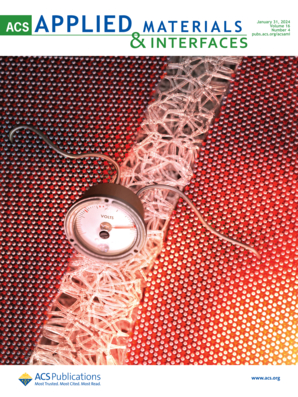
ACS Applied Materials & Interfaces is a leading interdisciplinary journal that brings together chemists, engineers, physicists, and biologists to explore the development and utilization of newly-discovered materials and interfacial processes for specific applications. Our journal has experienced remarkable growth since its establishment in 2009, both in terms of the number of articles published and the impact of the research showcased. We are proud to foster a truly global community, with the majority of published articles originating from outside the United States, reflecting the rapid growth of applied research worldwide.



 京公网安备 11010802042870号
京ICP备2023020795号-1
京公网安备 11010802042870号
京ICP备2023020795号-1

 分享
分享
 求助内容:
求助内容: 应助结果提醒方式:
 扫码关注我们
