{"title":"Autonomous aeroamphibious invisibility cloak with stochastic-evolution learning","authors":"Chao Qian, Yuetian Jia, Zhedong Wang, Jieting Chen, Pujing Lin, Xiaoyue Zhu, Erping Li, Hongsheng Chen","doi":"10.1117/1.ap.6.1.016001","DOIUrl":null,"url":null,"abstract":". Being invisible ad libitum has long captivated the popular imagination, particularly in terms of safeguarding modern high-end instruments from potential threats. Decades ago, the advent of metamaterials and transformation optics sparked considerable interest in invisibility cloaks, which have been mainly demonstrated in ground and waveguide modalities. However, an omnidirectional flying cloak has not been achieved, primarily due to the challenges associated with dynamic synthesis of metasurface dispersion. We demonstrate an autonomous aeroamphibious invisibility cloak that incorporates a suite of perception, decision, and execution modules, capable of maintaining invisibility amidst kaleidoscopic backgrounds and neutralizing external stimuli. The physical breakthrough lies in the spatiotemporal modulation imparted on tunable metasurfaces to sculpt the scattering field in both space and frequency domains. To intelligently control the spatiotemporal metasurfaces, we introduce a stochastic-evolution learning that automatically aligns with the optimal solution through maximum probabilistic inference. In a fully self-driving experiment, we implement this concept on an unmanned drone and showcase adaptive invisibility in three canonical landscapes — sea, land, and air — with a similarity rate of up to 95%. Our work extends the family of invisibility cloaks to flying modality and inspires other research on material discoveries and homeostatic meta-devices.","PeriodicalId":20,"journal":{"name":"ACS Medicinal Chemistry Letters","volume":" 4","pages":""},"PeriodicalIF":4.0000,"publicationDate":"2024-01-12","publicationTypes":"Journal Article","fieldsOfStudy":null,"isOpenAccess":false,"openAccessPdf":"","citationCount":"0","resultStr":null,"platform":"Semanticscholar","paperid":null,"PeriodicalName":"ACS Medicinal Chemistry Letters","FirstCategoryId":"101","ListUrlMain":"https://doi.org/10.1117/1.ap.6.1.016001","RegionNum":3,"RegionCategory":"医学","ArticlePicture":[],"TitleCN":null,"AbstractTextCN":null,"PMCID":null,"EPubDate":"","PubModel":"","JCR":"Q2","JCRName":"CHEMISTRY, MEDICINAL","Score":null,"Total":0}
引用次数: 0
Abstract
. Being invisible ad libitum has long captivated the popular imagination, particularly in terms of safeguarding modern high-end instruments from potential threats. Decades ago, the advent of metamaterials and transformation optics sparked considerable interest in invisibility cloaks, which have been mainly demonstrated in ground and waveguide modalities. However, an omnidirectional flying cloak has not been achieved, primarily due to the challenges associated with dynamic synthesis of metasurface dispersion. We demonstrate an autonomous aeroamphibious invisibility cloak that incorporates a suite of perception, decision, and execution modules, capable of maintaining invisibility amidst kaleidoscopic backgrounds and neutralizing external stimuli. The physical breakthrough lies in the spatiotemporal modulation imparted on tunable metasurfaces to sculpt the scattering field in both space and frequency domains. To intelligently control the spatiotemporal metasurfaces, we introduce a stochastic-evolution learning that automatically aligns with the optimal solution through maximum probabilistic inference. In a fully self-driving experiment, we implement this concept on an unmanned drone and showcase adaptive invisibility in three canonical landscapes — sea, land, and air — with a similarity rate of up to 95%. Our work extends the family of invisibility cloaks to flying modality and inspires other research on material discoveries and homeostatic meta-devices.
期刊介绍:
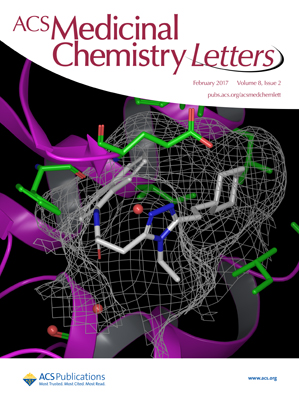
ACS Medicinal Chemistry Letters is interested in receiving manuscripts that discuss various aspects of medicinal chemistry. The journal will publish studies that pertain to a broad range of subject matter, including compound design and optimization, biological evaluation, drug delivery, imaging agents, and pharmacology of both small and large bioactive molecules. Specific areas include but are not limited to:
Identification, synthesis, and optimization of lead biologically active molecules and drugs (small molecules and biologics)
Biological characterization of new molecular entities in the context of drug discovery
Computational, cheminformatics, and structural studies for the identification or SAR analysis of bioactive molecules, ligands and their targets, etc.
Novel and improved methodologies, including radiation biochemistry, with broad application to medicinal chemistry
Discovery technologies for biologically active molecules from both synthetic and natural (plant and other) sources
Pharmacokinetic/pharmacodynamic studies that address mechanisms underlying drug disposition and response
Pharmacogenetic and pharmacogenomic studies used to enhance drug design and the translation of medicinal chemistry into the clinic
Mechanistic drug metabolism and regulation of metabolic enzyme gene expression
Chemistry patents relevant to the medicinal chemistry field.



 京公网安备 11010802042870号
京ICP备2023020795号-1
京公网安备 11010802042870号
京ICP备2023020795号-1

 分享
分享
 求助内容:
求助内容: 应助结果提醒方式:
 扫码关注我们
