Construction of cross-linked networks in polylactic acid biocomposites by using vegetable oil-modified collagen fibers for improving anti-stress relaxation and toughness

IF 6.2 1区 农林科学 Q1 AGRICULTURAL ENGINEERING Industrial Crops and Products Pub Date : 2024-04-01 Epub Date: 2024-02-01 DOI:10.1016/j.indcrop.2024.118160
Chao Lei , Weixing Xu , Bi Shi , Yunhang Zeng
{"title":"Construction of cross-linked networks in polylactic acid biocomposites by using vegetable oil-modified collagen fibers for improving anti-stress relaxation and toughness","authors":"Chao Lei ,&nbsp;Weixing Xu ,&nbsp;Bi Shi ,&nbsp;Yunhang Zeng","doi":"10.1016/j.indcrop.2024.118160","DOIUrl":null,"url":null,"abstract":"<div><p><span>Polylactic acid (PLA) is a typical bio-based polymer derived from crops. Its widespread application has been limited due to stress relaxation and brittleness. Here, a sustainable strategy to simultaneously improve the anti-stress relaxation and toughness of PLA </span>biocomposites<span> was proposed by blending PLA with epoxidized soybean oil (ESO)-modified collagen fiber (CF, ESO-CF). ESO enhanced the interfacial interaction between ESO-CF and PLA by constructing cross-linked networks in ESO-CF/PLA. Comparative analyses of stress relaxation and fracture behaviors were conducted between ESO-CF/PLA and pure PLA. The stress–strain curves of ESO-CF/PLA showed lower peak stress reduction rate (1% strain; 27.1%) and irrecoverable strain (zero stress; 0.3%) after 10 cycles compared with those of pure PLA, indicating that the introduction of ESO-CF greatly improved the anti-stress relaxation of PLA. Moreover, the elongation at break and the impact strength of ESO-CF/PLA were 301.6% and 78.9% higher than those of pure PLA, respectively, indicating that ESO-CF improved the toughness of PLA. The enhancements were mainly attributed to the naturally multidirectional and hierarchical structure of ESO-CF and the effective interfacial interaction between ESO-CF and PLA. This work provides insights into the development of PLA biocomposites with enhanced mechanical properties by blending with vegetable oil-modified natural fibers.</span></p></div>","PeriodicalId":13581,"journal":{"name":"Industrial Crops and Products","volume":"210 ","pages":"Article 118160"},"PeriodicalIF":6.2000,"publicationDate":"2024-04-01","publicationTypes":"Journal Article","fieldsOfStudy":null,"isOpenAccess":false,"openAccessPdf":"","citationCount":"0","resultStr":null,"platform":"Semanticscholar","paperid":null,"PeriodicalName":"Industrial Crops and Products","FirstCategoryId":"97","ListUrlMain":"https://www.sciencedirect.com/science/article/pii/S0926669024001407","RegionNum":1,"RegionCategory":"农林科学","ArticlePicture":[],"TitleCN":null,"AbstractTextCN":null,"PMCID":null,"EPubDate":"2024/2/1 0:00:00","PubModel":"Epub","JCR":"Q1","JCRName":"AGRICULTURAL ENGINEERING","Score":null,"Total":0}
引用次数: 0

Abstract

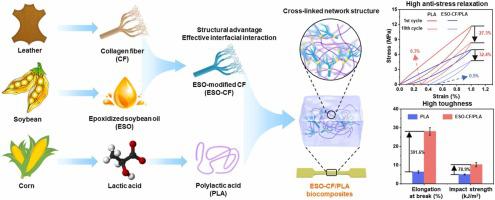
Polylactic acid (PLA) is a typical bio-based polymer derived from crops. Its widespread application has been limited due to stress relaxation and brittleness. Here, a sustainable strategy to simultaneously improve the anti-stress relaxation and toughness of PLA biocomposites was proposed by blending PLA with epoxidized soybean oil (ESO)-modified collagen fiber (CF, ESO-CF). ESO enhanced the interfacial interaction between ESO-CF and PLA by constructing cross-linked networks in ESO-CF/PLA. Comparative analyses of stress relaxation and fracture behaviors were conducted between ESO-CF/PLA and pure PLA. The stress–strain curves of ESO-CF/PLA showed lower peak stress reduction rate (1% strain; 27.1%) and irrecoverable strain (zero stress; 0.3%) after 10 cycles compared with those of pure PLA, indicating that the introduction of ESO-CF greatly improved the anti-stress relaxation of PLA. Moreover, the elongation at break and the impact strength of ESO-CF/PLA were 301.6% and 78.9% higher than those of pure PLA, respectively, indicating that ESO-CF improved the toughness of PLA. The enhancements were mainly attributed to the naturally multidirectional and hierarchical structure of ESO-CF and the effective interfacial interaction between ESO-CF and PLA. This work provides insights into the development of PLA biocomposites with enhanced mechanical properties by blending with vegetable oil-modified natural fibers.
Abstract Image

查看原文
分享 分享
微信好友 朋友圈 QQ好友 复制链接
本刊更多论文
利用植物油改性胶原纤维在聚乳酸生物复合材料中构建交联网络,改善抗应力松弛和韧性
聚乳酸(PLA)是从农作物中提取的一种典型的生物基聚合物。由于应力松弛和脆性,它的广泛应用受到了限制。本文提出了一种可持续的策略,通过将聚乳酸与环氧化大豆油(ESO)改性胶原纤维(CF,ESO-CF)混合,同时提高聚乳酸生物复合材料的抗应力松弛性和韧性。通过在 ESO-CF/PLA 中构建交联网络,ESO 增强了 ESO-CF 和 PLA 之间的界面相互作用。对 ESO-CF/PLA 和纯聚乳酸的应力松弛和断裂行为进行了比较分析。与纯聚乳酸相比,ESO-CF/PLA 的应力-应变曲线在 10 次循环后显示出更低的峰值应力降低率(1%应变;27.1%)和不可恢复应变(零应力;0.3%),表明 ESO-CF 的引入大大改善了聚乳酸的抗应力松弛性能。此外,与纯聚乳酸相比,ESO-CF/PLA 的断裂伸长率和冲击强度分别提高了 301.6% 和 78.9%,表明 ESO-CF 提高了聚乳酸的韧性。韧性的提高主要归功于ESO-CF天然的多向分层结构以及ESO-CF与聚乳酸之间有效的界面相互作用。这项研究为通过与植物油改性天然纤维共混来开发具有更佳机械性能的聚乳酸生物复合材料提供了新的思路。
本文章由计算机程序翻译,如有差异,请以英文原文为准。
求助全文
约1分钟内获得全文 去求助
来源期刊
Industrial Crops and Products
Industrial Crops and Products 农林科学-农业工程
CiteScore
9.50
自引率
8.50%
发文量
1518
审稿时长
43 days
期刊介绍: Industrial Crops and Products is an International Journal publishing academic and industrial research on industrial (defined as non-food/non-feed) crops and products. Papers concern both crop-oriented and bio-based materials from crops-oriented research, and should be of interest to an international audience, hypothesis driven, and where comparisons are made statistics performed.
期刊最新文献
In-depth insight into the corrosion inhibition mechanism of an environmentally benign lignin-based corrosion inhibitor: From molecular adsorption to film reconstruction Integrated microbiome-metabolome analysis reveals phytotoxicity of biodegradable and non-biodegradable microplastics microplastics in tobacco and biochar-mediated mitigation via particle size modulation The effect of crepe rubber maturation on properties of raw natural rubber and vulcanizates Regulation mechanisms of the combined addition of nitrogen fertilizer and nitrification inhibitor on phytoremediation efficiency and greenhouse gas emissions in heavy metal contaminated soil: A field study Experimental investigation and analysis on oilseed rape straw pyrolysis with catalytic Fe/Ni-CaO for enhanced hydrogen production
×
引用
GB/T 7714-2015
复制
MLA
复制
APA
复制
导出至
BibTeX EndNote RefMan NoteFirst NoteExpress
×
×
提示
您的信息不完整,为了账户安全,请先补充。
现在去补充
×
提示
您因"违规操作"
具体请查看互助需知
我知道了
×
提示
现在去查看 取消
×
提示
确定
0
微信
客服QQ
Book学术公众号 扫码关注我们
反馈
×
意见反馈
请填写您的意见或建议
请填写您的手机或邮箱
已复制链接
已复制链接
快去分享给好友吧!
我知道了
×
扫码分享
扫码分享
Book学术官方微信
Book学术文献互助
Book学术文献互助群
群 号:604180095
Book学术
文献互助 智能选刊 最新文献 互助须知 联系我们:info@booksci.cn
Book学术提供免费学术资源搜索服务,方便国内外学者检索中英文文献。致力于提供最便捷和优质的服务体验。
Copyright © 2023 Book学术 All rights reserved.
ghs 京公网安备 11010802042870号 京ICP备2023020795号-1





