RETRACTED ARTICLE: Development of
Electrochemical Immunosensors for Early Diagnosis of Polycystic Ovary Syndrome (PCOS),
and Their Potential Mobile Phone Application
Muhammad Ali Yousif Al-Janabi, Ramazan Bayat, Muhammed Bekmezci, Tiri Rima Nour Elhouda, Fatih Sen, Afsaneh Kaffash, Mehdi Baghayeri, Hassan Rokni, Fatemeh Karimi
{"title":"RETRACTED ARTICLE: Development of\n Electrochemical Immunosensors for Early Diagnosis of Polycystic Ovary Syndrome (PCOS),\n and Their Potential Mobile Phone Application","authors":"Muhammad Ali Yousif Al-Janabi, Ramazan Bayat, Muhammed Bekmezci, Tiri Rima Nour Elhouda, Fatih Sen, Afsaneh Kaffash, Mehdi Baghayeri, Hassan Rokni, Fatemeh Karimi","doi":"10.1007/s11244-023-01899-0","DOIUrl":null,"url":null,"abstract":"<div><p>An effective way of monitoring the biomarker is with electrochemical\n sensor studies. In this work, it was formed using electrochemical deposition of high\n conductivity gold nanoparticles (AuNPs) and an amine-functional reduced graphene\n oxide (NH<sub>2</sub>-RGO) nanocomposite. This technique not only\n reduced HAuCl<sub>4</sub> and graphene oxide in situ but also improved\n the electrocatalytic performance. XRD, SEM, and FTIR analytical methods confirmed\n the size and structure of the AuNPs/NH<sub>2</sub>-RGO nanoparticle. As\n a result of XRD analysis, AuNPs/NH2-RGO crystal structure was formed. In addition,\n antibodies (Ab) were immobilized on the modified electrode surface using a\n self-assembled monolayer. Cyclic voltammetry (CV) and differential pulse voltammetry\n (DPV) methods were used to evaluate the interaction of Ab with antigen. SHBG\n detection had a dynamic linear range of 0.6–12 nmol/L and a limit of\n detection (LOD) of 0.0043 µM in enhanced sensor applications. The\n AuNPs/NH<sub>2</sub>-RGO based sensor has the potential to be a\n valuable tool in clinical diagnostic applications in the future.</p></div>","PeriodicalId":801,"journal":{"name":"Topics in Catalysis","volume":"67 9-12","pages":"688 - 697"},"PeriodicalIF":3.0000,"publicationDate":"2024-02-03","publicationTypes":"Journal Article","fieldsOfStudy":null,"isOpenAccess":false,"openAccessPdf":"","citationCount":"0","resultStr":null,"platform":"Semanticscholar","paperid":null,"PeriodicalName":"Topics in Catalysis","FirstCategoryId":"92","ListUrlMain":"https://link.springer.com/article/10.1007/s11244-023-01899-0","RegionNum":3,"RegionCategory":"化学","ArticlePicture":[],"TitleCN":null,"AbstractTextCN":null,"PMCID":null,"EPubDate":"","PubModel":"","JCR":"Q2","JCRName":"CHEMISTRY, APPLIED","Score":null,"Total":0}
引用次数: 0
Abstract
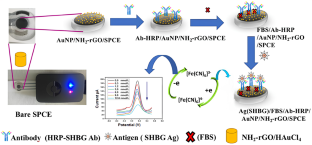
An effective way of monitoring the biomarker is with electrochemical
sensor studies. In this work, it was formed using electrochemical deposition of high
conductivity gold nanoparticles (AuNPs) and an amine-functional reduced graphene
oxide (NH2-RGO) nanocomposite. This technique not only
reduced HAuCl4 and graphene oxide in situ but also improved
the electrocatalytic performance. XRD, SEM, and FTIR analytical methods confirmed
the size and structure of the AuNPs/NH2-RGO nanoparticle. As
a result of XRD analysis, AuNPs/NH2-RGO crystal structure was formed. In addition,
antibodies (Ab) were immobilized on the modified electrode surface using a
self-assembled monolayer. Cyclic voltammetry (CV) and differential pulse voltammetry
(DPV) methods were used to evaluate the interaction of Ab with antigen. SHBG
detection had a dynamic linear range of 0.6–12 nmol/L and a limit of
detection (LOD) of 0.0043 µM in enhanced sensor applications. The
AuNPs/NH2-RGO based sensor has the potential to be a
valuable tool in clinical diagnostic applications in the future.
期刊介绍:
Topics in Catalysis publishes topical collections in all fields of catalysis which are composed only of invited articles from leading authors. The journal documents today’s emerging and critical trends in all branches of catalysis. Each themed issue is organized by renowned Guest Editors in collaboration with the Editors-in-Chief. Proposals for new topics are welcome and should be submitted directly to the Editors-in-Chief.
The publication of individual uninvited original research articles can be sent to our sister journal Catalysis Letters. This journal aims for rapid publication of high-impact original research articles in all fields of both applied and theoretical catalysis, including heterogeneous, homogeneous and biocatalysis.



 京公网安备 11010802042870号
京ICP备2023020795号-1
京公网安备 11010802042870号
京ICP备2023020795号-1

 分享
分享
 求助内容:
求助内容: 应助结果提醒方式:
 扫码关注我们
