Xuan Xu , Xiaozheng Jia , Peng Jing , Yuanyuan Zhang , Jianguo Cui , Kristina Zuzek , Sturm Saso , Baocang Liu , Jun Zhang
{"title":"In situ anodic leaching of Nd-Fe-B sludge with fast leaching kinetics for selective recovery of rare-earth elements","authors":"Xuan Xu , Xiaozheng Jia , Peng Jing , Yuanyuan Zhang , Jianguo Cui , Kristina Zuzek , Sturm Saso , Baocang Liu , Jun Zhang","doi":"10.1016/j.jre.2024.02.001","DOIUrl":null,"url":null,"abstract":"<div><div>Neodymium-iron-boron (Nd-Fe-B) sludge is an important secondary resource of rare-earth elements (REEs). However, the state-of-the-art recycling method, i.e., HCl-preferential dissolution faces challenges such as slow leaching kinetics, excessive chemical consumption and wastewater generation. In this work, the <em>in situ</em> anodic leaching of Nd-Fe-B sludge was developed to selectively recover REEs with high efficiency. The leaching rates of the REEs are 2.4–9.0 times higher using the <em>in situ</em> anodic leaching at the current density from 10 to 40 mA/cm<sup>2</sup> than using conventional chemical leaching under the maintained pH of 3.7. Mechanism studies reveal that the anode-generated H<sup>+</sup> plays the key role during the <em>in situ</em> anodic leaching process that locally increases the H<sup>+</sup> concentration at the interface of sludge particles, accelerating the leaching kinetics. By achieving a total leaching efficiency of Nd-Fe-B sludge close to 100% and the Fe deposition efficiency in the range of 70.9%–74.3%, selective leaching of REEs is successfully realized and thus largely reduces chemical consumption. Additionally, a two-step recycling route involving electrolysis-selective precipitation was proposed that enables a stable REEs recovery of 92.2% with recyclable electrolyte. This study provides a novel and environmentally-friendly strategy for the efficient recovery of REEs from secondary resources.</div></div>","PeriodicalId":16940,"journal":{"name":"Journal of Rare Earths","volume":"43 3","pages":"Pages 603-611"},"PeriodicalIF":7.2000,"publicationDate":"2025-03-01","publicationTypes":"Journal Article","fieldsOfStudy":null,"isOpenAccess":false,"openAccessPdf":"","citationCount":"0","resultStr":null,"platform":"Semanticscholar","paperid":null,"PeriodicalName":"Journal of Rare Earths","FirstCategoryId":"92","ListUrlMain":"https://www.sciencedirect.com/science/article/pii/S100207212400036X","RegionNum":1,"RegionCategory":"化学","ArticlePicture":[],"TitleCN":null,"AbstractTextCN":null,"PMCID":null,"EPubDate":"2024/2/5 0:00:00","PubModel":"Epub","JCR":"Q1","JCRName":"CHEMISTRY, APPLIED","Score":null,"Total":0}
引用次数: 0
Abstract
Neodymium-iron-boron (Nd-Fe-B) sludge is an important secondary resource of rare-earth elements (REEs). However, the state-of-the-art recycling method, i.e., HCl-preferential dissolution faces challenges such as slow leaching kinetics, excessive chemical consumption and wastewater generation. In this work, the in situ anodic leaching of Nd-Fe-B sludge was developed to selectively recover REEs with high efficiency. The leaching rates of the REEs are 2.4–9.0 times higher using the in situ anodic leaching at the current density from 10 to 40 mA/cm2 than using conventional chemical leaching under the maintained pH of 3.7. Mechanism studies reveal that the anode-generated H+ plays the key role during the in situ anodic leaching process that locally increases the H+ concentration at the interface of sludge particles, accelerating the leaching kinetics. By achieving a total leaching efficiency of Nd-Fe-B sludge close to 100% and the Fe deposition efficiency in the range of 70.9%–74.3%, selective leaching of REEs is successfully realized and thus largely reduces chemical consumption. Additionally, a two-step recycling route involving electrolysis-selective precipitation was proposed that enables a stable REEs recovery of 92.2% with recyclable electrolyte. This study provides a novel and environmentally-friendly strategy for the efficient recovery of REEs from secondary resources.
期刊介绍:
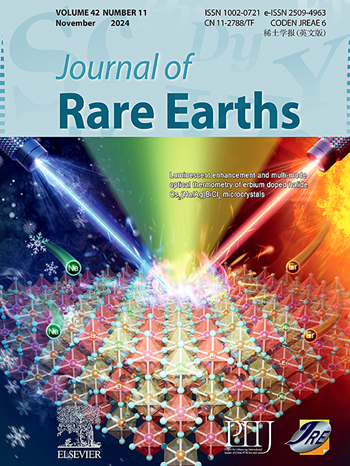
The Journal of Rare Earths reports studies on the 17 rare earth elements. It is a unique English-language learned journal that publishes works on various aspects of basic theory and applied science in the field of rare earths (RE). The journal accepts original high-quality original research papers and review articles with inventive content, and complete experimental data. It represents high academic standards and new progress in the RE field. Due to the advantage of abundant RE resources of China, the research on RE develops very actively, and papers on the latest progress in this field emerge every year. It is not only an important resource in which technicians publish and obtain their latest research results on RE, but also an important way of reflecting the updated progress in RE research field.
The Journal of Rare Earths covers all research and application of RE rare earths including spectroscopy, luminescence and phosphors, rare earth catalysis, magnetism and magnetic materials, advanced rare earth materials, RE chemistry & hydrometallurgy, RE metallography & pyrometallurgy, RE new materials, RE solid state physics & solid state chemistry, rare earth applications, RE analysis & test, RE geology & ore dressing, etc.





 京公网安备 11010802042870号
京ICP备2023020795号-1
京公网安备 11010802042870号
京ICP备2023020795号-1

 分享
分享
 求助内容:
求助内容: 应助结果提醒方式:
 扫码关注我们
