{"title":"Development and Characterization of Sulfasalazine Cubosomes for Potential Transdermal Drug Delivery.","authors":"Mekha Mathew, Anasuya Patil, Hemanth G","doi":"10.2174/0122117385269522231113041029","DOIUrl":null,"url":null,"abstract":"<p><strong>Background: </strong>Rheumatoid arthritis is indeed a constant, progressive autoimmune disease that acts on the synovial membrane, distinguished by joint pain, swelling, and tenderness. Sulfasalazine belongs to BCS Class IV having low solubility and low permeability. To overcome the issue and provide a localized effect Cubosomes were chosen for the transdermal drug delivery system.</p><p><strong>Objectives: </strong>The primary objective of this investigation was to pass on sulfasalazine-loaded cubosomes over the skin to treat rheumatoid arthritis. On the way to overcome this issue of oral sulfasalazine and provide localized effect, Cubosomes were chosen for the transdermal drug delivery system.</p><p><strong>Methods: </strong>Sulfasalazine-loaded cubosomes were prepared by the top-down method using GMO and Poloxamer 407. Different concentrations of lipid and surfactant were used in the formulation using 3<sup>2</sup> full factorial designs. The prepared formulations were assessed for p.s, z,p, %EE, FTIR, SEM, <i>in-vitro</i> release, <i>ex-vivo</i> permeation, and deposition studies with pH 7.4 phosphate buffer saline.</p><p><strong>Results: </strong>The particle size varies between 65 nm to 129 nm, while the negative zeta potential ranged from - 18.8 mV to -24.8 mV. The entrapment efficiency was between 87% and 95%. The formulations' in-vitro drug release was carried out for 12 hours. The optimized formulation showed a controlled release of sulfasalazine and better ex-vivo permeation and deposition properties than sulfasalazine suspension.</p><p><strong>Conclusion: </strong>Overall study findings support the possibility of applying transdermal sulfasalazineloaded cubosomes to alleviate rheumatoid arthritis.</p>","PeriodicalId":19774,"journal":{"name":"Pharmaceutical nanotechnology","volume":" ","pages":"320-327"},"PeriodicalIF":0.0000,"publicationDate":"2025-01-01","publicationTypes":"Journal Article","fieldsOfStudy":null,"isOpenAccess":false,"openAccessPdf":"https://www.ncbi.nlm.nih.gov/pmc/articles/PMC11851143/pdf/","citationCount":"0","resultStr":null,"platform":"Semanticscholar","paperid":null,"PeriodicalName":"Pharmaceutical nanotechnology","FirstCategoryId":"1085","ListUrlMain":"https://doi.org/10.2174/0122117385269522231113041029","RegionNum":0,"RegionCategory":null,"ArticlePicture":[],"TitleCN":null,"AbstractTextCN":null,"PMCID":null,"EPubDate":"","PubModel":"","JCR":"Q2","JCRName":"Pharmacology, Toxicology and Pharmaceutics","Score":null,"Total":0}
引用次数: 0
Abstract
Background: Rheumatoid arthritis is indeed a constant, progressive autoimmune disease that acts on the synovial membrane, distinguished by joint pain, swelling, and tenderness. Sulfasalazine belongs to BCS Class IV having low solubility and low permeability. To overcome the issue and provide a localized effect Cubosomes were chosen for the transdermal drug delivery system.
Objectives: The primary objective of this investigation was to pass on sulfasalazine-loaded cubosomes over the skin to treat rheumatoid arthritis. On the way to overcome this issue of oral sulfasalazine and provide localized effect, Cubosomes were chosen for the transdermal drug delivery system.
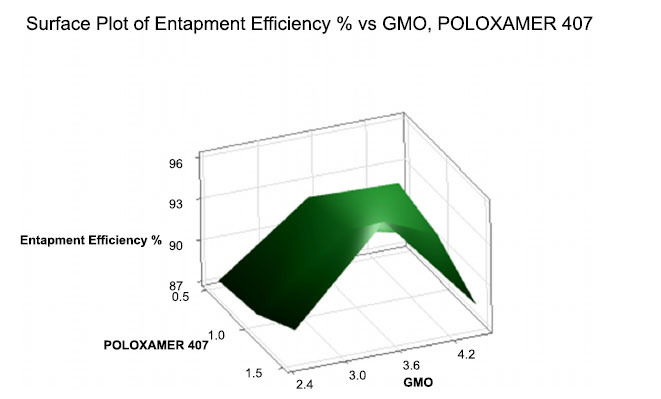
Methods: Sulfasalazine-loaded cubosomes were prepared by the top-down method using GMO and Poloxamer 407. Different concentrations of lipid and surfactant were used in the formulation using 32 full factorial designs. The prepared formulations were assessed for p.s, z,p, %EE, FTIR, SEM, in-vitro release, ex-vivo permeation, and deposition studies with pH 7.4 phosphate buffer saline.
Results: The particle size varies between 65 nm to 129 nm, while the negative zeta potential ranged from - 18.8 mV to -24.8 mV. The entrapment efficiency was between 87% and 95%. The formulations' in-vitro drug release was carried out for 12 hours. The optimized formulation showed a controlled release of sulfasalazine and better ex-vivo permeation and deposition properties than sulfasalazine suspension.
Conclusion: Overall study findings support the possibility of applying transdermal sulfasalazineloaded cubosomes to alleviate rheumatoid arthritis.
期刊介绍:
Pharmaceutical Nanotechnology publishes original manuscripts, full-length/mini reviews, thematic issues, rapid technical notes and commentaries that provide insights into the synthesis, characterisation and pharmaceutical (or diagnostic) application of materials at the nanoscale. The nanoscale is defined as a size range of below 1 µm. Scientific findings related to micro and macro systems with functionality residing within features defined at the nanoscale are also within the scope of the journal. Manuscripts detailing the synthesis, exhaustive characterisation, biological evaluation, clinical testing and/ or toxicological assessment of nanomaterials are of particular interest to the journal’s readership. Articles should be self contained, centred around a well founded hypothesis and should aim to showcase the pharmaceutical/ diagnostic implications of the nanotechnology approach. Manuscripts should aim, wherever possible, to demonstrate the in vivo impact of any nanotechnological intervention. As reducing a material to the nanoscale is capable of fundamentally altering the material’s properties, the journal’s readership is particularly interested in new characterisation techniques and the advanced properties that originate from this size reduction. Both bottom up and top down approaches to the realisation of nanomaterials lie within the scope of the journal.






 京公网安备 11010802042870号
京ICP备2023020795号-1
京公网安备 11010802042870号
京ICP备2023020795号-1

 分享
分享
 求助内容:
求助内容: 应助结果提醒方式:
 扫码关注我们
