{"title":"Flexible antibacterial degradable bioelastomer nanocomposites for ultrasensitive human–machine interaction sensing enabled by machine learning","authors":"Zihong Fu, Mingcheng Wang, Chenlin Huang, Zehui Li, Yue Yuan, Shikai Hu, Liqun Zhang, Pengbo Wan","doi":"10.1002/agt2.522","DOIUrl":null,"url":null,"abstract":"<p>Flexible wearables have attracted extensive interests for personal human motion sensing, intelligent disease diagnosis, and multifunctional electronic skins. However, the reported flexible sensors, mostly exhibited narrow detection range, low sensitivity, limited degradability to aggravate environmental pollution from vast electronic wastes, and poor antibacterial performance to hardly improve skin discomfort and skin inflammation from bacterial growth under long-term wearing. Herein, bioinspired from human skin featuring highly sensitive tactile sensation with spinous microstructures for amplifying sensing sensitivity between epidermis and dermis, a wearable antibacterial degradable electronics is prepared from degradable elastomeric substrate with MXene-coated spinous microstructures templated from lotus leaf assembled with the interdigitated electrode. The degradable elastomer is facilely obtained with tunable modulus to match the modulus of human skin with improved hydrophilicity for rapid degradation. The as-obtained sensor displays ultra-low detection limit (0.2 Pa), higher sensitivity (up to 540.2 kPa<sup>−1</sup>), outstanding cycling stability (>23,000 cycles), a wide detection range, robust degradability, and excellent antibacterial capability. Facilitated by machine learning, the collected sensing signals from the integrated sensors on volunteer's fingers to the related American Sign Language are effectively recognized with an accuracy up to 99%, showing excellent potential in wireless human movement sensing and smart machine learning-enabled human–machine interaction.</p>","PeriodicalId":72127,"journal":{"name":"Aggregate (Hoboken, N.J.)","volume":"5 3","pages":""},"PeriodicalIF":13.7000,"publicationDate":"2024-02-14","publicationTypes":"Journal Article","fieldsOfStudy":null,"isOpenAccess":false,"openAccessPdf":"https://onlinelibrary.wiley.com/doi/epdf/10.1002/agt2.522","citationCount":"0","resultStr":null,"platform":"Semanticscholar","paperid":null,"PeriodicalName":"Aggregate (Hoboken, N.J.)","FirstCategoryId":"1085","ListUrlMain":"https://onlinelibrary.wiley.com/doi/10.1002/agt2.522","RegionNum":0,"RegionCategory":null,"ArticlePicture":[],"TitleCN":null,"AbstractTextCN":null,"PMCID":null,"EPubDate":"","PubModel":"","JCR":"Q1","JCRName":"CHEMISTRY, MULTIDISCIPLINARY","Score":null,"Total":0}
引用次数: 0
Abstract
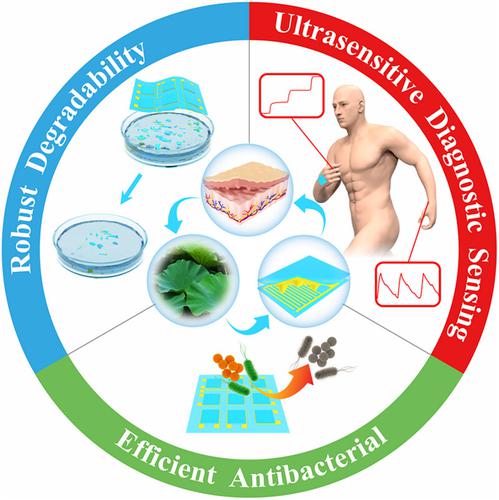
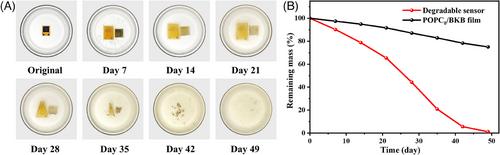
Flexible wearables have attracted extensive interests for personal human motion sensing, intelligent disease diagnosis, and multifunctional electronic skins. However, the reported flexible sensors, mostly exhibited narrow detection range, low sensitivity, limited degradability to aggravate environmental pollution from vast electronic wastes, and poor antibacterial performance to hardly improve skin discomfort and skin inflammation from bacterial growth under long-term wearing. Herein, bioinspired from human skin featuring highly sensitive tactile sensation with spinous microstructures for amplifying sensing sensitivity between epidermis and dermis, a wearable antibacterial degradable electronics is prepared from degradable elastomeric substrate with MXene-coated spinous microstructures templated from lotus leaf assembled with the interdigitated electrode. The degradable elastomer is facilely obtained with tunable modulus to match the modulus of human skin with improved hydrophilicity for rapid degradation. The as-obtained sensor displays ultra-low detection limit (0.2 Pa), higher sensitivity (up to 540.2 kPa−1), outstanding cycling stability (>23,000 cycles), a wide detection range, robust degradability, and excellent antibacterial capability. Facilitated by machine learning, the collected sensing signals from the integrated sensors on volunteer's fingers to the related American Sign Language are effectively recognized with an accuracy up to 99%, showing excellent potential in wireless human movement sensing and smart machine learning-enabled human–machine interaction.




 京公网安备 11010802042870号
京ICP备2023020795号-1
京公网安备 11010802042870号
京ICP备2023020795号-1

 分享
分享

 求助内容:
求助内容: 应助结果提醒方式:
 扫码关注我们
