{"title":"Non-degenerate dodecapole resonances in an asymmetric linear ion trap of round rod geometry","authors":"Pintu Mandal , Manas Mukherjee","doi":"10.1016/j.ijms.2024.117217","DOIUrl":null,"url":null,"abstract":"<div><p>Linear ion traps and quadrupole mass spectrometers play vital roles in quantum technologies and classical mass spectrometry respectively. Therefore, such systems with nearly same operational principles, are very well studied both theoretically and experimentally. Despite such vast knowledge base, linear ion traps continue to be an important research topic, particularly the effect of small perturbations from ideal conditions. Here, non-degenerate nonlinear resonances of the ion dynamics in a linear three-segmented round-rod radio-frequency ion trap have been studied. Purposefully designed perturbation from an ideal 4-rod symmetric structure results in additional instabilities in the dynamics of the trapped ions. The weightage of the dodecapole potential increases by an order of magnitude in such an asymmetric setup compared to that present in usual symmetric setup of nearly equivalent geometry. The experimental results are corroborated by ion dynamics simulations with commercial software SIMION. Increased dodecapole potential in the asymmetric structure leads to resolution of the frequency of ion oscillation in two mutually perpendicular directions in the radial plane which is otherwise unresolved in a symmetric structure in absence of dc potential. Such asymmetric linear trap, in principle, finds importance in the study of Coulomb crystal, mass spectrometry and relevant trapped ion dynamics. It also opens up the possibility to remove undesired ion species (often known as dark ion) within a chain of physical qubits.</p></div>","PeriodicalId":338,"journal":{"name":"International Journal of Mass Spectrometry","volume":"498 ","pages":"Article 117217"},"PeriodicalIF":1.7000,"publicationDate":"2024-04-01","publicationTypes":"Journal Article","fieldsOfStudy":null,"isOpenAccess":false,"openAccessPdf":"","citationCount":"0","resultStr":null,"platform":"Semanticscholar","paperid":null,"PeriodicalName":"International Journal of Mass Spectrometry","FirstCategoryId":"92","ListUrlMain":"https://www.sciencedirect.com/science/article/pii/S1387380624000289","RegionNum":3,"RegionCategory":"化学","ArticlePicture":[],"TitleCN":null,"AbstractTextCN":null,"PMCID":null,"EPubDate":"2024/2/15 0:00:00","PubModel":"Epub","JCR":"Q3","JCRName":"PHYSICS, ATOMIC, MOLECULAR & CHEMICAL","Score":null,"Total":0}
引用次数: 0
Abstract
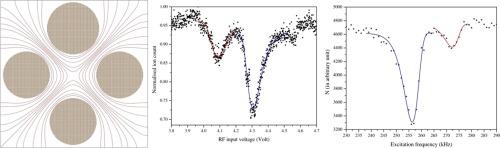
Linear ion traps and quadrupole mass spectrometers play vital roles in quantum technologies and classical mass spectrometry respectively. Therefore, such systems with nearly same operational principles, are very well studied both theoretically and experimentally. Despite such vast knowledge base, linear ion traps continue to be an important research topic, particularly the effect of small perturbations from ideal conditions. Here, non-degenerate nonlinear resonances of the ion dynamics in a linear three-segmented round-rod radio-frequency ion trap have been studied. Purposefully designed perturbation from an ideal 4-rod symmetric structure results in additional instabilities in the dynamics of the trapped ions. The weightage of the dodecapole potential increases by an order of magnitude in such an asymmetric setup compared to that present in usual symmetric setup of nearly equivalent geometry. The experimental results are corroborated by ion dynamics simulations with commercial software SIMION. Increased dodecapole potential in the asymmetric structure leads to resolution of the frequency of ion oscillation in two mutually perpendicular directions in the radial plane which is otherwise unresolved in a symmetric structure in absence of dc potential. Such asymmetric linear trap, in principle, finds importance in the study of Coulomb crystal, mass spectrometry and relevant trapped ion dynamics. It also opens up the possibility to remove undesired ion species (often known as dark ion) within a chain of physical qubits.
期刊介绍:
The journal invites papers that advance the field of mass spectrometry by exploring fundamental aspects of ion processes using both the experimental and theoretical approaches, developing new instrumentation and experimental strategies for chemical analysis using mass spectrometry, developing new computational strategies for data interpretation and integration, reporting new applications of mass spectrometry and hyphenated techniques in biology, chemistry, geology, and physics.
Papers, in which standard mass spectrometry techniques are used for analysis will not be considered.
IJMS publishes full-length articles, short communications, reviews, and feature articles including young scientist features.



 京公网安备 11010802042870号
京ICP备2023020795号-1
京公网安备 11010802042870号
京ICP备2023020795号-1

 分享
分享

 求助内容:
求助内容: 应助结果提醒方式:
 扫码关注我们
