{"title":"Residence time distribution experiments in a hybrid anaerobic blanket reactor treating real pharmaceutical wastewater","authors":"P. Mullai , S. Vishali , K. Dharmalingam","doi":"10.1016/j.jtice.2024.105381","DOIUrl":null,"url":null,"abstract":"<div><h3>Background</h3><div>The phenomena of mixing is considered important due to its involvement in modelling and design of reactors.</div></div><div><h3>Methods</h3><div>The residence time distribution (RTD) experiments to find out the mixing characteristics were conducted in hybrid anaerobic blanket reactor (HABR) with four different OLRs of pharmaceutical wastewater using lithium chloride as tracer by means of stimulus-response technique. The mean hydraulic retention time, dispersion and Peclet number for various OLRs in HABR were determined.</div></div><div><h3>Significant findings</h3><div>The experimental COD removal efficiencies in HABR and the theoretical performance were found out using the axial dispersion flow model (ADFM) and plug flow model (PFM). The estimated theoretical chemical oxygen demand (COD) removal efficiencies, using the ADFM were 92.4 %, 82.0 %, 63.0 % and 41.7 % and the values respectively for PFM were 97.27 %, 93.92 %, 83.47 % and 59.34 %. The error percentage detected was less than 7 % in ADFM which exhibited better flow representation in HABR. Furthermore, the value of correlation coefficient (R<sup>2</sup> = 0.9956) between the theoretical COD removal efficiencies and experimental values confirmed the suitability of the ADF model.</div></div>","PeriodicalId":381,"journal":{"name":"Journal of the Taiwan Institute of Chemical Engineers","volume":"166 ","pages":"Article 105381"},"PeriodicalIF":6.3000,"publicationDate":"2025-01-01","publicationTypes":"Journal Article","fieldsOfStudy":null,"isOpenAccess":false,"openAccessPdf":"","citationCount":"0","resultStr":null,"platform":"Semanticscholar","paperid":null,"PeriodicalName":"Journal of the Taiwan Institute of Chemical Engineers","FirstCategoryId":"5","ListUrlMain":"https://www.sciencedirect.com/science/article/pii/S1876107024000403","RegionNum":3,"RegionCategory":"工程技术","ArticlePicture":[],"TitleCN":null,"AbstractTextCN":null,"PMCID":null,"EPubDate":"2024/2/6 0:00:00","PubModel":"Epub","JCR":"Q1","JCRName":"ENGINEERING, CHEMICAL","Score":null,"Total":0}
引用次数: 0
Abstract
Background
The phenomena of mixing is considered important due to its involvement in modelling and design of reactors.
Methods
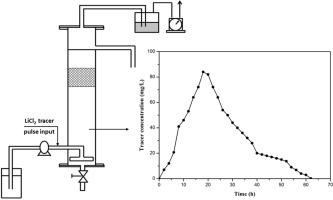
The residence time distribution (RTD) experiments to find out the mixing characteristics were conducted in hybrid anaerobic blanket reactor (HABR) with four different OLRs of pharmaceutical wastewater using lithium chloride as tracer by means of stimulus-response technique. The mean hydraulic retention time, dispersion and Peclet number for various OLRs in HABR were determined.
Significant findings
The experimental COD removal efficiencies in HABR and the theoretical performance were found out using the axial dispersion flow model (ADFM) and plug flow model (PFM). The estimated theoretical chemical oxygen demand (COD) removal efficiencies, using the ADFM were 92.4 %, 82.0 %, 63.0 % and 41.7 % and the values respectively for PFM were 97.27 %, 93.92 %, 83.47 % and 59.34 %. The error percentage detected was less than 7 % in ADFM which exhibited better flow representation in HABR. Furthermore, the value of correlation coefficient (R2 = 0.9956) between the theoretical COD removal efficiencies and experimental values confirmed the suitability of the ADF model.
期刊介绍:
Journal of the Taiwan Institute of Chemical Engineers (formerly known as Journal of the Chinese Institute of Chemical Engineers) publishes original works, from fundamental principles to practical applications, in the broad field of chemical engineering with special focus on three aspects: Chemical and Biomolecular Science and Technology, Energy and Environmental Science and Technology, and Materials Science and Technology. Authors should choose for their manuscript an appropriate aspect section and a few related classifications when submitting to the journal online.



 京公网安备 11010802042870号
京ICP备2023020795号-1
京公网安备 11010802042870号
京ICP备2023020795号-1

 分享
分享
 求助内容:
求助内容: 应助结果提醒方式:
 扫码关注我们
