Muhammad Shalahuddin, Wikan Danar Sunindyo, Mohammad Ridwan Effendi, Kridanto Surendro
{"title":"Fuzzy-set qualitative comparative analysis (fsQCA) for validating causal relationships in system dynamics models","authors":"Muhammad Shalahuddin, Wikan Danar Sunindyo, Mohammad Ridwan Effendi, Kridanto Surendro","doi":"10.1002/eng2.12855","DOIUrl":null,"url":null,"abstract":"<p>Modelers often create diverse system dynamics models for the same issue, depending on their viewpoints, which can decrease stakeholder assurance. Validating system dynamics may enhance stakeholder confidence. This study suggests using fuzzy-set qualitative comparative analysis (fsQCA) as a technique based on a set theory approach to validate the causal connections between entities in causal loop diagram (CLD) models. This case study analyzed the issue of Indonesian mobile network operators with limited sample data, utilizing the fsQCA method to test causal connections between entities in the CLD model that require validation. Following the creation of the CLD model through the system dynamics methodology, fsQCA was employed to enhance the previously formed model. The fsQCA method fuses qualitative comparative analysis (QCA) with fuzzy set theory, permitting partial membership, and can identify causal links among entities in the CLD model. It assists in testing causal relationships using limited sample data and boosts stakeholder confidence in the CLD model.</p>","PeriodicalId":72922,"journal":{"name":"Engineering reports : open access","volume":"6 10","pages":""},"PeriodicalIF":2.0000,"publicationDate":"2024-02-04","publicationTypes":"Journal Article","fieldsOfStudy":null,"isOpenAccess":false,"openAccessPdf":"https://onlinelibrary.wiley.com/doi/epdf/10.1002/eng2.12855","citationCount":"0","resultStr":null,"platform":"Semanticscholar","paperid":null,"PeriodicalName":"Engineering reports : open access","FirstCategoryId":"1085","ListUrlMain":"https://onlinelibrary.wiley.com/doi/10.1002/eng2.12855","RegionNum":0,"RegionCategory":null,"ArticlePicture":[],"TitleCN":null,"AbstractTextCN":null,"PMCID":null,"EPubDate":"","PubModel":"","JCR":"Q3","JCRName":"COMPUTER SCIENCE, INTERDISCIPLINARY APPLICATIONS","Score":null,"Total":0}
引用次数: 0
Abstract
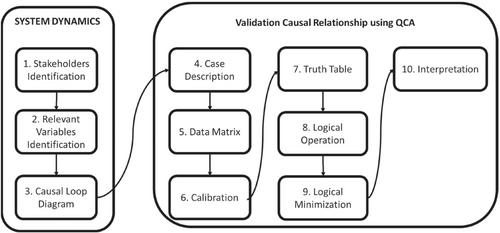
Modelers often create diverse system dynamics models for the same issue, depending on their viewpoints, which can decrease stakeholder assurance. Validating system dynamics may enhance stakeholder confidence. This study suggests using fuzzy-set qualitative comparative analysis (fsQCA) as a technique based on a set theory approach to validate the causal connections between entities in causal loop diagram (CLD) models. This case study analyzed the issue of Indonesian mobile network operators with limited sample data, utilizing the fsQCA method to test causal connections between entities in the CLD model that require validation. Following the creation of the CLD model through the system dynamics methodology, fsQCA was employed to enhance the previously formed model. The fsQCA method fuses qualitative comparative analysis (QCA) with fuzzy set theory, permitting partial membership, and can identify causal links among entities in the CLD model. It assists in testing causal relationships using limited sample data and boosts stakeholder confidence in the CLD model.



 京公网安备 11010802042870号
京ICP备2023020795号-1
京公网安备 11010802042870号
京ICP备2023020795号-1

 分享
分享

 求助内容:
求助内容: 应助结果提醒方式:
 扫码关注我们
