{"title":"Remediation of azodye contaminated soil by Electrokinetics","authors":"Selvakumar Santhosh , Subramani Abilaji , Mohamad S AlSalhi , Sandhanasamy Devanesan , Jayaraman Narenkumar , Rajaram Rajamohan , Aruliah Rajasekar","doi":"10.1016/j.jtice.2023.105262","DOIUrl":null,"url":null,"abstract":"<div><h3>Background</h3><div>An in situ electrokinetic remediation (EK) method was employed for the effective removal of the azo dye in the contaminated soil. Besides, the catalysts sodium chloride and potassium sulphate were evaluated for the total removal efficiency of pollutant in the soil</div></div><div><h3>Methods</h3><div>The direct current (10 V/cm<sup>−1</sup>) was selected for EK (56 h) and the ruthenium oxide (RuO<sub>2</sub>) and titanium oxide (TiO<sub>2</sub>) as anode and cathode materials respectively.The soil was spiked with 100 mg/kg of azo dyes namely congo red, methylene blue, methylene red and trypan blue.</div></div><div><h3>Significant findings</h3><div>The UV spectrum reveals that the higher concentration of pollutant in the cathode than anode insodium chloride (NaCl) catalyst. Chemical oxygen demand was achieved in the NaCl (82%) than potassium sulphate (62 %). The higher removal rate of the dye was observed in the NaCl, which was due to the active chlorine generation and breakdown the dye. FTIR confirms the breakdown of the azo dye during the EK. Plant growth (<em>vicia faba)</em>in the treated soil resulted in well germination when compared to untreated soil due to the lesser toxic pollutant present in the soil. Overall, this study concluded that EK techniques are promising method combined with sodium chloride for the effective removal of the azo dyes.</div></div>","PeriodicalId":381,"journal":{"name":"Journal of the Taiwan Institute of Chemical Engineers","volume":"166 ","pages":"Article 105262"},"PeriodicalIF":6.3000,"publicationDate":"2025-01-01","publicationTypes":"Journal Article","fieldsOfStudy":null,"isOpenAccess":false,"openAccessPdf":"","citationCount":"0","resultStr":null,"platform":"Semanticscholar","paperid":null,"PeriodicalName":"Journal of the Taiwan Institute of Chemical Engineers","FirstCategoryId":"5","ListUrlMain":"https://www.sciencedirect.com/science/article/pii/S1876107023005898","RegionNum":3,"RegionCategory":"工程技术","ArticlePicture":[],"TitleCN":null,"AbstractTextCN":null,"PMCID":null,"EPubDate":"","PubModel":"","JCR":"Q1","JCRName":"ENGINEERING, CHEMICAL","Score":null,"Total":0}
引用次数: 0
Abstract
Background
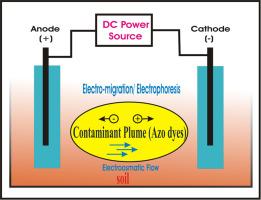
An in situ electrokinetic remediation (EK) method was employed for the effective removal of the azo dye in the contaminated soil. Besides, the catalysts sodium chloride and potassium sulphate were evaluated for the total removal efficiency of pollutant in the soil
Methods
The direct current (10 V/cm−1) was selected for EK (56 h) and the ruthenium oxide (RuO2) and titanium oxide (TiO2) as anode and cathode materials respectively.The soil was spiked with 100 mg/kg of azo dyes namely congo red, methylene blue, methylene red and trypan blue.
Significant findings
The UV spectrum reveals that the higher concentration of pollutant in the cathode than anode insodium chloride (NaCl) catalyst. Chemical oxygen demand was achieved in the NaCl (82%) than potassium sulphate (62 %). The higher removal rate of the dye was observed in the NaCl, which was due to the active chlorine generation and breakdown the dye. FTIR confirms the breakdown of the azo dye during the EK. Plant growth (vicia faba)in the treated soil resulted in well germination when compared to untreated soil due to the lesser toxic pollutant present in the soil. Overall, this study concluded that EK techniques are promising method combined with sodium chloride for the effective removal of the azo dyes.
期刊介绍:
Journal of the Taiwan Institute of Chemical Engineers (formerly known as Journal of the Chinese Institute of Chemical Engineers) publishes original works, from fundamental principles to practical applications, in the broad field of chemical engineering with special focus on three aspects: Chemical and Biomolecular Science and Technology, Energy and Environmental Science and Technology, and Materials Science and Technology. Authors should choose for their manuscript an appropriate aspect section and a few related classifications when submitting to the journal online.



 京公网安备 11010802042870号
京ICP备2023020795号-1
京公网安备 11010802042870号
京ICP备2023020795号-1

 分享
分享
 求助内容:
求助内容: 应助结果提醒方式:
 扫码关注我们
