Lachlan McIntosh, Price Jackson, Brittany Emmerson, James P Buteau, Ramin Alipour, Grace Kong, Michael S Hofman
{"title":"Quantitative calibration of Tb-161 SPECT/CT in view of personalised dosimetry assessment studies.","authors":"Lachlan McIntosh, Price Jackson, Brittany Emmerson, James P Buteau, Ramin Alipour, Grace Kong, Michael S Hofman","doi":"10.1186/s40658-024-00611-9","DOIUrl":null,"url":null,"abstract":"<p><strong>Background: </strong>Terbium-161 (<sup>161</sup>Tb)-based radionuclide therapy poses an alternative to current Lutetium-177 (<sup>177</sup>Lu) approaches with the additional benefit of secondary Auger and conversion electron emissions capable of delivering high doses of localised damage to micro-metastases including single cells. Quantitative single-photon emission computed tomography, paired with computed tomography (SPECT/CT), enables quantitative measurement from post-therapy imaging. In view of dosimetry extrapolations, a Tb-161 sensitivity SPECT/CT camera calibration was performed using a method previously validated for <sup>177</sup>Lu.</p><p><strong>Methods: </strong>Serial imaging of a NEMA/IEC body phantom with Tb-161 was performed on SPECT/CT with low-energy high-resolution collimators employing a photopeak of 75 keV with a 20% width. Quantitative stability and recovery coefficients were investigated over a sequence of 19 scans with buffered <sup>161</sup>Tb solution at total phantom activity ranging from 70 to 4990 MBq.</p><p><strong>Results: </strong>Sphere recovery coefficients were 0.60 ± 0.05, 0.52 ± 0.07, 0.45 ± 0.07, 0.39 ± 0.07, 0.28 ± 0.08, and 0.20 ± 0.08 for spheres 37, 28, 22, 17, 13, and 10mm, respectively, when considered across all activity and scan durations with dual-energy window scatter correction. Whole-field reconstructed sensitivity was calculated as 1.42E-5 counts per decay. Qualitatively, images exhibited no visual artefacts and were comparable to <sup>177</sup>Lu SPECT/CT.</p><p><strong>Conclusions: </strong>Quantitative SPECT/CT of <sup>161</sup>Tb is feasible over a range of activities enabling dosimetry analogous to <sup>177</sup>Lu whilst also producing suitable imaging for clinical review. This has been incorporated into a prospective trial of <sup>161</sup>Tb-PSMA for men with metastatic prostate cancer.</p>","PeriodicalId":11559,"journal":{"name":"EJNMMI Physics","volume":"11 1","pages":"18"},"PeriodicalIF":3.2000,"publicationDate":"2024-02-19","publicationTypes":"Journal Article","fieldsOfStudy":null,"isOpenAccess":false,"openAccessPdf":"https://www.ncbi.nlm.nih.gov/pmc/articles/PMC10876500/pdf/","citationCount":"0","resultStr":null,"platform":"Semanticscholar","paperid":null,"PeriodicalName":"EJNMMI Physics","FirstCategoryId":"3","ListUrlMain":"https://doi.org/10.1186/s40658-024-00611-9","RegionNum":2,"RegionCategory":"医学","ArticlePicture":[],"TitleCN":null,"AbstractTextCN":null,"PMCID":null,"EPubDate":"","PubModel":"","JCR":"Q2","JCRName":"RADIOLOGY, NUCLEAR MEDICINE & MEDICAL IMAGING","Score":null,"Total":0}
引用次数: 0
Abstract
Background: Terbium-161 (161Tb)-based radionuclide therapy poses an alternative to current Lutetium-177 (177Lu) approaches with the additional benefit of secondary Auger and conversion electron emissions capable of delivering high doses of localised damage to micro-metastases including single cells. Quantitative single-photon emission computed tomography, paired with computed tomography (SPECT/CT), enables quantitative measurement from post-therapy imaging. In view of dosimetry extrapolations, a Tb-161 sensitivity SPECT/CT camera calibration was performed using a method previously validated for 177Lu.
Methods: Serial imaging of a NEMA/IEC body phantom with Tb-161 was performed on SPECT/CT with low-energy high-resolution collimators employing a photopeak of 75 keV with a 20% width. Quantitative stability and recovery coefficients were investigated over a sequence of 19 scans with buffered 161Tb solution at total phantom activity ranging from 70 to 4990 MBq.
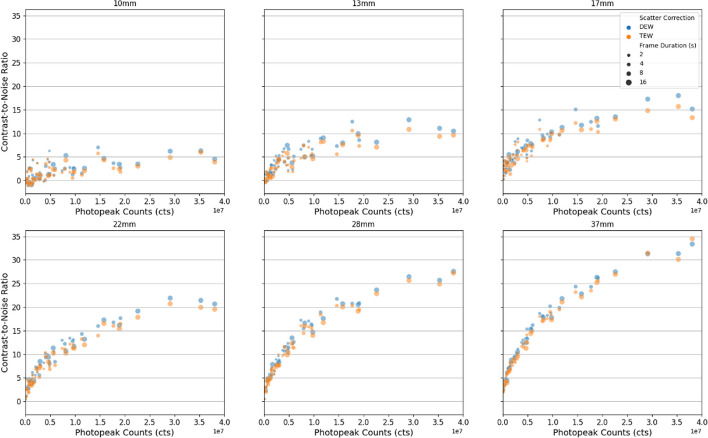
Results: Sphere recovery coefficients were 0.60 ± 0.05, 0.52 ± 0.07, 0.45 ± 0.07, 0.39 ± 0.07, 0.28 ± 0.08, and 0.20 ± 0.08 for spheres 37, 28, 22, 17, 13, and 10mm, respectively, when considered across all activity and scan durations with dual-energy window scatter correction. Whole-field reconstructed sensitivity was calculated as 1.42E-5 counts per decay. Qualitatively, images exhibited no visual artefacts and were comparable to 177Lu SPECT/CT.
Conclusions: Quantitative SPECT/CT of 161Tb is feasible over a range of activities enabling dosimetry analogous to 177Lu whilst also producing suitable imaging for clinical review. This has been incorporated into a prospective trial of 161Tb-PSMA for men with metastatic prostate cancer.
期刊介绍:
EJNMMI Physics is an international platform for scientists, users and adopters of nuclear medicine with a particular interest in physics matters. As a companion journal to the European Journal of Nuclear Medicine and Molecular Imaging, this journal has a multi-disciplinary approach and welcomes original materials and studies with a focus on applied physics and mathematics as well as imaging systems engineering and prototyping in nuclear medicine. This includes physics-driven approaches or algorithms supported by physics that foster early clinical adoption of nuclear medicine imaging and therapy.





 京公网安备 11010802042870号
京ICP备2023020795号-1
京公网安备 11010802042870号
京ICP备2023020795号-1

 分享
分享
 求助内容:
求助内容: 应助结果提醒方式:
 扫码关注我们
