{"title":"Unveiling the Radiative Electron-Hole Recombination of MoS<sub>2</sub> Nanostructures at Extreme pH Conditions.","authors":"Nayana K, Sunitha A P","doi":"10.1007/s10895-024-03616-w","DOIUrl":null,"url":null,"abstract":"<p><p>Nanostructures of MoS<sub>2</sub> are in wide research for optoelectronic, energy and biological applications. Opto-electronic and biological applications requires the tuning of photoluminescence properties of MoS<sub>2</sub> nanostructures. In this article, nanosized MoS<sub>2</sub> is hydrothermally synthesized, and photoluminescence at extreme pH conditions (pH 1 and 13) is examined. As the photoluminescence gives a key to probe the radiative electron-hole recombination, here, photoluminescence emissions are used as an indicator to suggest the pattern of electron-hole recombination in the material at extreme pH conditions. Raman spectroscopy, dynamic light scattering, Scanning electron microscopic image and energy dispersive x-ray analysis are done for material confirmation. At pH 1 and 13 as-synthesized nanostructured MoS<sub>2</sub> exhibited both upconversion and downconversion photoluminescence. The intensity of photoluminescence is varied with respect to pH. Excitation-dependent photoluminescence mechanisms and preliminary understanding on the ratio of quantum yields and life span of excited state of as-synthesized nanostructured MoS<sub>2</sub> are unveiled here.</p>","PeriodicalId":15800,"journal":{"name":"Journal of Fluorescence","volume":" ","pages":"1467-1474"},"PeriodicalIF":3.1000,"publicationDate":"2025-03-01","publicationTypes":"Journal Article","fieldsOfStudy":null,"isOpenAccess":false,"openAccessPdf":"","citationCount":"0","resultStr":null,"platform":"Semanticscholar","paperid":null,"PeriodicalName":"Journal of Fluorescence","FirstCategoryId":"92","ListUrlMain":"https://doi.org/10.1007/s10895-024-03616-w","RegionNum":4,"RegionCategory":"化学","ArticlePicture":[],"TitleCN":null,"AbstractTextCN":null,"PMCID":null,"EPubDate":"2024/2/21 0:00:00","PubModel":"Epub","JCR":"Q2","JCRName":"BIOCHEMICAL RESEARCH METHODS","Score":null,"Total":0}
引用次数: 0
Abstract
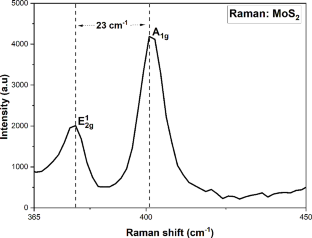
Nanostructures of MoS2 are in wide research for optoelectronic, energy and biological applications. Opto-electronic and biological applications requires the tuning of photoluminescence properties of MoS2 nanostructures. In this article, nanosized MoS2 is hydrothermally synthesized, and photoluminescence at extreme pH conditions (pH 1 and 13) is examined. As the photoluminescence gives a key to probe the radiative electron-hole recombination, here, photoluminescence emissions are used as an indicator to suggest the pattern of electron-hole recombination in the material at extreme pH conditions. Raman spectroscopy, dynamic light scattering, Scanning electron microscopic image and energy dispersive x-ray analysis are done for material confirmation. At pH 1 and 13 as-synthesized nanostructured MoS2 exhibited both upconversion and downconversion photoluminescence. The intensity of photoluminescence is varied with respect to pH. Excitation-dependent photoluminescence mechanisms and preliminary understanding on the ratio of quantum yields and life span of excited state of as-synthesized nanostructured MoS2 are unveiled here.
期刊介绍:
Journal of Fluorescence is an international forum for the publication of peer-reviewed original articles that advance the practice of this established spectroscopic technique. Topics covered include advances in theory/and or data analysis, studies of the photophysics of aromatic molecules, solvent, and environmental effects, development of stationary or time-resolved measurements, advances in fluorescence microscopy, imaging, photobleaching/recovery measurements, and/or phosphorescence for studies of cell biology, chemical biology and the advanced uses of fluorescence in flow cytometry/analysis, immunology, high throughput screening/drug discovery, DNA sequencing/arrays, genomics and proteomics. Typical applications might include studies of macromolecular dynamics and conformation, intracellular chemistry, and gene expression. The journal also publishes papers that describe the synthesis and characterization of new fluorophores, particularly those displaying unique sensitivities and/or optical properties. In addition to original articles, the Journal also publishes reviews, rapid communications, short communications, letters to the editor, topical news articles, and technical and design notes.



 京公网安备 11010802042870号
京ICP备2023020795号-1
京公网安备 11010802042870号
京ICP备2023020795号-1

 分享
分享
 求助内容:
求助内容: 应助结果提醒方式:
 扫码关注我们
