Yifei Xiao , Lele Zhang , Tao Liu , Qisong Sun , Xiaolong Song , Yikun Fang , Anhua Li , Minggang Zhu , Wei Li
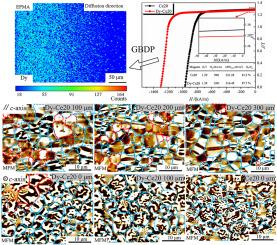
{"title":"Microstructure, microchemistry, and micro-magnetism of dysprosium grain boundary diffused (Nd, Ce)–Fe–B magnets","authors":"Yifei Xiao , Lele Zhang , Tao Liu , Qisong Sun , Xiaolong Song , Yikun Fang , Anhua Li , Minggang Zhu , Wei Li","doi":"10.1016/j.jre.2024.01.015","DOIUrl":null,"url":null,"abstract":"<div><div>The microstructure of (Nd, Ce)–Fe–B sintered magnets with different diffusion depths was characterized by a magnetic force microscope, and the relationship between the magnetic properties and the local structure of grain boundary diffused magnets is discussed. The domains perpendicular to the <em>c</em>-axis (easy magnetization direction) show a typical maze-like pattern, while those parallel to the <em>c</em>-axis show the characteristics of plate domains. The significant gradient change is shown in the concentration of Dy with the direction of diffusion from the surface to the interior. Dy diffuses along grain boundaries and (Dy, Nd)<sub>2</sub>Fe<sub>14</sub>B layer with a high anisotropy field formed around the grains. Through <em>in-situ</em> electron probe micro-analysis/magnetic force microscopy (EPMA/MFM), it is found that the average domain width decreases, and the proportion of single domain grains increases as diffusion depth increases. This is caused by both the change of concentration and distribution of Dy. The grain boundary diffusion process changes the microstructure and microchemistry inside the magnet, and these local magnetism differences can be reflected by the configuration of the magnetic domain structure.</div></div>","PeriodicalId":16940,"journal":{"name":"Journal of Rare Earths","volume":"43 3","pages":"Pages 556-568"},"PeriodicalIF":7.2000,"publicationDate":"2024-02-07","publicationTypes":"Journal Article","fieldsOfStudy":null,"isOpenAccess":false,"openAccessPdf":"","citationCount":"0","resultStr":null,"platform":"Semanticscholar","paperid":null,"PeriodicalName":"Journal of Rare Earths","FirstCategoryId":"92","ListUrlMain":"https://www.sciencedirect.com/science/article/pii/S1002072124000292","RegionNum":1,"RegionCategory":"化学","ArticlePicture":[],"TitleCN":null,"AbstractTextCN":null,"PMCID":null,"EPubDate":"","PubModel":"","JCR":"Q1","JCRName":"CHEMISTRY, APPLIED","Score":null,"Total":0}
引用次数: 0
Abstract
The microstructure of (Nd, Ce)–Fe–B sintered magnets with different diffusion depths was characterized by a magnetic force microscope, and the relationship between the magnetic properties and the local structure of grain boundary diffused magnets is discussed. The domains perpendicular to the c-axis (easy magnetization direction) show a typical maze-like pattern, while those parallel to the c-axis show the characteristics of plate domains. The significant gradient change is shown in the concentration of Dy with the direction of diffusion from the surface to the interior. Dy diffuses along grain boundaries and (Dy, Nd)2Fe14B layer with a high anisotropy field formed around the grains. Through in-situ electron probe micro-analysis/magnetic force microscopy (EPMA/MFM), it is found that the average domain width decreases, and the proportion of single domain grains increases as diffusion depth increases. This is caused by both the change of concentration and distribution of Dy. The grain boundary diffusion process changes the microstructure and microchemistry inside the magnet, and these local magnetism differences can be reflected by the configuration of the magnetic domain structure.
期刊介绍:
The Journal of Rare Earths reports studies on the 17 rare earth elements. It is a unique English-language learned journal that publishes works on various aspects of basic theory and applied science in the field of rare earths (RE). The journal accepts original high-quality original research papers and review articles with inventive content, and complete experimental data. It represents high academic standards and new progress in the RE field. Due to the advantage of abundant RE resources of China, the research on RE develops very actively, and papers on the latest progress in this field emerge every year. It is not only an important resource in which technicians publish and obtain their latest research results on RE, but also an important way of reflecting the updated progress in RE research field.
The Journal of Rare Earths covers all research and application of RE rare earths including spectroscopy, luminescence and phosphors, rare earth catalysis, magnetism and magnetic materials, advanced rare earth materials, RE chemistry & hydrometallurgy, RE metallography & pyrometallurgy, RE new materials, RE solid state physics & solid state chemistry, rare earth applications, RE analysis & test, RE geology & ore dressing, etc.



 京公网安备 11010802042870号
京ICP备2023020795号-1
京公网安备 11010802042870号
京ICP备2023020795号-1

 分享
分享
 求助内容:
求助内容: 应助结果提醒方式:
 扫码关注我们
